







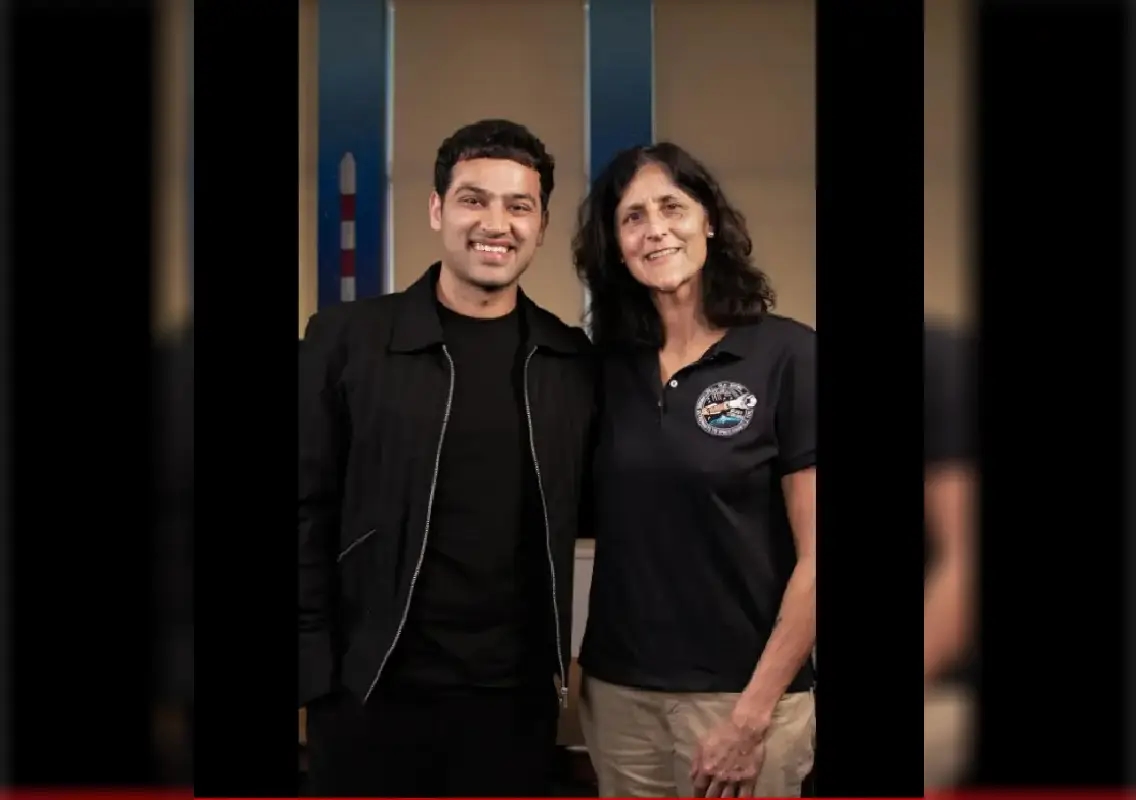


New Delhi: NASA astronaut Sunita Williams, who recently retired after an illustrious 27-year career in human spaceflight, is currently in India and has reflected on her childhood experiences that, she says, shaped her into the person and professional she became. Williams shared these insights during an unreleased podcast interaction with entrepreneur and podcaster Raj Shamani, offering a rare personal perspective on the foundations of her resilience and success.
At 60, Williams is among the most accomplished astronauts in NASA’s history. Over the course of multiple missions, she spent a record 608 days in space, served as commander of the International Space Station (ISS), and became widely known for her calm leadership in extreme and uncertain conditions. In her conversation with Raj Shamani, she traced many of these qualities back to her upbringing.
Growing up in a multicultural family
During the interaction, Williams spoke at length about her family background, describing it as deeply multicultural and formative. Her father, Deepak Pandya, is from Gujarat in western India, while her mother, Ursuline Bonnie Pandya, is a Slovenian-American. As a result, she grew up in a household that followed different traditions, religions and food cultures.
“It’s a big benefit. You don’t realise it when you’re a kid. It’s life, that’s how it is,” Williams said. She explained that this exposure to diversity was natural to her as a child but later proved to be a major advantage in life.
According to Williams, learning to appreciate different cultures at a young age helped her develop empathy, adaptability and an open mind. “I think just [the] appreciation for different cultures at a young age was really beneficial and set me up for success,” she added.
Lessons that translated to space
Williams told Raj Shamani that her multicultural upbringing taught her to relate to different kinds of people and, importantly, to listen patiently. These skills became critical during her years as an astronaut, where teamwork and mutual trust are essential for survival and mission success.
Life aboard the ISS involves living in close quarters with astronauts from multiple countries for months at a time. Williams noted that understanding cultural differences and respecting varied viewpoints helped her navigate interpersonal dynamics in space, especially during stressful situations.
She said the ability to remain calm, listen carefully and respond thoughtfully was something she carried from her childhood into her professional life, both as an astronaut and as a leader.
Tested during extended space missions
The mental and emotional strength Williams developed early in life was tested during her final space mission. What was originally planned as a short mission lasting just over a week unexpectedly extended to more than 90 days due to unforeseen circumstances. Williams remained aboard the ISS for months longer than anticipated before safely returning to Earth.
Despite the uncertainty and prolonged isolation, she maintained composure and professionalism, earning praise from colleagues and space agencies worldwide. Observers have often cited her resilience during this period as a hallmark of her career.
A career marked by records and leadership
Sunita Williams’ retirement marks the end of a remarkable chapter in human space exploration. Over 27 years, she accumulated 608 days in space, one of the highest totals for any astronaut. She carried out multiple spacewalks, contributed to key scientific experiments, and played a crucial role in maintaining and operating the ISS.
As commander of the ISS, Williams led international crews and managed complex missions, reinforcing her reputation as a dependable and inspiring leader. Her achievements have made her a role model, particularly for young people and women aspiring to careers in science and space exploration.
Strong ties to India
During her visit to India, Williams has once again acknowledged her connection to her father’s homeland. She has visited Gujarat several times in the past and has often spoken about her admiration for India’s growing space programme and scientific talent.
Her reflections shared with Raj Shamani have resonated widely, especially among Indian audiences, who see her as a symbol of the global Indian diaspora’s contribution to science and technology.
Conclusion
By sharing her personal journey with Raj Shamani, Sunita Williams offered insight into the human experiences behind a legendary space career. Her story underscores how values learned during childhood—openness, patience and respect for diversity—can shape extraordinary achievements. As she steps into retirement, Williams continues to inspire, reminding the world that even the most advanced journeys into space are grounded in lessons learned early in life.