







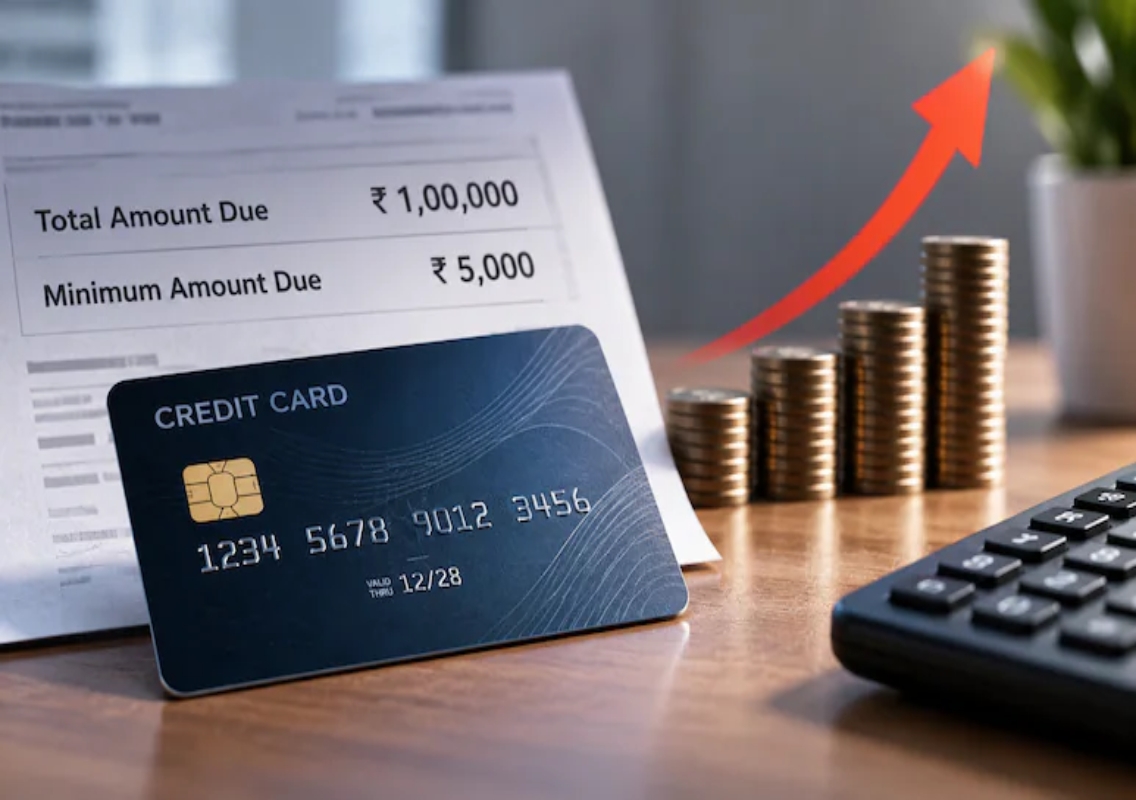


New Delhi: A ₹1 lakh credit card bill can quickly become an expensive debt if you pay only the minimum amount due every month. While making the minimum payment by the due date can help avoid immediate late-payment consequences, it does not clear the outstanding balance.
The unpaid amount can continue to attract finance charges, while the interest-free period on new transactions may also be affected. This can make a seemingly manageable credit card balance increasingly difficult to repay.
For cardholders facing a large monthly bill, understanding the difference between the total amount due and the minimum amount due is therefore crucial.
What happens when you pay only the minimum?
The minimum amount due is the smallest payment a cardholder is required to make by the due date under the card’s terms.
For illustration, if the total outstanding on a credit card is ₹1 lakh and the minimum due is 5%, the cardholder may have to pay around ₹5,000.
Making that ₹5,000 payment does not mean the ₹1 lakh bill has been settled. Around ₹95,000 remains outstanding and can attract finance charges. The exact minimum-payment calculation varies between card issuers and individual card statements.
Paying the minimum on time can help prevent the account from immediately being treated as overdue, but it should not be mistaken for an interest-free repayment option.
The interest-free period can disappear
One of the biggest disadvantages of carrying a credit card balance is the potential loss of the interest-free credit period.
When the full amount due is not paid by the due date, finance charges can apply to the outstanding balance according to the card issuer’s terms. Interest may also affect subsequent transactions, depending on the card’s rules.
This is why credit cards can become considerably more expensive than many other forms of borrowing when a balance is carried forward.
A cardholder who normally pays the full statement amount and enjoys an interest-free period can therefore face a very different cost structure after beginning to revolve a balance.
How expensive can a ₹1 lakh balance become?
Credit card finance charges can be high.
For example, SBI Card lists finance charges of up to 3.75% per month, or 45% per annum, on several unsecured credit cards. The actual rate depends on the particular card and its terms.
Consider a simplified illustration in which the entire ₹1 lakh outstanding attracts a finance charge of 3.75% for one month and there are no new purchases.
The calculation would be:
- Outstanding balance: ₹1,00,000
- Monthly finance charge at 3.75%: ₹3,750
- GST at 18% on the finance charge: ₹675
- Finance charge plus GST: ₹4,425
If the cardholder pays only ₹5,000 that month, approximately ₹575 would effectively reduce the principal in this simplified example.
The actual calculation on a credit card can be more complicated because issuers apply their specific terms, billing cycles, transaction dates, payments, refunds and other adjustments.
New spending can make the debt worse
The problem becomes more serious if the card continues to be used while an old balance remains unpaid.
Suppose ₹95,000 remains after a payment and the cardholder then makes another ₹20,000 of purchases. The overall outstanding could rise again rather than fall.
New transactions can also be affected by the loss of the interest-free period, depending on the issuer’s terms.
This creates a cycle in which the cardholder makes payments every month but sees the debt reduce only slowly.
Why paying only the minimum can be misleading
The minimum due can create the impression that a large credit card bill is affordable because the immediate payment requirement is much smaller than the total outstanding.
However, the minimum payment is primarily designed to keep the account from becoming immediately overdue; it is not an efficient long-term debt repayment strategy.
For a ₹1 lakh balance, paying ₹5,000 once does not solve the underlying problem if substantial finance charges continue to accumulate.
The longer the balance remains outstanding, the more expensive the borrowing can become.
What should you do if you cannot pay ₹1 lakh?
If paying the entire bill is not possible, the first priority should be to stop adding unnecessary new spending to the card.
The next step should be to pay as much above the minimum due as your finances reasonably allow. A larger payment reduces the outstanding balance faster and therefore reduces the amount on which future finance charges can accumulate.
Cardholders should also examine alternatives available from their issuer, such as an eligible EMI conversion or another lower-cost repayment option, after comparing the total cost and terms.
The important point is not to allow a large credit card balance to become a permanent revolving debt.
Full payment is generally the cheapest option
If you have sufficient funds and can pay the entire statement amount without compromising essential expenses or your emergency savings, paying the full bill by the due date is generally the most cost-effective approach.
It can help preserve the interest-free benefit offered by the card, subject to the issuer’s terms.
However, paying the full bill should not mean draining an emergency fund or taking on another expensive form of debt simply to clear the card.
The right approach depends on the individual’s overall financial position.
Minimum due should be a short-term safety net
The minimum payment can be useful when a temporary cash-flow problem prevents a cardholder from clearing the entire bill. But relying on it month after month can turn a manageable expense into costly long-term debt.
For someone with a ₹1 lakh outstanding balance, the objective should therefore be to reduce the principal as quickly as reasonably possible while avoiding fresh discretionary spending on the card.
Credit cards work best when the monthly spending can be fully repaid. Once a balance starts revolving, the cost of borrowing can rise sharply.