







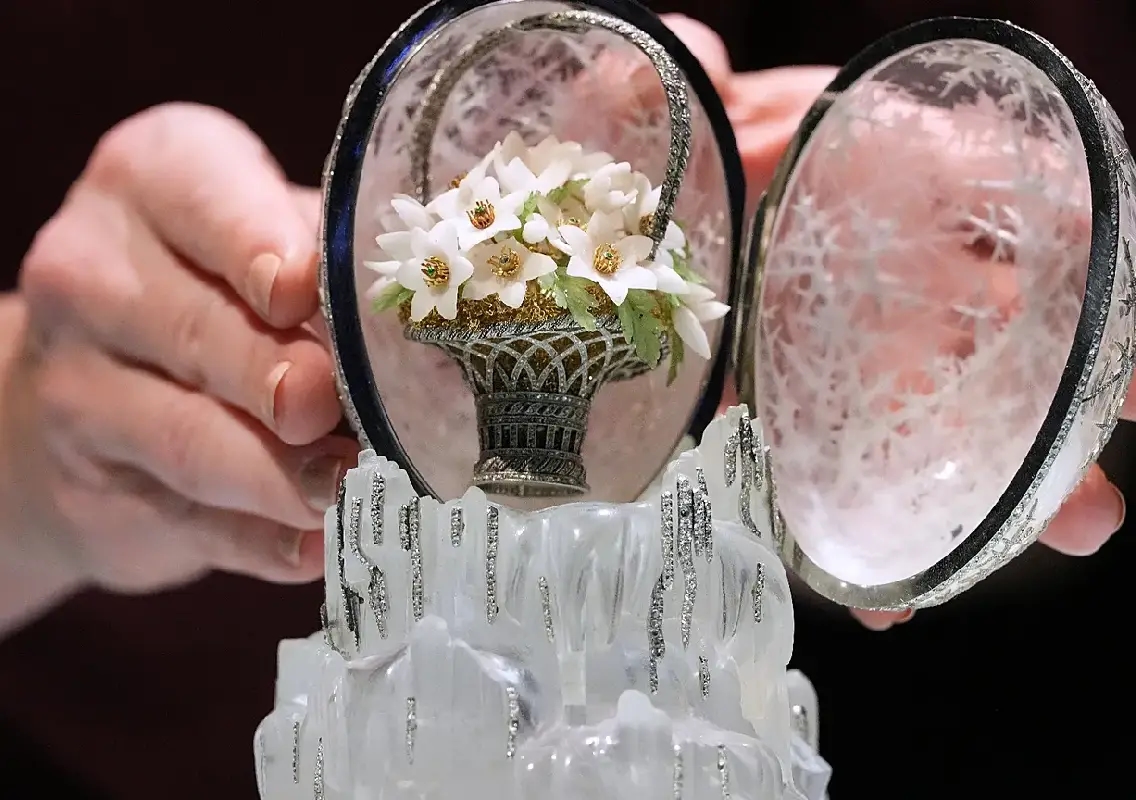


In a landmark moment for the art and collectibles world, one of the last surviving Imperial Fabergé eggs still in private ownership has sold for an extraordinary £22.9 million ($30.2 million) at Christie’s in London. Known as the Winter Egg, the masterpiece was commissioned by Tsar Nicholas II in 1913 as a gift for his mother and is widely regarded as one of the most technically brilliant works created by the House of Fabergé.
The three-minute bidding contest surpassed Christie’s pre-sale estimate of £20 million, setting a new record for the Russian jeweller and reaffirming the Winter Egg’s place among the most coveted objets d’art ever produced.
A rare Imperial treasure
The sale underscored the extraordinary rarity of Fabergé’s Imperial Eggs. Of the fifty created between 1885 and 1916, only a handful remain in private hands — just seven, according to Christie’s. Most are housed in museums or remain missing after the turmoil of the early 20th century.
Margo Oganesian, head of Fabergé and Russian artworks at Christie’s, said the auction reaffirmed the Winter Egg’s unmatched artistic and historic value.
“This new record reaffirmed the enduring significance, rarity and brilliance of what is widely regarded as one of Fabergé’s finest creations,” she said. “This was an exceptional and historic opportunity for collectors to acquire a work of unparalleled importance.”
Design inspired by frost
The Winter Egg is celebrated for its innovation, craftsmanship, and departure from traditional historic styles. Made from rock crystal (clear quartz), it was meticulously crafted to resemble a frosted block of ice. Its platinum exterior features a delicate snowflake motif set with 4,500 rose-cut diamonds.
Inside is Fabergé’s signature “surprise”: a miniature suspended basket of wood anemones carved from white quartz, nephrite, and garnets.
Uniquely, the piece was designed by Alma Pihl, one of Fabergé’s rare female designers, who is said to have drawn inspiration from ice crystals on a workshop windowpane. Her distinct artistic vision contributed to the egg’s reputation as Fabergé’s most “modern” creation, despite being crafted over a century ago.
From imperial gift to global treasure
Nicholas II originally purchased the egg for 24,600 rubles, the third-highest price the House of Fabergé ever charged. After the Russian Revolution, it was seized and sold by the Bolsheviks, eventually making its way into private British collections.
The egg disappeared from public record in 1975 but resurfaced in 1994, when it sold at Christie’s Geneva for over 7.2 million Swiss francs (around $5.6 million). It broke its own record again in 2002, selling for $9.6 million in New York. No Imperial Egg has appeared at auction since then, making Tuesday’s sale the first in 23 years.
Antiques specialist Kieran McCarthy of Wartski described the Winter Egg as an unparalleled example of artistic transformation.
“The thousands of diamonds have no intrinsic value; the value comes purely in the artistic expression and the creation of this scintillating idea of frost,” he said. “It’s like holding a lump of ice in your hand.”
Part of a princely collection
The Winter Egg was the highlight of a wider sale featuring nearly 50 Fabergé objects, including pendants, decorative boxes, and figurines. The auctioned items came from what Christie’s described only as a “princely collection,” keeping the seller’s identity confidential.
Among other notable lots:
- A hardstone figurine of a street painter sold for £1.5 million ($2 million).
- A rare illustrated reference book documenting over 1,000 Fabergé works fetched £508,000 ($670,865).
The enduring legacy of Fabergé
Fabergé’s Imperial Eggs were produced as Easter gifts for the Romanov family between 1885 and 1916, under Tsars Alexander III and Nicholas II. Their intricate workmanship, innovative design, and historical significance have made them legendary in the world of decorative arts.
For readers interested in the wider history of Fabergé, more information can be found on the Fabergé egg – Wikipedia.
Related News Karnataka reports include:
- Exquisite artefacts draw global collectors to European auctions (newskarnataka.com link)
- Historic artworks fetch record prices amid rising demand for heritage collectibles (newskarnataka.com link)
A masterpiece preserved
With its record-breaking sale, the Winter Egg continues its remarkable journey—from imperial Russia, through revolution and rediscovery, to global admiration in modern auction houses. Its longevity and artistic brilliance ensure its position as one of the rarest and most captivating works of decorative art in existence.