







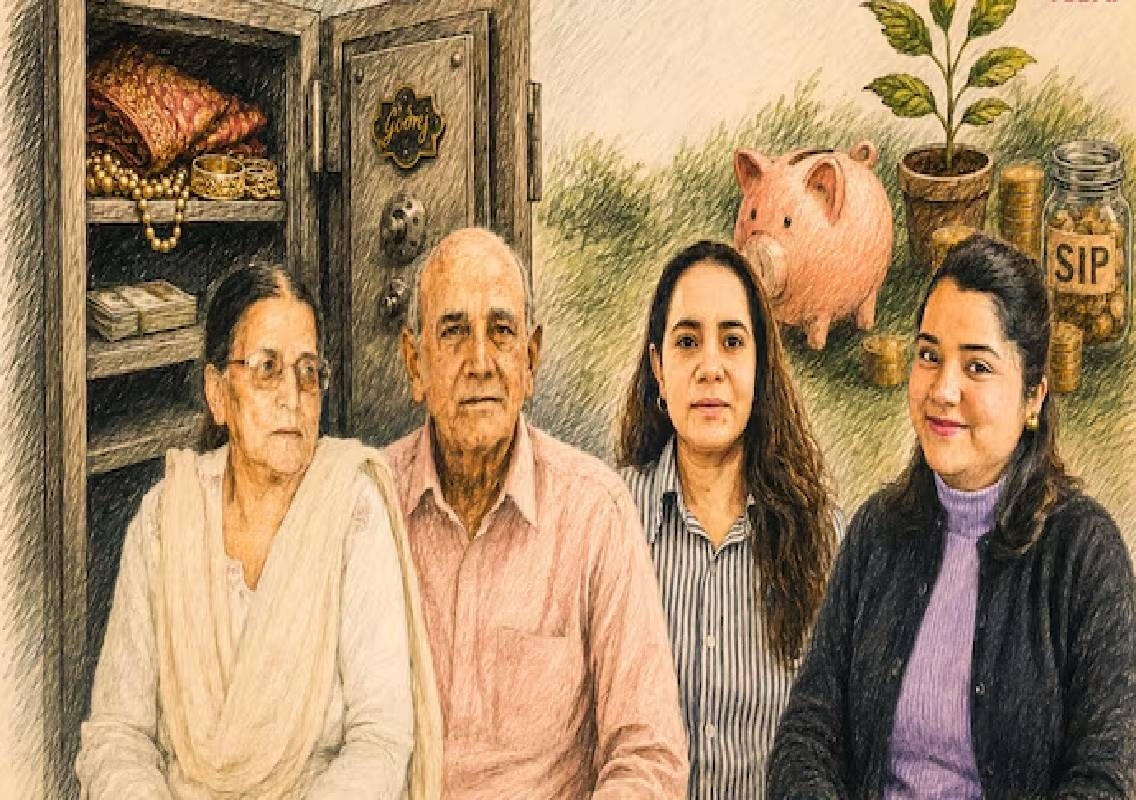


New Delhi: The excitement of receiving a first salary has remained unchanged across generations, but what Indians choose to do with that money has evolved dramatically. From storing cash and gold inside Godrej steel lockers to investing in Systematic Investment Plans (SIPs) and equities, India’s relationship with money reflects the country’s changing economic landscape, according to a feature published by India Today.
The story traces financial habits across nearly a century, revealing how each generation’s priorities were shaped by the opportunities, responsibilities and investment options available during their time.
When wealth lived inside a Godrej almirah
For older generations, financial security was centred on protecting wealth rather than growing it.
The feature recounts the memories of a 95-year-old woman who recalled that family savings were kept inside the locker of a Godrej steel almirah, alongside gold jewellery wrapped in cloth. At the time, mutual funds, demat accounts or SIPs did not exist, and cash, gold and later fixed deposits were considered the safest way to preserve wealth.
First salary meant supporting the family
For many Indians who began working in the decades after Independence, receiving a first salary was viewed as a family milestone rather than an individual achievement.
A retired Indian Railways employee recalled handing over his entire first salary to his parents, saying it felt natural because they had sacrificed to educate him. Savings typically went into fixed deposits, post office schemes and LIC policies, reflecting a generation that prioritised financial discipline and long-term security.
Millennials balanced dreams and responsibility
As India’s financial ecosystem expanded, younger professionals gained access to a wider range of investment products.
Many millennials still contributed to household expenses with their first salary but also began saving for personal aspirations. While some initially preferred traditional bank savings, they gradually explored mutual funds, equities and other investment avenues as financial awareness improved.
Gen Z embraces investing early
Today’s young earners are entering the workforce with greater financial literacy than previous generations.
The feature notes that many members of Generation Z now begin SIPs, build emergency funds and invest in equities soon after receiving their first salary. Rather than waiting until later in life, young professionals increasingly see investing as an essential part of financial planning from the beginning of their careers.
Financial tools have changed, values remain
Although investment products have transformed over the decades, one theme remains consistent across generations: using the first salary to build a more secure future.
Earlier generations focused on preserving wealth through cash, gold and fixed deposits, while younger Indians are using digital investment platforms, mutual funds and market-linked products to create long-term wealth. Despite these differences, supporting family and achieving financial stability continue to remain common goals.
India’s financial journey mirrors economic progress
The evolution from Godrej lockers to SIPs reflects broader changes in India’s economy.
Greater financial inclusion, digital banking, online investment platforms and increased awareness have fundamentally changed how Indians save and invest. Experts believe younger generations now have more opportunities than ever to create wealth through disciplined investing while continuing the tradition of financial responsibility.
Conclusion
India’s first salary story is no longer just about receiving a payslip—it is a reflection of how the country’s financial habits have evolved. While earlier generations trusted steel lockers, gold and fixed deposits, today’s young professionals are turning towards SIPs, equities and digital investments. Yet across every generation, the first salary continues to symbolise responsibility, pride and the hope of building a better future.