







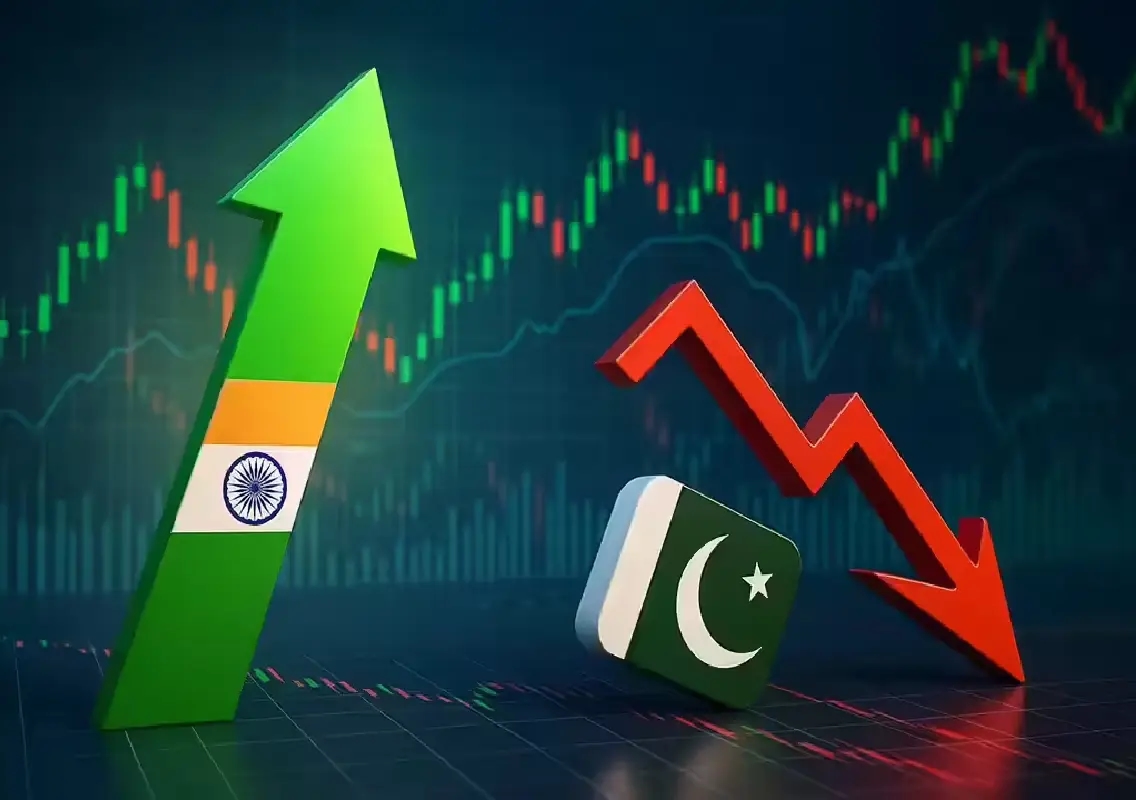


A single line from economist Noah Smith set off a wave of debate across Indian and Pakistani timelines:
“In another decade, we’re going to have another ‘North and South Korea at night’ photo.”
The reference is famous — a satellite image showing South Korea brightly lit and North Korea in relative darkness. Smith’s point was not literal dramatics but the power of compounding GDP growth, and how it could redraw the economic map of South Asia by the mid-2030s.
India vs Pakistan: A widening economic gulf
In 2024, India and Pakistan still shared geography, history and culture — but not economic trajectory.
Nominal GDP (2024):
- India: ~$3.9 trillion
- Pakistan: ~$370–410 billion
(A gap of roughly 10:1)
GDP per capita:
- India: ~$2,700
- Pakistan: ~$1,500–1,700
Growth paths moving in opposite directions
India grew 8.2% in the July–September 2024 quarter, its fastest in six quarters, beating forecasts even after new US tariffs. India remains on track for ~7% annual growth — the fastest among major economies.
Pakistan, meanwhile, grew ~2.38% in 2024 after contracting the previous year. One-year differences may seem small, but over a decade they compound sharply.
If India holds 6–7% and Pakistan stays near 2–3%, India’s economy will continue pulling away at speed — a trend already visible. Several Indian states now generate economic output comparable to all of Pakistan.
Why the divergence matters
India’s growth is broad-based:
- IT and digital services
- Financial and telecom sectors
- Manufacturing push
- A huge domestic market
- Major infrastructure corridors lighting up the map
Pakistan’s story is stop-start, shaped by:
- Repeated IMF bailouts
- Currency crises
- Structural issues like elite capture and corruption
- Low investment and unstable policy cycles
An IMF-linked analysis recently described these structural issues as a “tax on growth.”
The 2035 satellite image idea
If trends continue, the subcontinent of 2035 could show:
- A brighter India — expressways, industrial belts, and dense urbanisation
- A Pakistan that has grown, but not at the speed needed to close the gap
Not a Korea-style gulf — but a visible divergence nonetheless, powered by compounding growth.