







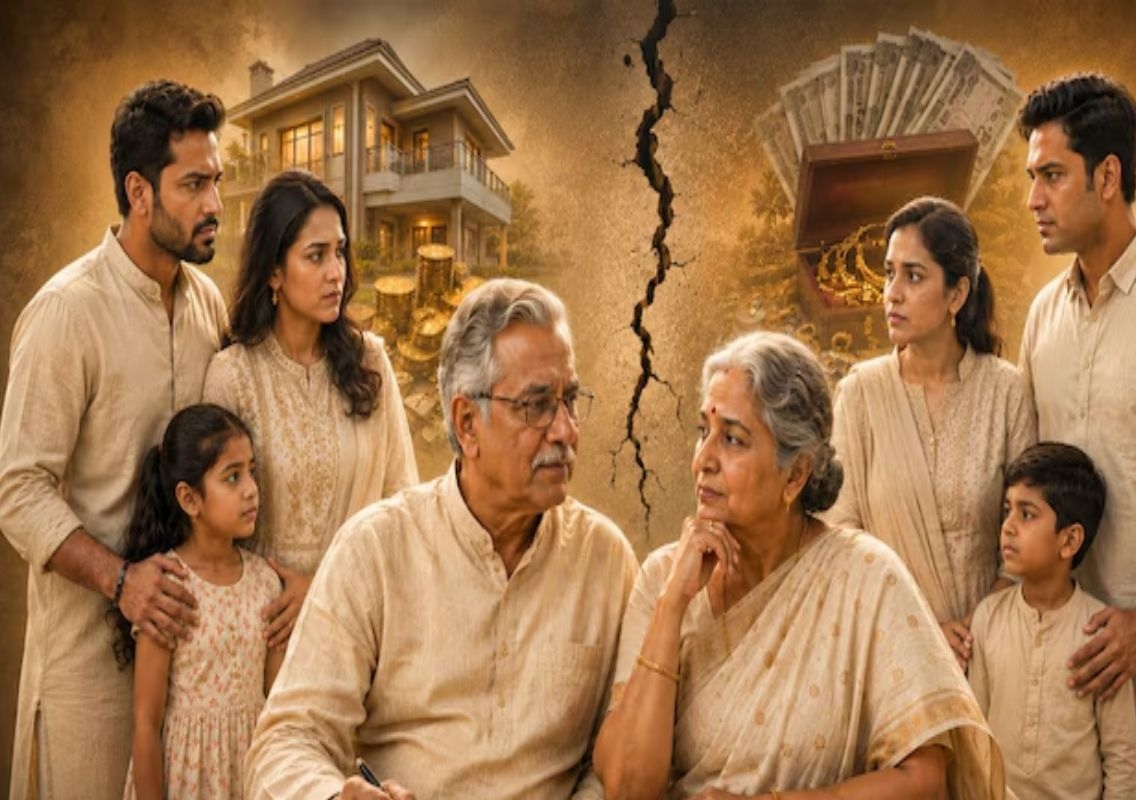


New Delhi: A house built over decades. Bank accounts carefully maintained. Investments accumulated with discipline. For many Indian families, these assets represent a lifetime of effort and sacrifice. Yet, despite this, a large number of Indians leave behind no clear instructions on how their wealth should be distributed, often setting the stage for confusion, disputes and fractured relationships.
The consequences of not writing a Will are rarely immediate, but when they surface, they can be deeply damaging.
When inheritance becomes conflict
Stories of families torn apart over property disputes are far from uncommon in India. In many cases, disagreements are not rooted in long-standing rivalries but arise suddenly after the death of a parent who left no Will.
Siblings who once shared strong bonds can find themselves in legal battles over homes, land, jewellery or financial assets. Lawyers step in, court cases drag on for years, and properties often remain unused or locked while disputes continue.
Such outcomes defeat the very purpose of wealth creation, which is to provide security and stability for the next generation.
A growing economy, but weak succession planning
India’s economic growth has enabled millions to accumulate wealth at an unprecedented scale. From real estate and mutual funds to stocks, gold and family businesses, asset ownership is becoming increasingly common.
However, while financial awareness around investing has improved, succession planning continues to lag behind.
Recent survey data highlights the scale of the issue:
- Nearly 84.8% of Indians do not have a Will
- Around 62.5% have no plans to create one
- Only 15.2% currently have a Will in place
Equally concerning is the lack of communication. Nearly half of respondents have never discussed inheritance or succession planning with their families, indicating that the issue is often avoided altogether.
The taboo around discussing death
One of the biggest reasons for this gap is cultural.
In many Indian households, conversations around death are considered uncomfortable or even inauspicious. Writing a Will is often seen as something to be done “later” or only in old age.
There is also a widespread belief that families will “figure things out” when the time comes.
In reality, the absence of clarity can lead to prolonged disputes, emotional stress and financial complications.
Legal framework and reality
In the absence of a Will, asset distribution is governed by succession laws such as the Hindu Succession Act, 1956 or other personal laws depending on religion.
While these laws provide a framework, they do not always reflect the specific wishes of the deceased. They also do not eliminate the possibility of disputes, especially when multiple heirs are involved or when assets are complex.
Additionally, transferring ownership without a Will can involve lengthy legal processes, documentation and, in some cases, court intervention.
Common misconceptions about Wills
Several myths continue to prevent Indians from writing Wills:
“Wills are only for the wealthy”
This is perhaps the most common misconception. In reality, anyone with assets—no matter how modest—and dependants should consider writing a Will.
“Nominees are the final owners”
Many believe that naming a nominee in a bank account or insurance policy determines ownership. However, a nominee is typically only a trustee, not the legal heir.
“There is always time”
Life is unpredictable. Delaying estate planning can leave families unprepared in the event of an unexpected loss.
“It is too complicated”
Drafting a basic Will is relatively straightforward and does not necessarily require extensive legal procedures.
More than just a legal document
A Will is often seen as a legal formality, but its role goes far beyond that.
It is:
- A statement of intent
- A guide for loved ones
- A tool to reduce uncertainty
More importantly, it helps preserve relationships at a time when emotions are already fragile.
By clearly outlining how assets should be distributed, a Will removes ambiguity and reduces the scope for misunderstandings.
The emotional and financial cost of inaction
Failing to create a Will can have long-term consequences for families:
- Legal disputes: Cases can take years to resolve
- Financial strain: Legal fees and delays can erode asset value
- Emotional stress: Conflicts can permanently damage relationships
- Asset underutilisation: Properties and investments may remain locked
In many cases, the cost of not having a Will far exceeds the effort required to create one.
Why younger Indians should pay attention
Estate planning is often associated with older generations, but changing lifestyles make it relevant for younger individuals as well.
Today, many young Indians:
- Own homes
- Invest in financial markets
- Run businesses or startups
- Support dependants
In such scenarios, having a Will ensures that assets are distributed smoothly and according to personal wishes.
The legacy question
When people think about inheritance, they often focus on tangible assets—homes, money, gold or investments.
However, the true legacy is not just wealth, but clarity.
Clarity ensures that:
- Loved ones are not burdened with uncertainty
- Relationships remain intact
- Assets serve their intended purpose
A well-drafted Will does not eliminate grief, but it can prevent confusion and conflict during an already difficult time.
Conclusion
India’s wealth story is one of remarkable progress, driven by decades of hard work and financial discipline. Yet, this progress remains incomplete without proper succession planning.
Writing a Will is not about anticipating death. It is about protecting the people who matter most and ensuring that a lifetime of effort translates into lasting security rather than disputes.
In a country where families are central to social and economic life, perhaps the most important financial decision is not just how wealth is created, but how it is passed on.