










New Delhi: India’s new labour codes are set to reshape how salaries are structured and how statutory benefits such as provident fund (PF) and gratuity are calculated. While there is widespread discussion around the “50 per cent basic salary rule”, experts emphasise that the real impact lies in how “wages” are defined and used for benefit calculations—not merely how salary components are split on paper.
The reforms, particularly under the Code on Wages, 2019, aim to standardise wage definitions across industries. However, for employees, the key takeaway is understanding how these changes affect take-home pay and long-term savings.
Understanding the 50% wage rule
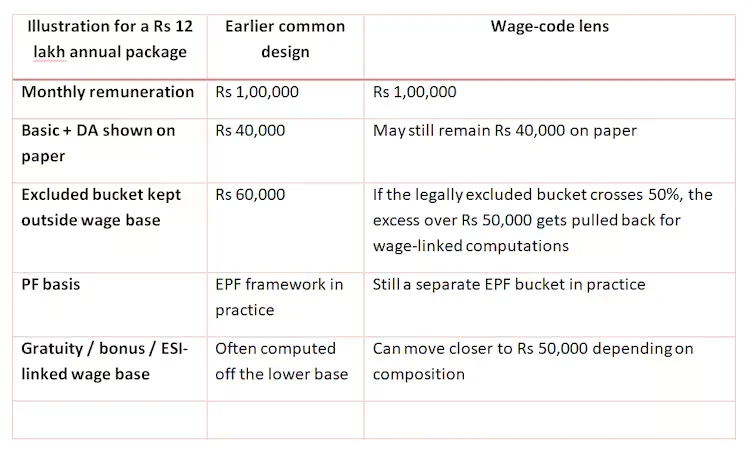
At the centre of the discussion is the definition of “wages” under Section 2(y) of the Code on Wages. The rule states that if allowances and exclusions exceed 50 per cent of total remuneration, the excess amount must be added back to wages.
This means employers cannot disproportionately reduce basic salary and increase allowances to minimise statutory contributions. Even if the “basic” component is shown as less than 50 per cent, parts of the salary may still be treated as wages for calculating benefits like gratuity and bonus.
In simple terms, the focus shifts from how salary is presented (CTC) to how much of it qualifies as “wages” under the law.
PF calculations: What stays and what changes
Provident Fund continues to operate under the Employees’ Provident Fund Organisation framework. Contributions are typically 12 per cent of basic wages, dearness allowance and retaining allowance.
Importantly, PF remains somewhat separate from the broader wage definition debate. The existing wage ceiling of Rs 15,000 per month still applies unless an employee opts for higher contributions.
However, if companies align PF contributions with a higher wage base, employees may see:
- Increased monthly PF deductions
- Lower take-home salary
- Higher long-term retirement savings
For example, if the PF wage base rises from Rs 40,000 to Rs 50,000, the employee contribution increases from Rs 4,800 to Rs 6,000 per month.
Impact on take-home salary
For employees in the Rs 8 lakh to Rs 15 lakh annual CTC range, the changes are expected to be moderate rather than drastic.
In many cases:
- Monthly take-home pay may reduce by around Rs 1,000 to Rs 3,000
- The reduction depends on whether PF is calculated on capped or actual wages
- Employers may restructure salaries without increasing overall CTC
Where PF remains capped at Rs 15,000, the immediate impact is minimal. However, where higher wage contributions are applied, the reduction becomes more noticeable.
Gratuity benefits likely to improve
Gratuity calculations are directly linked to the last drawn wage. A higher wage base under the new rules means employees could receive a larger gratuity payout over time.
One of the biggest changes benefits fixed-term employees. As per recent clarifications, such employees become eligible for gratuity after completing just one year of service, instead of the traditional five-year requirement.
This is a significant shift, especially for professionals on short-term contracts who earlier missed out on gratuity benefits.
Who benefits the most—and who doesn’t
The impact of the new labour codes will vary across employee categories:
Biggest beneficiaries:
- Employees with long tenures
- Those with allowance-heavy salary structures
- Fixed-term employees now eligible for gratuity after one year
Limited impact for:
- Frequent job switchers
- Employees with PF capped at Rs 15,000
- Those whose salary structures already align with wage definitions
In short, this is not a uniform gain for all employees.
Key questions employees must ask
Experts advise employees to focus on four critical aspects:
- What is my actual statutory wage base (not just CTC)?
- Is PF calculated on capped wages or full wages?
- Has the employer changed only the salary structure or also the benefit base?
- Am I gaining better long-term benefits despite a slight drop in take-home pay?
Additionally, employees should maintain proper documentation, including UAN details, nominations, salary slips and employment records, to avoid disputes in the future.
Conclusion
The new labour codes mark a structural shift in India’s payroll system, prioritising transparency and long-term social security over short-term cash in hand. While some employees may see a slight dip in monthly take-home salary, the trade-off comes in the form of stronger retirement savings and improved gratuity benefits.
Understanding the difference between CTC and statutory wages will be crucial for employees to make informed financial decisions in this evolving landscape.
(Disclaimer: The article has been authored by Pratik Vaidya, Managing Director and Chief Vision Officer of Karma Management Global Consulting Solutions Pvt. Ltd. and also Director of the National Executive Council of the Indo-American Chamber of Commerce. Views expressed are personal.)