







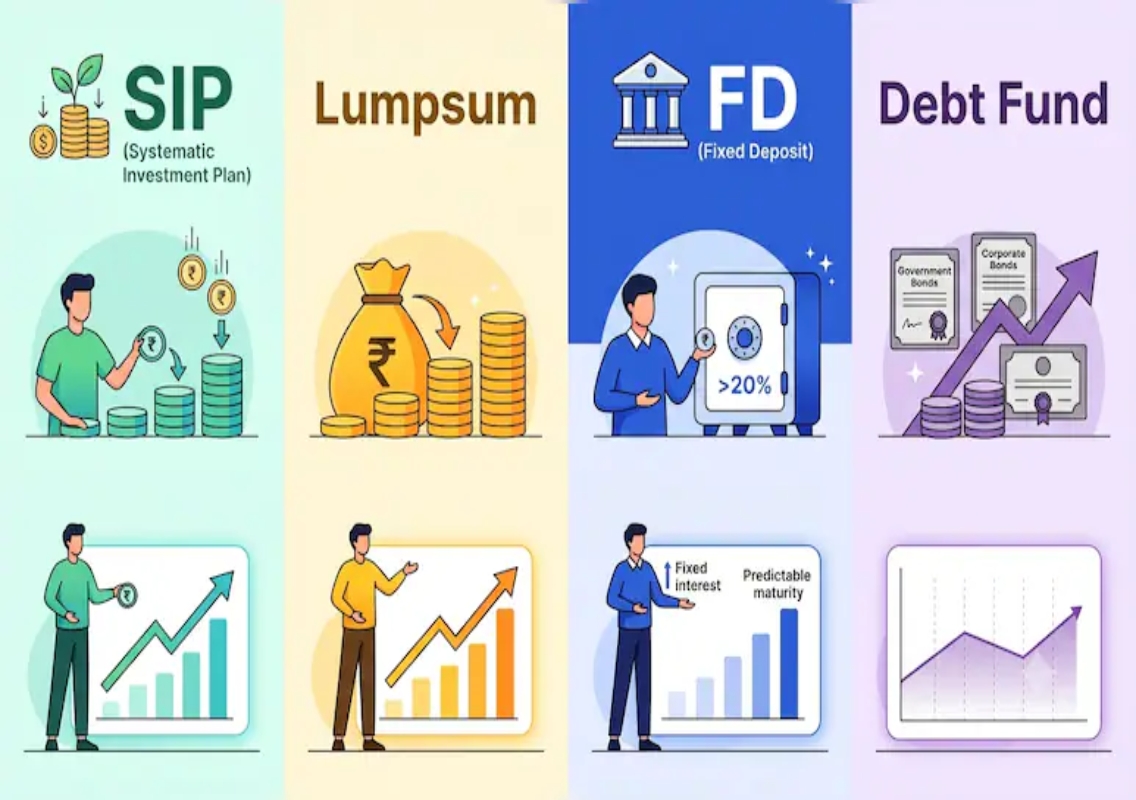


Mumbai: Having Rs 25 lakh sitting in a bank account gives an investor several options, but deciding where to put the money depends on the investment horizon, risk appetite, liquidity requirements and financial goals. Investors can consider equity mutual funds through a lumpsum investment or staggered SIP, bank fixed deposits or debt mutual funds.
The choice is not simply about finding the investment that offers the highest possible return. Each option carries a different combination of risk, liquidity, certainty and potential for wealth creation. NDTV Profit’s comparison highlights how investors with Rs 25 lakh can evaluate these choices before deploying their money.
SIP: Spread Rs 25 lakh over six to 12 months
A Systematic Investment Plan, or SIP, allows investors to invest a fixed amount at regular intervals into a mutual fund. While SIPs are commonly associated with monthly investments from salaries, investors who already have a sizeable corpus can also use a staggered approach.
For example, instead of putting the entire Rs 25 lakh into an equity mutual fund on one day, an investor could divide the amount into smaller instalments and deploy it over six to 12 months.
The biggest advantage is that the investor does not have to commit the entire corpus immediately. If the market falls sharply soon after the investment begins, only the amount already deployed would be exposed to that decline, while the remaining money could be invested later.
However, staggered investing has a trade-off. If markets rise during those six to 12 months, the money that remains outside the market may miss some potential gains.
Therefore, SIP or staggered investing can appeal to investors who are uncomfortable putting a large amount into equity markets at one time.
Lumpsum: Entire Rs 25 lakh invested at once
Under a lumpsum strategy, the full Rs 25 lakh is invested in a mutual fund at the beginning.
If the investment is made in an equity mutual fund, the entire corpus becomes exposed to market movements from day one. A rising market can allow the full amount to participate in gains immediately. However, a sharp market correction soon after the investment can also result in a significant temporary fall in portfolio value.
Lumpsum investing may therefore suit investors who have a long investment horizon and can tolerate short-term volatility.
The major advantage is that the entire capital gets more time in the market. But investors should be careful about trying to predict the perfect entry point because consistently timing market highs and lows is difficult.
Fixed deposit: More certainty, lower market risk
For investors whose priority is capital stability and predictable returns, a bank fixed deposit can be considered.
Unlike equity mutual funds, an FD is not linked to daily stock market movements. Banks offer a predetermined interest rate for the selected tenure, giving investors greater visibility over the interest they can earn. FD tenures can range from a few days to several years, depending on the bank and product.
An FD could be particularly relevant for someone who expects to need the money within a relatively short period or cannot tolerate a decline in the principal amount.
However, the interest earned on an FD is taxable according to the applicable rules, which means investors should consider the post-tax return rather than only the advertised interest rate.
FDs also generally have lower long-term return potential than equity-oriented investments, although the latter come with significantly higher market risk.
Debt funds: Liquidity with market-linked returns
Debt mutual funds invest in fixed-income instruments such as government securities, treasury bills, corporate bonds, commercial papers and other money-market instruments.
They can provide investors with exposure to fixed-income assets while generally offering greater liquidity than products with a fixed lock-in. However, debt funds are not equivalent to bank FDs and do not provide guaranteed returns.
Debt funds may suit investors who want relatively lower volatility than equity funds while retaining access to their money.
The risk level can also vary depending on the type of debt fund and the securities held in its portfolio. Investors therefore need to examine the fund’s underlying assets, maturity profile and credit exposure before investing.
Which option is suitable for different investors?
There is no single answer for everyone with Rs 25 lakh.
An investor who has a long-term horizon and can tolerate market fluctuations may consider equity mutual funds. Such an investor could choose a lumpsum approach if comfortable with short-term volatility, or stagger the investment over six to 12 months if concerned about entering the market at an unfavourable time.
An investor who expects to need the money in less than three years or cannot accept a fall in principal may find an FD more appropriate, subject to the applicable interest rate, taxation and deposit terms.
Debt funds could be considered by investors seeking relatively stable fixed-income exposure with liquidity, but they should remember that returns are market-linked and not guaranteed.
Don’t invest the entire Rs 25 lakh without an emergency plan
Before deciding between SIP, lumpsum, FD and debt funds, investors should also consider whether the entire Rs 25 lakh is genuinely available for investment.
Money required for emergencies, near-term expenses, outstanding high-cost debt or known financial commitments should not automatically be placed in volatile assets.
Maintaining an adequate emergency reserve can prevent an investor from having to sell long-term investments during a market downturn.
The remaining surplus can then be allocated according to the investor’s financial goals and time horizon.
Risk and return should be considered together
The key difference between these four approaches is the balance between risk, return potential and certainty.
A lumpsum equity investment offers the possibility of higher long-term growth but exposes the entire corpus to market fluctuations immediately. A staggered SIP approach spreads the entry points and can make the investment process psychologically easier, but some money remains outside the market during the deployment period.
An FD offers greater certainty over the interest rate but generally has lower long-term growth potential. Debt funds occupy a different position, offering exposure to fixed-income securities and liquidity without guaranteeing returns.
Investors should therefore avoid choosing an option purely because it has the highest historical or expected return.
What should you do with Rs 25 lakh?
The most suitable strategy depends on when the money will be needed, how much volatility the investor can tolerate and what the money is meant to achieve.
Someone with a long-term wealth-creation goal and a high risk tolerance may lean towards equity mutual funds. A cautious investor may prefer safer avenues such as FDs for near-term requirements, while debt funds could be considered for relatively stable fixed-income exposure with liquidity.
For investors worried about deploying Rs 25 lakh at once, spreading an equity investment over six to 12 months is one possible approach. On the other hand, investors with a long horizon who are comfortable with market volatility may choose to invest a larger portion upfront.
Ultimately, there is no universal winner between SIP, lumpsum, FD and debt funds. The right decision should be based on the investor’s financial goal, investment horizon, liquidity needs, risk tolerance and tax position, rather than simply chasing the highest potential return.