







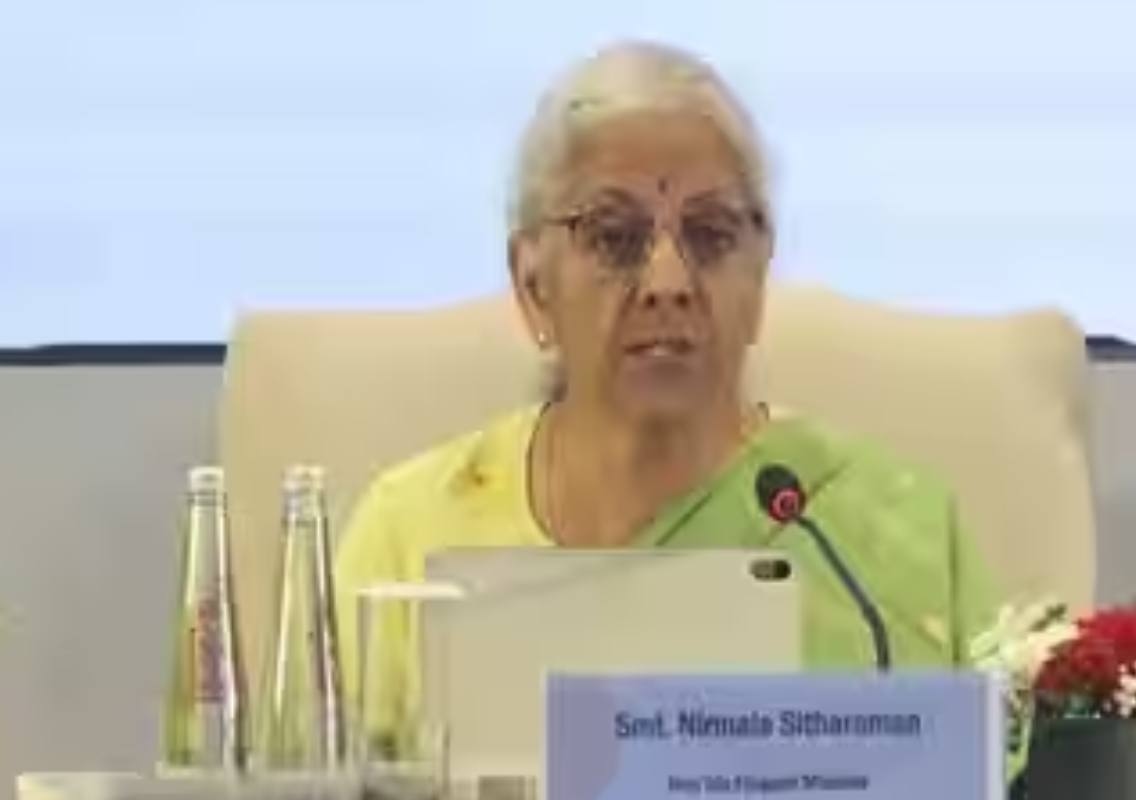


New Delhi: Union Finance Minister Nirmala Sitharaman has clarified that the newly introduced Merchant Discount Rate (MDR) on specified UPI merchant transactions above Rs 2,000 is not a government charge and will not be passed on to consumers.
The clarification comes amid concerns and confusion over the new UPI pricing framework, under which a 0.4% MDR will apply to certain person-to-merchant transactions above Rs 2,000 from October 15.
Sitharaman said the charge is a payment ecosystem fee and not a tax, cess or surcharge imposed by the government. She also stressed that consumers should not be charged the MDR separately when making UPI payments.
“This is not a tax, this is not a cess, this is not even a surcharge. And the collection is not coming to the Consolidated Fund of India. So, let’s first understand, this is not a government issue,” Sitharaman said.
Who will pay the UPI MDR?
Explaining how the new framework works, Sitharaman said the MDR is collected by entities involved in processing and facilitating digital payments.
These include the National Payments Corporation of India (NPCI), payment aggregators, service providers, point-of-sale providers and merchant banks.
“The merchant is the one who is going to pay. That money is not coming to the Government of India and we are not imposing it,” she said.
Sitharaman further said the cost should not be passed on to customers. The government has maintained that the MDR should be borne within the merchant-side payment ecosystem rather than appearing as an additional charge on a customer’s bill.
UPI transactions of up to Rs 2,000 remain outside the MDR framework. The new charge applies to specified merchant categories for transactions above that threshold. Person-to-person UPI transfers are also not covered by the MDR.
Why the Rs 2,000 threshold matters
The Rs 2,000 threshold has become a key part of the new UPI pricing framework.
The government and NPCI have sought to protect smaller transactions from the new MDR. NPCI Managing Director and CEO Dilip Asbe said around 96% of UPI transactions by volume are below Rs 2,000, while about 75% of overall UPI transaction value remains outside the MDR framework.
Asbe said India currently processes around Rs 30 lakh crore in UPI transaction value, with merchant payments accounting for approximately Rs 6-7 lakh crore. He said the MDR framework primarily affects transactions above the Rs 2,000 threshold.
The government has also clarified that no charge can be imposed on UPI transactions of up to Rs 2,000.
NPCI estimates limited consumer risk
Asbe has acknowledged that there could be some risk of merchants attempting to pass on the cost, but said the overall exposure is limited.
According to his assessment, only around 10% of the MDR value could potentially involve businesses where there is a risk of costs being passed on to consumers. He said banks, payment aggregators, acquiring banks and NPCI would have to work to ensure that the charges are not passed on.
Asbe also said around 80% of the MDR value is expected to come from businesses with annual gross merchandise value or digital payment collections exceeding Rs 1,000 crore. Another 10% is expected to come from businesses with annual GMV above Rs 1 crore.
According to NPCI, many of these larger businesses already accept credit cards and therefore already pay charges for digital payment acceptance. This, Asbe said, makes them less likely to transfer the additional UPI cost to consumers.
Most small merchants expected to remain outside the levy
NPCI has also highlighted the number of small merchants that have never recorded a UPI transaction above Rs 2,000.
Asbe said India has more than 60 million merchants accepting digital payments and that around 75% of them have not recorded a transaction above the threshold.
“So, there is no impact of our policy on them,” he said, according to Business Standard.
The structure is therefore intended to concentrate MDR collections among higher-value merchant transactions rather than imposing a charge across all UPI payments.
Why has UPI MDR been introduced?
The return of MDR is also linked to the long-term financial sustainability of the UPI ecosystem.
UPI operated without MDR for several years, helping accelerate adoption of digital payments across India. However, NPCI has argued that the ecosystem needs a revenue stream to support continued investment in infrastructure and innovation.
Asbe said the proposed 0.4% MDR could generate around Rs 13,000-15,000 crore in its first year, while leaving the majority of UPI transactions outside the charging framework. He said the payment system’s estimated annual cost is around Rs 21,000 crore.
He also said UPI transaction value is expected to grow by around 10% this year, while transaction volumes could increase by 15-17%.
According to Asbe, investment in UPI infrastructure has slowed after the heavy spending during the first five to six years of the platform’s development. He also cited education, awareness and trust as factors that could influence future growth.
UPI aims to expand beyond payments
The longer-term ambition for UPI goes beyond facilitating everyday digital payments.
Asbe said the objective is to eventually take UPI usage to one billion users and build infrastructure that can support wider access to financial products such as credit, investments and insurance.
The new MDR framework is therefore being positioned by NPCI as part of an effort to create a more sustainable payment ecosystem while protecting low-value transactions.
What consumers need to know
For consumers, the key distinction is between the payment amount and the MDR paid by the merchant-side ecosystem.
A customer making an eligible UPI payment above Rs 2,000 should not be separately charged the MDR, according to the government’s stated position. Transactions up to Rs 2,000 remain outside the MDR framework, while the new 0.4% charge applies only to specified merchant categories.
Sitharaman’s clarification is aimed at addressing concerns that the new MDR amounts to a government-imposed UPI tax.
The government maintains that it is neither a tax nor a charge collected for the Consolidated Fund of India. Instead, it is a fee within the digital payments ecosystem, with merchants and participating payment entities bearing the cost.