







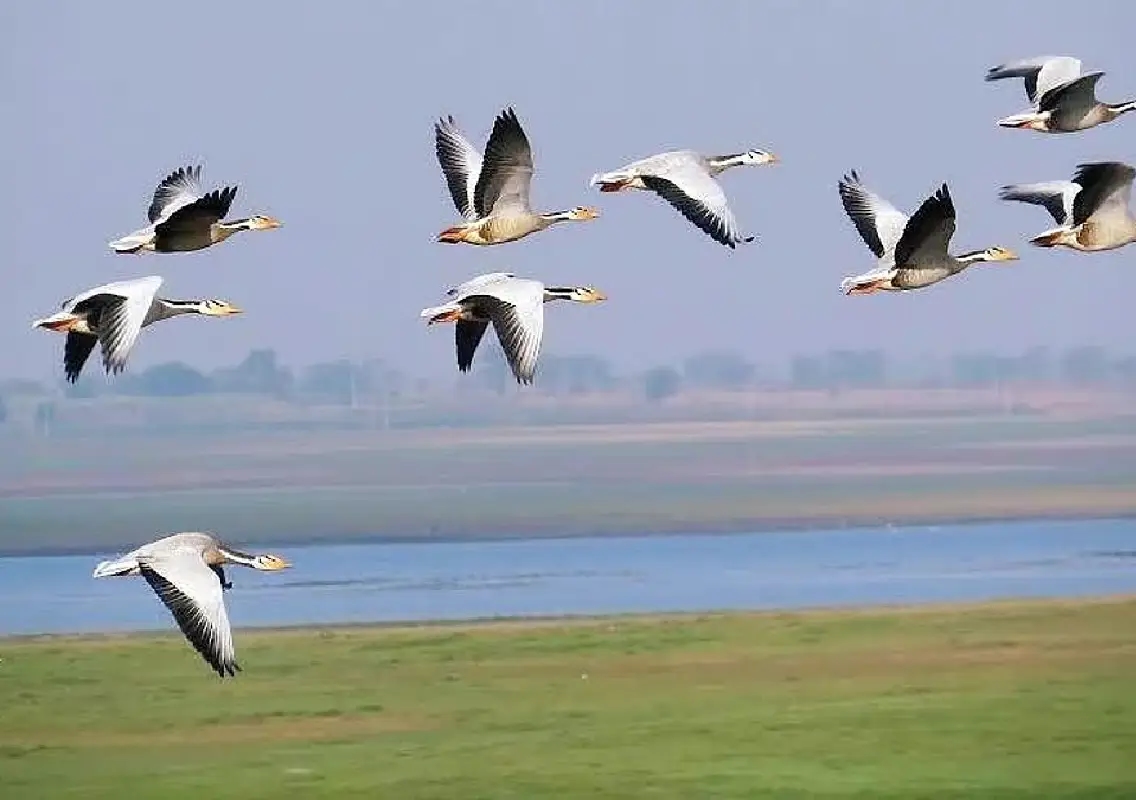


A bar-headed goose bearing the collar tag X-52 landed at Magadi Lake last Sunday, marking its seventh recorded visit in 12 years. The bird’s return is a remarkable testament to one of nature’s most challenging migratory journeys — a non-stop flight over the Himalayas, where oxygen levels are low and temperatures drop sharply.
Magadi Lake, renowned as one of India’s most significant wintering grounds for bar-headed geese (Anser indicus), has already witnessed the arrival of more than 4,000 geese this season. Migrating from Mongolia, Tibet in China and other parts of Central Asia, these birds seek peninsular India’s milder winters to escape harsh sub-zero breeding habitats.
Long-distance travellers return
X-52 is among 31 tagged bar-headed geese documented at Magadi Lake over the past decade by researchers and forest officials. Scientists in Mongolia and China continue to tag these birds to better understand migratory behaviour, ecological requirements and long-term survival patterns.
Each tag has a unique colour code and number, enabling birdwatchers and citizen scientists worldwide to upload sighting data whenever a tagged bird is spotted. This global participation helps create a continuous record of their travel routes and stopover locations.
Why tagging matters
Scientists use two primary methods — ring tagging and satellite tagging — to map migration paths, resting sites, flight altitudes, dietary habits and seasonal behaviours.
Ashwin Viswanathan, regional reviewer for eBird, an international bird observation platform, explains that citizen science alone can document breeding and wintering sites, but tags provide far deeper insights.
“Tags allow researchers to follow the exact route, altitude, feeding patterns, population trends and threats faced during migration. Such information is vital to conserving migratory corridors, which depend on cooperation across countries,” he notes.
Local researchers track individual geese
Gadag-based biodiversity researcher Manjunath S Nayak, who has monitored bar-headed geese at Magadi Lake for 12 years, says X-52 has been visiting the lake since 2013. Another tagged goose, P-71, has returned five times.
“These birds would remain anonymous without tags. Tagging helps us understand breeding age, lifespan and broader life-cycle patterns,” Nayak says.
The continuing arrival of known individuals such as X-52 reflects the resilience of migratory birds and underscores the ecological importance of Magadi Lake as a safe wintering habitat.
Gaps in India’s tagging efforts
Despite strong international tagging initiatives, experts point out that India — and Karnataka in particular — has made limited progress in tagging migratory birds for scientific research.
Principal Chief Conservator of Forests (Wildlife) P C Ray acknowledges that while the Karnataka Forest Department supports research, approvals become complicated when dealing with species protected under Schedule I of the Wildlife Protection Act, 1972. In such cases, permissions are granted only by the Union government.
“There is often a delay in getting approval,” Ray says, noting that the procedure can slow down essential tagging and long-term monitoring projects.
Protecting migratory corridors
Researchers warn that safeguarding migratory species requires more than just breeding and wintering habitat protection. Birds rely on uninterrupted corridors stretching across international borders. Data gathered from tagging programmes is crucial for mapping these corridors and identifying threats such as habitat loss, pollution and hunting along the way.
Magadi Lake’s growing population of bar-headed geese highlights the region’s ecological value and the need for sustained conservation efforts. With continued collaboration between researchers, government agencies and citizen scientists, Karnataka can play a significant role in the conservation of these extraordinary high-altitude migrators.