







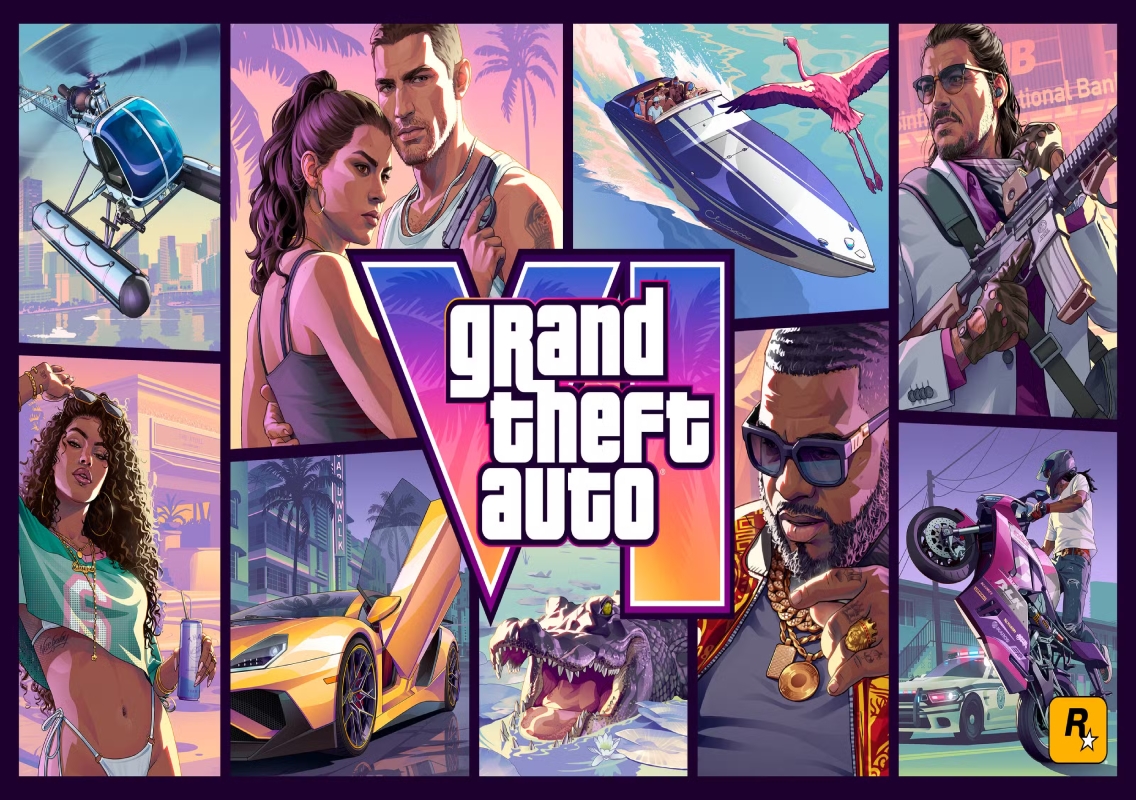


Mangaluru: Rockstar Games’ upcoming Grand Theft Auto 6 (GTA 6) is shaping up to deliver one of the most ambitious open-world experiences in gaming, with the developer putting greater emphasis on a living environment rather than simply creating a larger map. Set across the fictional state of Leonida and centred on Vice City, the game is expected to combine a vast environment with more detailed characters, wildlife, vehicles and dynamic systems.
With GTA 6 scheduled to launch on November 19, 2026, Rockstar has gradually revealed more about its world through trailers and its recent Extended Look. The information released so far suggests that the game will build significantly on the open-world foundations established by GTA 5 and Red Dead Redemption 2.
Leonida will extend beyond Vice City
Vice City will once again be at the heart of GTA 6, but the game will not be restricted to an urban environment.
The wider Leonida setting includes beaches, waterways, rural areas, swamps and other environments, giving players a much broader world to explore. Recent footage has shown that Rockstar is using different environments to create distinct experiences instead of filling the map with variations of the same urban landscape.
This is an important evolution from GTA 5. Los Santos and Blaine County already offered an impressive combination of city, countryside and wilderness, but GTA 6 appears to be pushing the concept further by connecting a much wider variety of locations into one continuous setting.
Rockstar is focusing on world density
One of the biggest differences between GTA 6 and earlier games could be the amount of activity taking place within its world.
Rather than measuring the game’s ambition purely by square kilometres, Rockstar appears to be concentrating on making locations feel populated and reactive. Recent reports have highlighted NPC routines, wildlife and environmental interactions as important components of the experience.
This approach is similar to what Rockstar achieved with Red Dead Redemption 2, where pedestrians, animals and other characters often appeared to have their own routines and reactions to the player’s actions.
In GTA 6, that philosophy appears to be returning in a more modern setting.
NPCs could react more naturally
Pedestrian behaviour is expected to be one of the most noticeable changes.
Recent preview reports have described NPCs reacting differently depending on what players do. Armed characters can cause people nearby to flee, while some NPCs may attempt to defend themselves or react to threats differently. Police behaviour is also reportedly more context-sensitive.
These systems could make the open world feel less scripted.
In previous GTA games, pedestrians were often primarily background characters. GTA 6 appears to be moving towards a system where NPCs can contribute to unexpected situations.
For example, a simple confrontation on a street could potentially develop differently depending on the people nearby, their reactions and how quickly law enforcement becomes involved.
A more sophisticated wanted system
The police system is another area where GTA 6 could introduce significant changes.
Recent reports indicate that Rockstar is working with a more detailed wanted system in which law enforcement can use information such as a player’s appearance, clothing and vehicle when tracking them. A six-star wanted system has also been reported.
If implemented as reported, this could make escaping from the police considerably more strategic.
Instead of simply driving away and waiting for the wanted level to disappear, players could potentially need to think about whether witnesses saw them, what vehicle they were using and how they look.
Such a system would fit Rockstar’s broader attempt to make the open world respond more logically to player actions.
Wildlife will have a bigger role
GTA 6 is also expected to feature a substantial wildlife ecosystem across Leonida.
The game’s environments include areas where players can encounter animals, while recent information has pointed to activities such as hunting and fishing. Reports have also suggested that dozens of animal species are present in the world.
Wildlife could help distinguish different parts of the map.
Animals in the swamps, for example, can make those regions feel fundamentally different from the busy streets of Vice City. This type of environmental detail was a major part of Red Dead Redemption 2 and could become an important element of GTA 6’s exploration.
More activities beyond the main story
Rockstar also appears to be expanding the number of things players can do when they are not following the main storyline.
Footage from the Extended Look has shown or highlighted activities including basketball, gym workouts, scuba diving, jet skiing, kayaking, airboating, racing, shooting ranges, swimming and boxing, among others.
The importance of these activities is not simply that they give players more things to do.
They can also help make the world feel like a place rather than a collection of missions. Players can leave a story objective behind and simply explore, participate in activities or discover unexpected situations.
Dynamic events could make exploration unpredictable
Another major area of interest is the possibility of more dynamic encounters.
Recent reports have described situations in which NPCs can become involved in crimes or unexpected events without the player necessarily initiating them. Such encounters could potentially turn into opportunities, distractions or entirely new situations.
This would represent a natural progression of Rockstar’s open-world design.
Instead of every major event being triggered by a mission marker, players could encounter situations while simply travelling around Leonida.
That unpredictability could be particularly valuable in a game expected to have a very long lifespan.
The map is about more than size
There has been considerable discussion about how large GTA 6’s map will be compared with previous Rockstar games.
However, the more important question may be how much content and interaction Rockstar can place within that space. GTA 5’s map remains memorable because of the combination of urban areas, countryside, mountains, highways and ocean environments.
GTA 6 appears to be following the same philosophy while increasing the density of interactions and activities.
Some unofficial map-size estimates have placed Leonida at a significantly larger scale than GTA 5, but these figures should be treated cautiously unless Rockstar provides an official measurement.
GTA 6 could bring Red Dead Redemption-style immersion to Vice City
Perhaps the biggest expectation surrounding GTA 6 is that Rockstar will combine the freedom and humour of Grand Theft Auto with the systemic depth of Red Dead Redemption 2.
The result could be an open world where pedestrians behave more naturally, animals populate different ecosystems, police investigations are more persistent and weather and geography contribute more to gameplay.
The game’s environments are also designed to support a wide range of activities, from city-based entertainment to exploration in remote areas of Leonida.
That combination could make GTA 6 feel less like a traditional open-world game and more like a continuously operating digital world.
Release date remains November 19, 2026
GTA 6 is currently scheduled to launch on November 19, 2026, for PlayStation 5 and Xbox Series X|S. A PC release date has not yet been officially confirmed.
Until launch, some reported features should still be treated as previews, leaks or speculation rather than guaranteed elements of the final game. Rockstar can change systems during development, and not every detail reported by third-party sources has been officially confirmed.
Nevertheless, the information revealed so far suggests that Rockstar’s biggest priority with GTA 6 is not simply creating a bigger map.
It is creating a more reactive and believable open world.
If Rockstar succeeds, GTA 6 could set a new benchmark for how players expect open-world environments to behave, particularly in terms of NPC reactions, environmental detail, wildlife and spontaneous events.