







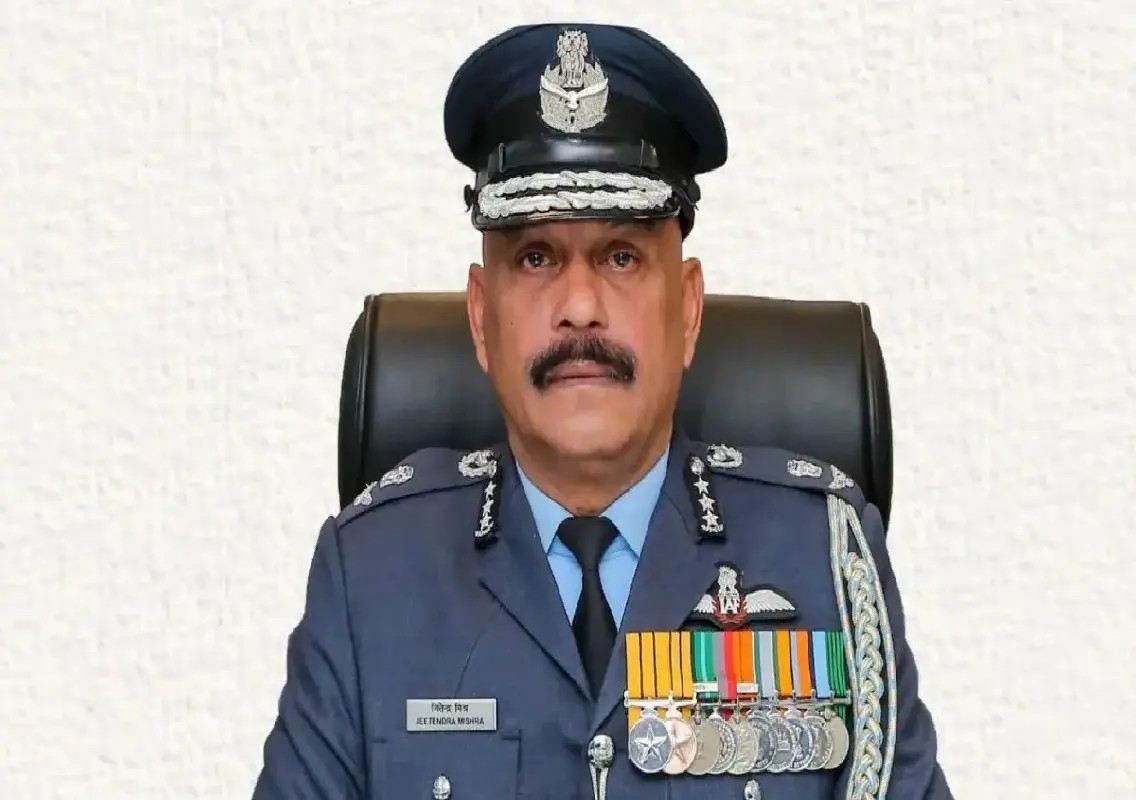


Lucknow: Air Marshal Jeetendra Mishra , who commanded India’s Western Air Command during Operation Sindoor, has been selected as the first Chief Executive Officer (CEO) of the Shri Ram Janmabhoomi temple in Ayodhya. The appointment comes months after his retirement from the Indian Air Force and marks a major shift from military command to temple administration.
Mishra retired in April 2026 after a distinguished career in military aviation. He served as Air Officer Commanding-in-Chief of the Western Air Command when Operation Sindoor was launched on May 7, 2025, following the Pahalgam terror attack.
Speaking to The Times of India, Mishra said he learnt about his appointment through news reports and was yet to receive official communication from the Shri Ram Janmabhoomi Teerth Kshetra Trust.
From military command to temple administration
Mishra’s selection brings an experienced military leader into an organisation whose administrative responsibilities have expanded significantly with the development and growing footfall of the Ram temple.
Govind Dev Giri, general secretary of the Shri Ram Janmabhoomi Teerth Kshetra Trust, said the standard operating procedure governing the CEO’s appointment and functioning had not yet been finalised.
The CEO is expected to play a key role in coordinating the Trust’s expanding administrative operations, including planning, logistics, coordination and management of the temple complex and its associated activities.
Mishra’s long experience in handling large organisations, complex operations and inter-agency coordination is expected to be relevant to the responsibilities of the new position.
Western Air Command played key role in Operation Sindoor
Mishra was heading the Western Air Command when Operation Sindoor began in May 2025.
The Western Air Command is one of the Indian Air Force’s most important operational formations and was central to the air operations conducted during the military response to the Pahalgam terror attack.
During the operation, Mishra oversaw decisions concerning the deployment of aircraft and air defence assets. Much of the planning and execution of the air campaign was directed from command rooms under the Western Air Command.
His leadership during the operation was subsequently recognised at the highest level.
President Droupadi Murmu conferred the Sarvottam Yudh Seva Medal on Mishra for his distinguished service during Operation Sindoor.
Experience in aviation testing and defence procurement
Mishra’s career extends well beyond operational command. He joined the National Defence Academy in 1983 and was commissioned as a fighter pilot in December 1986.
He subsequently qualified as an experimental test pilot, one of the most specialised assignments in military aviation.
As a test pilot, he was involved in evaluating aircraft during their development and testing phases. His responsibilities included assessing aircraft performance and identifying technical limitations before the platforms were inducted into operational service.
Mishra served as the chief test pilot of both the Indian Air Force and Hindustan Aeronautics Limited (HAL), giving him extensive exposure to military aviation development and aircraft testing.
His experience also includes working with defence research and development establishments and scientists on aviation-related systems.
Strengthened Pathankot after 2016 attack
Following the terrorist attack on the Pathankot air base in January 2016, Mishra was selected to take charge of the station.
He was tasked with strengthening its administration and security systems following the attack.
He later commanded the Aircraft and Systems Testing Establishment in Bengaluru. The establishment works in coordination with HAL, the Defence Research and Development Organisation and civilian scientists on aviation systems and related technological developments.
These assignments provided Mishra with experience in coordinating personnel and institutions with different areas of expertise.
Experience in defence procurement
Mishra also spent three years at Air Headquarters in New Delhi, where he was associated with defence procurement.
During his tenure, he was involved with around 75 projects and played a role in the Air Force’s participation in the first emergency procurement tranche during 2019 and 2020.
His exposure to procurement, project management and coordination is likely to be among the areas that the Trust considered while selecting its first CEO.
The position requires someone capable of managing large-scale operations and coordinating multiple stakeholders, particularly as the temple complex and associated infrastructure continue to develop.
Training in India and abroad
Mishra’s professional training includes specialised programmes in war management and strategic studies.
He underwent training in war management at the Air Command and Staff College in the United States. He also studied strategic studies at the Royal College of Defence Studies in London.
His professional background therefore combines operational military experience with exposure to strategic planning, technology, procurement and organisational management.
The Trust’s decision to select a former senior military commander reflects the importance of administrative and coordination capabilities in managing the growing responsibilities associated with the temple.
Selection followed extensive screening
The Trust’s process to select its first CEO reportedly began with 5,585 applications.
A selection committee headed by retired Justice Permod Kohli and comprising Lieutenant General V K Chaturvedi and nuclear scientist Dr Suresh Haware undertook the selection process.
The committee used technology-assisted screening, verification procedures and online assessments to evaluate applicants.
The eventual selection of Mishra places a decorated former Air Force commander at the helm of the temple’s administrative structure.
Uttar Pradesh roots
Although Mishra spent much of his professional life in the Indian Air Force, he has roots in Uttar Pradesh.
He originally belongs to Bhopatpura in Deoria district, located roughly three hours by road from Ayodhya.
He comes from a middle-class family, with his father having worked as a lecturer. His journey from joining the National Defence Academy in 1983 to becoming a senior Air Force commander represents a career spanning four decades of military aviation and strategic assignments.
His connection to Uttar Pradesh also adds a regional dimension to his new responsibility in Ayodhya.
Experience from Operation Sindoor
In a recent podcast interview, Mishra discussed aspects of the air campaign conducted during Operation Sindoor and explained how Indian forces identified and engaged targets deep inside Pakistan.
He recalled an operation involving a target located around 314 km away, describing how a brief operational instruction led to the target being engaged.
However, several details concerning the military operation remain classified.
During his discussion, Mishra highlighted planning, precision, technology and coordination among different arms of the armed forces as important elements of the operation.
Those qualities — particularly planning, coordination and the management of complex systems — are also likely to be relevant to his new role.
A new chapter in Ayodhya
Mishra’s appointment marks a significant transition from military service to civilian institutional administration.
The Ram temple Trust is managing an increasingly complex ecosystem involving temple operations, infrastructure, devotees, logistics and administrative coordination. The creation of the CEO post is intended to provide a dedicated executive structure for these expanding responsibilities.
While the Trust is yet to finalise the standard operating procedure for the position, Mishra’s selection gives the organisation a leader with extensive experience in managing large formations and high-pressure operations.
For Mishra, the appointment represents a new chapter after retiring from the Indian Air Force in April 2026. From commanding one of the country’s key air formations during a major military operation to taking responsibility for the administration of one of India’s most prominent religious sites, his new role marks a striking change in professional responsibility.