







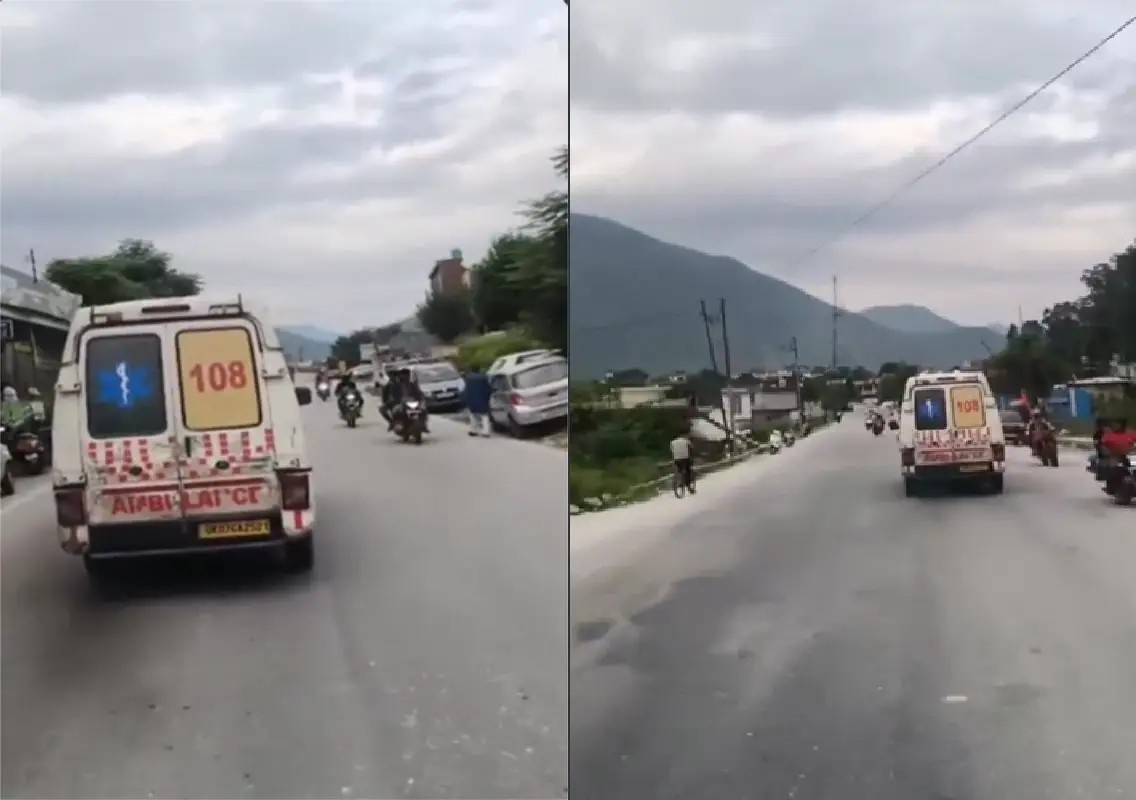


Rudraprayag: A video from the Nagrasu area of Rudraprayag has raised concerns over road safety after a 108 ambulance was allegedly seen travelling at high speed on the wrong side of the road.
The ambulance, bearing registration number UK07GA2521, can be seen in the video moving rapidly against the normal flow of traffic. Other vehicles appear to move aside to make way for the emergency vehicle.
The footage has prompted questions about whether emergency response vehicles should be permitted to adopt such risky driving practices while responding to calls.
Ambulance seen travelling against traffic
The video shows the ambulance approaching along the wrong side of the road while other motorists are travelling in the opposite direction.
Several vehicles appear to make way for the ambulance as it continues forward.
While emergency vehicles often need to reach hospitals or incident locations quickly, travelling at high speed against the flow of traffic can create significant risks for other motorists, pedestrians and the ambulance crew itself.
The incident has therefore renewed concerns about the balance between emergency response and road safety.
Emergency response does not remove safety responsibility
Ambulances are required to respond quickly when lives may be at risk. Delays in reaching an accident site or transporting a critically ill patient can have serious consequences.
However, the need for speed does not necessarily eliminate the responsibility to operate the vehicle safely.
Driving on the wrong side of the road at high speed can leave approaching motorists with little time to react. A sudden manoeuvre by another vehicle or an unexpected obstruction could potentially result in a serious collision.
The video has consequently triggered discussion about the need for emergency vehicle drivers to follow appropriate safety protocols even when responding to urgent calls.
Need for responsible emergency driving
Emergency vehicle drivers operate under demanding circumstances, particularly in areas where roads are narrow, winding or heavily congested. Rudraprayag’s mountainous terrain can further complicate emergency travel.
At the same time, road users need to be able to anticipate the movements of emergency vehicles. Ambulance drivers may need to use alternate lanes or overtake traffic in certain circumstances, but such manoeuvres should be carried out with due caution.
The video alone does not establish the circumstances in which the ambulance was travelling or whether it was responding to a genuine emergency. It also does not provide information about the traffic conditions immediately before or after the recorded portion.
Any assessment of the incident would therefore need to consider the full context, including whether the ambulance was on an emergency call and what instructions or circumstances influenced the driver’s actions.
Road safety remains the priority
The incident serves as a reminder that emergency response and road safety must go hand in hand. Ambulances play a critical role in saving lives, but unsafe driving can potentially place additional lives at risk.
The footage has brought attention to the importance of responsible driving by emergency vehicle operators, particularly on busy and challenging roads.
A rapid response is essential during emergencies, but it should ideally be achieved without creating avoidable dangers for other road users.