


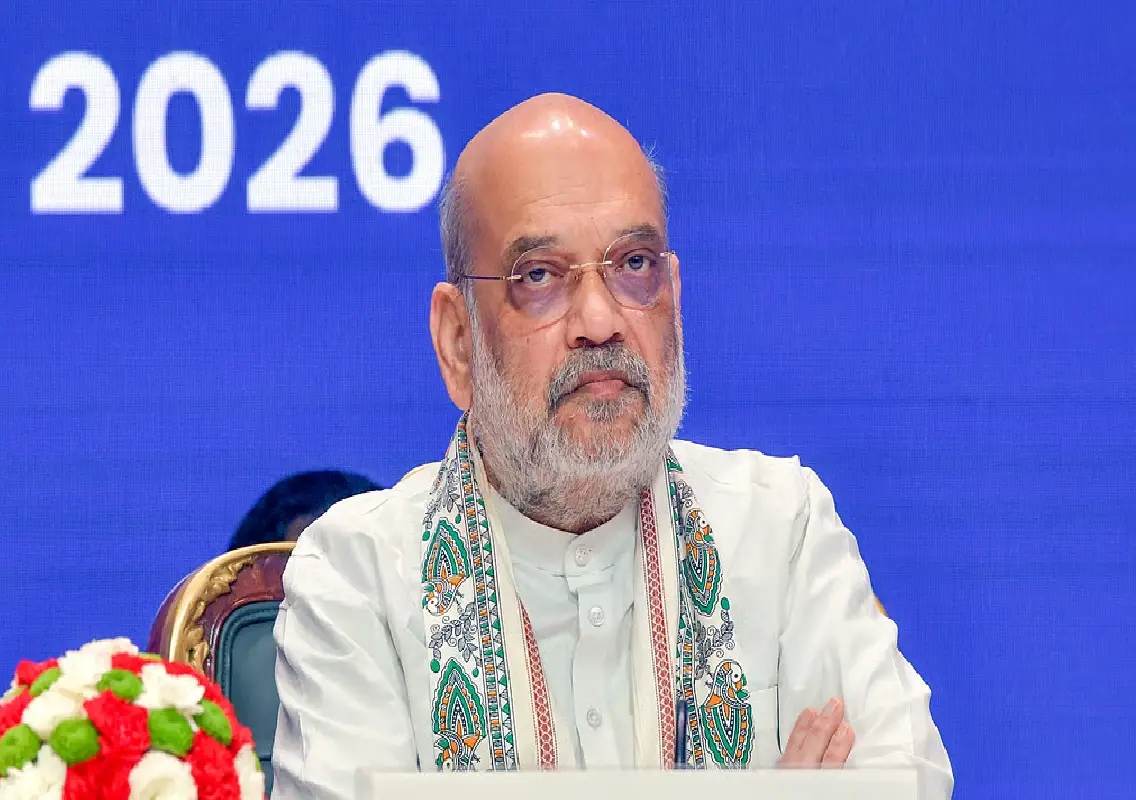


New Delhi: Union Home Minister Amit Shah on Tuesday hailed the Bharatiya Janata Party’s (BJP) performance in Gujarat’s local body elections, claiming that the results reflected continued public support for Prime Minister Narendra Modi. He also criticised the Congress over its electoral record in the state and took aim at the Aam Aadmi Party (AAP) for its performance.
Addressing the media in New Delhi, Shah said the BJP had won 90 of the 104 seats contested across three civic bodies in Gujarat. The results, he said, demonstrated the party’s continued political strength in the state.
The Home Minister directed particular criticism at Congress leader Rahul Gandhi, questioning the party’s electoral relevance in Gujarat and referring to what he described as decades of defeats.
“I want to make this point clear—and specifically convey it to Rahul ji—that the Congress party has not won a single election in 41 years. The last election they won was back in 1985; since then, they have faced continuous defeats in Gujarat,” Shah said.
His remarks came as the BJP sought to highlight its performance in the civic polls as evidence of continued voter support for its leadership and political agenda.
BJP wins 38 seats in Gandhinagar
Shah highlighted the BJP’s performance in the Gandhinagar Municipal Corporation, which falls within his parliamentary constituency. According to the Home Minister, the party won 38 of the corporation’s 44 seats.
He also claimed that the BJP had increased its vote share in Gandhinagar by 10 per cent compared with the previous election.
“This massive victory in Gujarat reflects the mood of the state’s voters, demonstrating that the electorate of Gujarat stands rock-solid behind Narendra Modi ji,” Shah said.
The Gandhinagar result was a key point in the Home Minister’s assessment of the BJP’s performance. By highlighting both the number of seats won and the claimed increase in vote share, Shah sought to underline the party’s electoral gains in the state.
The BJP has traditionally maintained a strong political presence in Gujarat, Modi’s home state, and the party’s performance in local elections is closely watched for indications of its standing at the grassroots level.
However, civic election results reflect voting patterns in specific local jurisdictions and do not, by themselves, establish how voters may behave in state or national elections.
Shah targets Congress over electoral record
Shah accused the Congress of struggling to regain its electoral footing in Gujarat, citing 1985 as the last time the party won an election in the state.
He used the results to question Rahul Gandhi’s leadership and the Congress’s ability to challenge the BJP in Gujarat.
The remarks added to the continuing political exchanges between the BJP and the Congress, with both parties seeking to frame election results as evidence of their broader political standing.
Shah’s criticism focused on the Congress’s history of electoral defeats in Gujarat and its continued efforts to contest the BJP’s dominance. His assertion about the party’s electoral record was presented as part of his political response to the latest civic poll results.
The Congress’s performance in the local body elections will be important for assessing its organisational strength and its ability to compete with the BJP at the municipal level.
AAP faces criticism over security deposits
The Home Minister also criticised the Aam Aadmi Party, which contested 32 seats in the elections.
According to Shah, AAP forfeited its security deposit in every seat it contested. He cited this performance while arguing that the BJP had emerged as the dominant force in the civic polls.
The AAP has attempted to expand its political presence beyond its traditional strongholds, including through contests in Gujarat. Shah’s remarks sought to portray the party’s performance in these elections as a setback to those efforts.
The reported results across the three civic bodies gave the BJP an opportunity to target both the Congress, its principal rival in Gujarat, and AAP, another party seeking to build a presence in the state.
BJP projects results as endorsement of Modi
Shah described the BJP’s victory as a reflection of public confidence in Modi’s leadership. He argued that the party’s seat tally and its claimed increase in vote share in Gandhinagar indicated continued support among Gujarat voters.
The BJP is likely to use the results to reinforce its political messaging in the state, while the opposition parties will face the task of evaluating their performance and strengthening their local organisations.
The civic poll outcome adds another chapter to Gujarat’s political contest, where the BJP has maintained a strong presence and opposition parties have sought to challenge its position.
While Shah projected the results as evidence of the BJP’s continued popularity, the broader political implications will depend on subsequent electoral contests and the performance of the parties across different levels of government.