







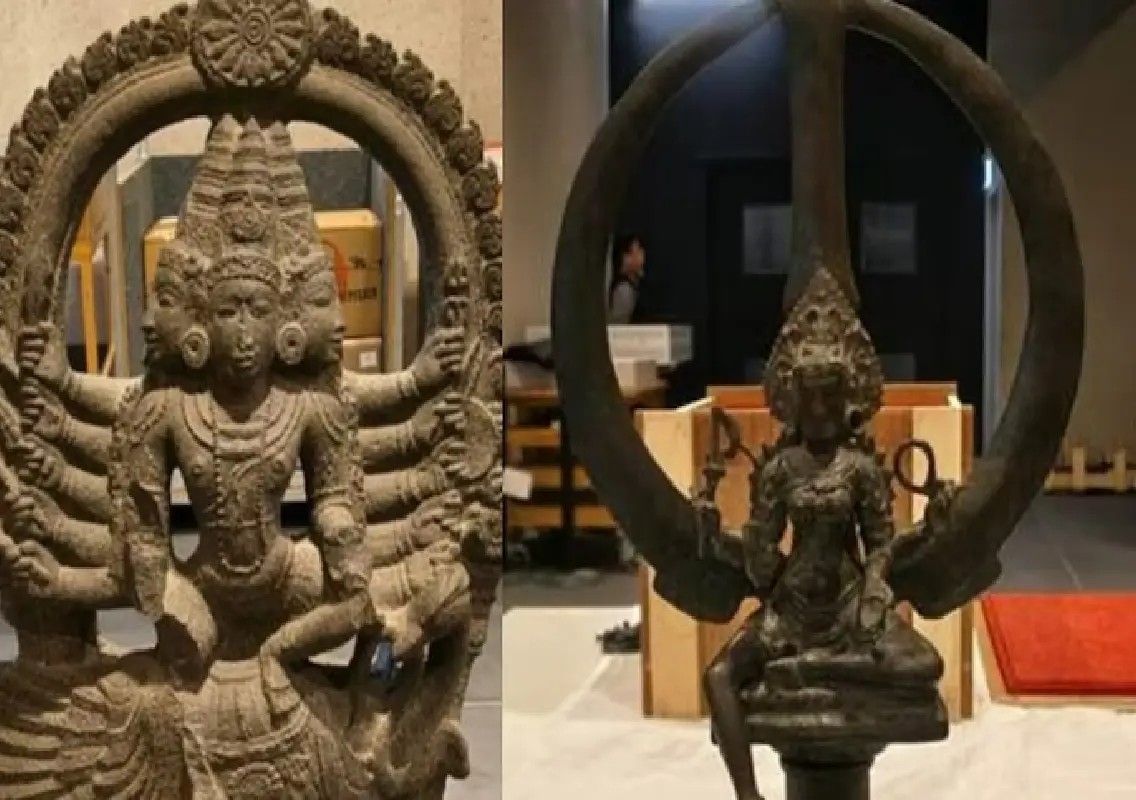


New Delhi: Three rare antiquities linked to Tamil Nadu’s temple heritage are set to return to India from Australia, marking another milestone in the country’s efforts to recover artefacts trafficked overseas. The objects—a Chola-era Karttikeya idol, a medieval Nandi sculpture and a ceremonial Chola-period trishul—are being repatriated under the Mutual Legal Assistance Treaty (MLAT) after investigations established that they had been illegally removed from temples in Tamil Nadu.
The artefacts are currently housed at the National Gallery of Australia and will be placed in Indian museums following their return. Their repatriation coincides with Prime Minister Narendra Modi’s visit to Australia.
Antiquities traced to Tamil Nadu temples
The Tamil Nadu Idol Wing Criminal Investigation Department (CID) launched investigations into the missing artefacts after First Information Reports (FIRs) were registered in 2016.
Officials examined temple records, archival documents, old photographs and museum catalogues to establish the provenance of the antiquities and trace their movement outside India. Based on the evidence gathered, India sought their return through the MLAT framework, following which Australian authorities agreed to repatriate the objects.
The return forms part of India’s ongoing efforts to recover cultural treasures smuggled abroad through illegal trafficking networks over several decades.
Chola-era Karttikeya idol returns home
Among the three antiquities is a stone sculpture of Shanmukha, the six-headed form of Lord Karttikeya, also known as Murugan, Skanda or Subramanya.
The sculpture dates to the 12th century and originally belonged to the Naganathaswamy Temple at Manambadi near Kumbakonam in Tamil Nadu.
Standing approximately 130 centimetres tall, the idol is believed to have been created during the Chola period, associated with the reign of Rajendra Chola I.
The six-headed representation of Karttikeya carries deep religious significance in Hindu tradition. Various interpretations associate the six faces with the six directions, six virtues or the six stars of the Krittika constellation that, according to mythology, nurtured the deity.
The sculpture also reflects the refined craftsmanship of the Chola dynasty, renowned for its balanced proportions, intricate ornamentation and artistic excellence.
Medieval Nandi sculpture to be repatriated
The second artefact is a stone sculpture of Nandi, the sacred bull and mount of Lord Shiva.
The sculpture belonged to the Kailasanathar Temple at Kaduvankudi in present-day Tiruvarur district and is believed to date between the 13th and 16th centuries.
Carved from a single block of stone and measuring about one metre in length, the sculpture exemplifies the skill of medieval South Indian sculptors.
While the Tamil Nadu Idol Wing estimates its financial value at around ₹4 crore, historians emphasise that its cultural and religious significance far exceeds its monetary worth.
Rare ceremonial trishul also returning
The third object is a ceremonial metal trishul crowned with an image of Goddess Bhadrakali, dating to the late Chola period.
The trident originally belonged to the Sri Kasiviswanathaswamy Temple in Tamil Nadu.
Unlike stone idols installed permanently inside temple sanctums, ceremonial tridents were traditionally used during religious festivals and processions.
Standing around 46 centimetres high and measuring over one metre in width, the trishul symbolises protection, strength and justice. While commonly associated with Lord Shiva, the trident also holds special significance in traditions devoted to the Goddess, particularly Bhadrakali.
Importance of provenance in recovering antiquities
Officials said the successful repatriation underscores the growing importance of provenance research in the global museum community.
Provenance refers to the documented history of an artefact’s ownership and movement. Museums and governments increasingly examine whether cultural objects entered collections through lawful and ethical means.
Where evidence establishes theft or illegal export, institutions are increasingly cooperating with countries of origin to facilitate their return.
India’s efforts to recover cultural heritage
The return of these three antiquities adds to India’s expanding list of recovered cultural treasures.
Over the past decade, several countries—including Australia, the United States, Canada and the United Kingdom—have returned Indian artefacts after investigations confirmed that they had been illegally removed from temples and heritage sites.
Officials say such recoveries help preserve India’s cultural legacy while restoring sacred objects to the communities and traditions from which they originated.