


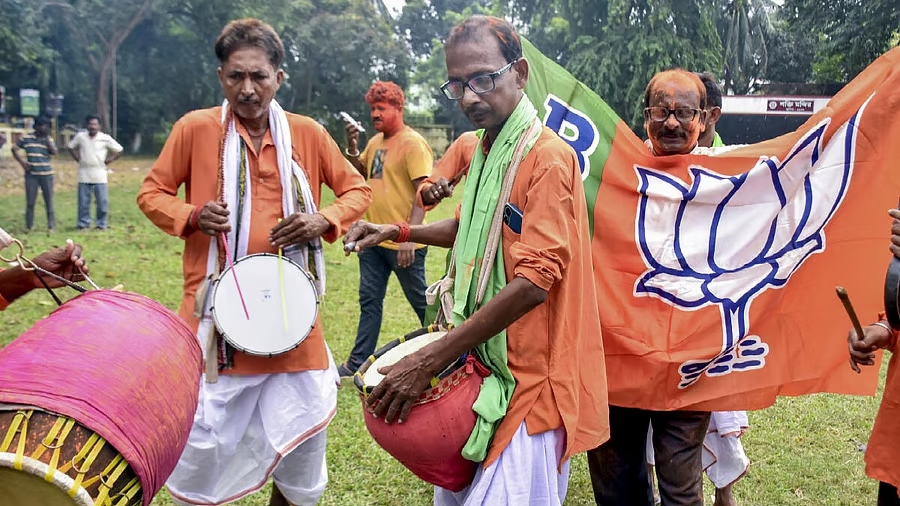


Kolkata: The Bharatiya Janata Party (BJP) on Friday won both the Nandigram and Rejinagar Assembly by-elections in West Bengal, defeating its nearest rivals by 1,22,753 votes and 75,816 votes, respectively.
In Nandigram, BJP candidate Hasirani Rath defeated Congress nominee Milan Pradhan by a record margin. Rath, the mother of slain personal assistant to Chief Minister Suvendu Adhikari, Chandranath Rath, secured 1,64,427 votes against Pradhan’s 41,674, according to the Election Commission’s results.
The BJP also won Rejinagar in Murshidabad district, a constituency where Muslims account for nearly 70 per cent of the electorate. Its candidate, Shankharavh Sarkar, polled 1,29,914 votes, defeating Aam Janata Unnayan Party (AJUP) nominee Golam Nabi Azad, who received 54,098 votes.
The results mark a significant electoral development for the BJP, particularly in Rejinagar, where the Trinamool Congress (TMC), Congress and regional political formations have traditionally competed for support. However, the constituency-wide result does not by itself establish how individual communities voted.
Hasirani Rath wins Nandigram by 1.22 lakh votes
Rath secured 1,64,427 votes in Nandigram, in Purba Medinipur district, while Congress candidate Pradhan finished second with 41,674 votes.
The victory margin of 1,22,753 votes underlined the scale of the BJP’s win in a constituency that has occupied a prominent place in West Bengal politics for more than a decade.
Rath’s candidature also carried a personal and political dimension. She is the mother of Chandranath Rath, who was associated with Adhikari and was killed earlier this year.
The Nandigram by-election was necessitated after Adhikari, who won the constituency in the 2026 Assembly elections, retained Bhabanipur and vacated Nandigram.
The seat has particular political significance because of the anti-land acquisition movement that helped the TMC expand its influence in the region before coming to power in West Bengal in 2011. Nandigram also became a focal point of the state’s political contest in subsequent elections.
The latest result consolidates the BJP’s position in the constituency, with Rath winning by a margin exceeding 1.22 lakh votes.
Rejinagar delivers another major BJP victory
In Rejinagar, BJP candidate Shankharavh Sarkar defeated AJUP nominee Golam Nabi Azad by 75,816 votes.
Sarkar secured 1,29,914 votes, while Azad received 54,098, according to the Election Commission’s figures. The BJP won approximately 63.14 per cent of the votes, compared with 26.29 per cent for the AJUP candidate.
The result attracted attention because Rejinagar is a Muslim-majority constituency in Murshidabad district. Muslims account for nearly 70 per cent of its electorate, and the seat has traditionally seen contests involving the TMC, Congress and regional political parties.
The BJP’s victory therefore places the spotlight on the constituency’s electoral dynamics. However, vote totals for the constituency as a whole cannot establish the voting choices of individual religious communities without more detailed polling data.
The result also came amid a fragmented opposition, with several parties contesting the seat against the BJP and AJUP.
Congress, TMC and Left trail in Rejinagar
The opposition candidates in Rejinagar were unable to match the vote totals secured by Sarkar and Azad.
Congress candidate Abdullahil Kafi received 6,168 votes, finishing ahead of the Mamata All India Trinamool Congress nominee Rabiul Alam Chowdhury, who polled 3,847 votes.
The CPI(M) candidate secured 3,797 votes, while Democratic Trinamool Congress (DTMC) nominee Safiuzzaman Saikh received 2,044 votes.
The distribution of votes among multiple opposition candidates meant that none came close to challenging the BJP’s winning total.
The result also highlighted the electoral challenge facing the Congress, the TMC factions and the Left in a constituency where regional political organisations have sought to build their own support bases.
While the BJP secured a substantial victory, the result alone does not establish why individual voters chose one candidate over another. Local issues, candidate selection, campaign strategies and the presence of multiple contestants are among the factors that can influence constituency-level outcomes.
AJUP founder Humayun Kabir had vacated Rejinagar
The Rejinagar by-election was held after AJUP founder Humayun Kabir vacated the seat.
Kabir, a former TMC leader who later established the AJUP, had won Rejinagar by more than 58,000 votes in the 2026 Assembly elections. He subsequently retained Nowda, necessitating the by-election in Rejinagar.
His son, Golam Nabi Azad, contested the by-election as the AJUP candidate but finished behind Sarkar by 75,816 votes.
The result represents a sharp contrast with the AJUP’s previous victory in the constituency. It also gives the BJP a seat in a region where the political competition has included established parties as well as newer regional formations.
The by-election outcome is likely to prompt further scrutiny of the factors behind the change in the constituency’s result. However, drawing conclusions about long-term voting patterns would require examining the wider electoral record and detailed constituency-level data.
Fragmented opposition faces a setback
The twin victories came as opposition parties failed to mount a competitive challenge to the BJP in either constituency.
In Nandigram, Congress candidate Milan Pradhan received 41,674 votes, while CPI candidate Santi Gopal Giri finished a distant third with 5,779 votes. Candidates from the All India Secular Front, the Democratic Trinamool Congress and other groups also failed to challenge Rath’s winning total.
In Rejinagar, the opposition vote was divided among the AJUP, Congress, TMC, DTMC and CPI(M), with the BJP winning by a margin of more than 75,000 votes.
The results underline the scale of the BJP’s victories in the two seats. They also provide a fresh electoral outcome for the parties to assess as they consider their candidate choices, campaign strategies and local organisation.
What the bypoll results mean for West Bengal
The victories in Nandigram and Rejinagar give the BJP wins in two constituencies with different political histories and electoral profiles.
Nandigram has been central to West Bengal’s political narrative since the land acquisition protests that helped reshape the state’s political landscape. Rejinagar, meanwhile, has attracted attention because of its Muslim-majority electorate and the competition among established parties and regional formations.
The BJP’s margins in both seats were substantial, but the results should be understood in the context of the specific candidates, local contests and circumstances that led to the by-elections.
Rath’s victory follows Adhikari’s decision to retain Bhabanipur after winning Nandigram in the 2026 Assembly elections. Sarkar’s win in Rejinagar follows Kabir’s decision to retain Nowda, leaving the seat vacant.
With the Election Commission declaring both results on Friday, the BJP has secured two significant by-election victories. The scale of the margins, particularly in Rejinagar, is likely to keep attention focused on the state’s changing electoral competition, while further analysis will be needed to establish the reasons behind the results and their implications for future contests.