







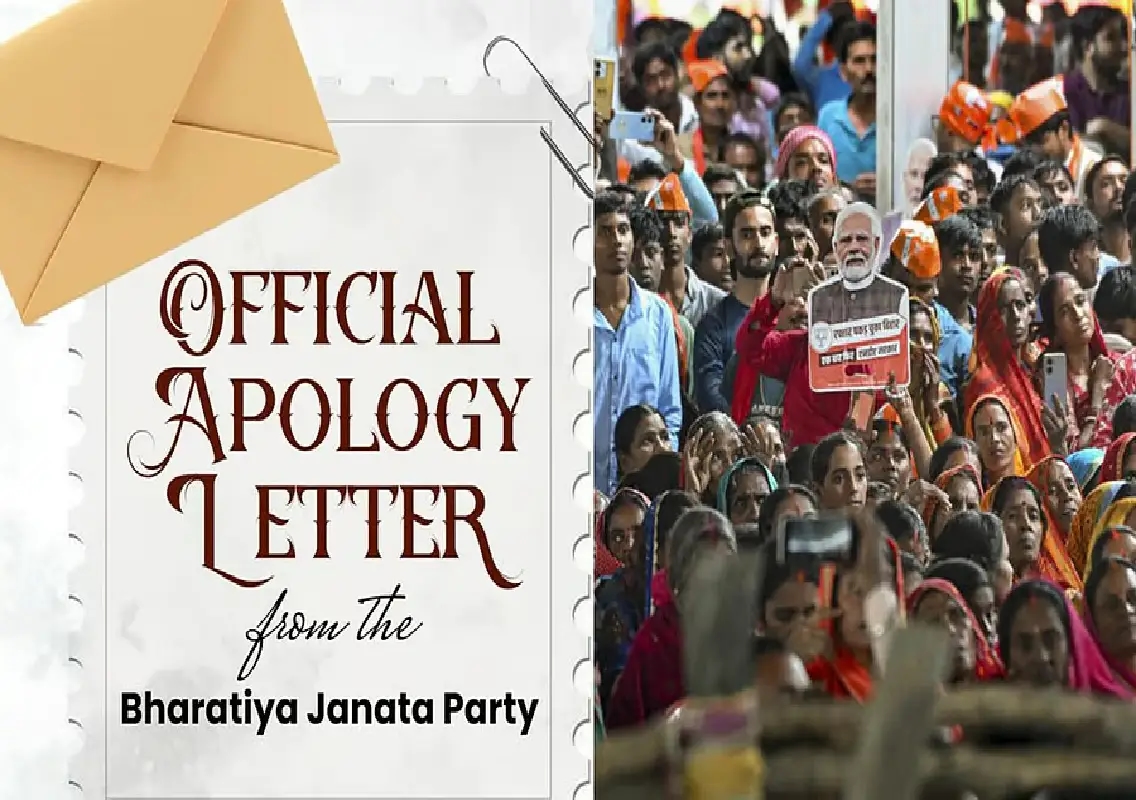


The Bharatiya Janata Party (BJP) has adopted the widely popular ‘apology trend’ — a social-media marketing tactic where brands humourously apologise for being “too good” — to highlight its flagship welfare and development schemes. The trend, which began in the corporate world earlier this year, has now made its way into politics with the ruling party issuing a series of tongue-in-cheek “apologies” on social media platform X.
Over the past few months, brands across sectors have used the format to express mock regret for exceeding expectations. The trend was kicked off by Volkswagen India, which issued a faux “official apology” for making cars that were “too hard to part ways with”. The post went viral, prompting several other major companies — including Skoda, Reliance Digital and Adani Ambuja Cement — to follow suit.
BJP’s political spin on a viral marketing trend
In a multi-post thread, the BJP reinterpreted the trend to spotlight the Union government’s performance over the past decade. Each post carried an “apology” paired with an achievement under a key central scheme.
The thread opened with an apology for delivering clean tap water to more than 15 crore rural families under the Jal Jeevan Mission. “Every household deserved safe water, and we made it happen — not as a dream, but as a right,” the post said.
The BJP then “apologised” for constructing over 4 crore pucca houses under the Pradhan Mantri Awas Yojana (PMAY). The party emphasised that the programme was not just about infrastructure, but about providing dignity, stability and a secure foundation for families across the country.
Highlighting flagship welfare programmes
Another post in the thread focused on the Swachh Bharat Mission, under which 12 crore toilets have been built across India. The BJP stated that the initiative had transformed hygiene practices and restored dignity to millions, especially women in rural areas. The party, continuing the humorous tone, said it was offering “apologies for making sanitation a part of daily life”.
The Saubhagya Yojana — aimed at universal household electrification — also featured prominently. The party said, “Sorry for brightening up 2.6 crore homes,” noting how access to electricity had created new opportunities for study, livelihood and household safety.
The Ujjwala Yojana, which provides subsidised LPG connections, formed the basis of another apology. More than 10.3 crore women have received clean cooking gas under the scheme. The BJP said it apologised “to those who profited from smoky kitchens,” adding that the shift to clean fuel had protected women’s health and improved their daily lives.
Emphasis on connectivity and infrastructure
The series also touched upon the Pradhan Mantri Gram Sadak Yojana (PMGSY), which connected 99% of India’s villages through all-weather roads. The BJP “apologised” for smoother roads and shorter journeys, stressing that improved last-mile connectivity had brought economic opportunities to remote areas.
The modernisation of the Indian Railways was also showcased. “Apologies for the speed of modernisation,” the post read, citing the introduction of Vande Bharat and Amrit Bharat trains that represent a significant upgrade in comfort, speed and reliability.
Remembering Covid-19 welfare measures
The BJP’s final set of apologies revisited the Covid-19 pandemic, during which 81.3 crore Indians received free food grains under the Pradhan Mantri Garib Kalyan Anna Yojana (PMGKAY). The party said it was “sorry for turning Garib Kalyan into action, not just a slogan,” highlighting the government’s efforts to ensure that no one went hungry during the unprecedented crisis.
The thread concluded with an overarching apology “for building a New India that delivers”, stating that governance in the country today is defined by “grit, growth and genuine care”.
Politics meets pop culture in election season
The BJP’s use of the apology trend comes at a time when political parties are increasingly adopting digital-first communication strategies. Social-media-driven narratives, especially those that tap into ongoing pop-culture trends, have become an important tool in political messaging, particularly in the run-up to elections.
Analysts say the BJP’s campaign serves two purposes: it showcases a lighter, more relatable communication style while simultaneously reinforcing the government’s achievements. By aligning with a trend that has already captured public imagination, the party is seeking to make its message more engaging and shareable.
Whether this creative spin will influence voter perceptions remains to be seen, but it has already sparked discussion online and drawn attention to the government’s flagship welfare schemes.