







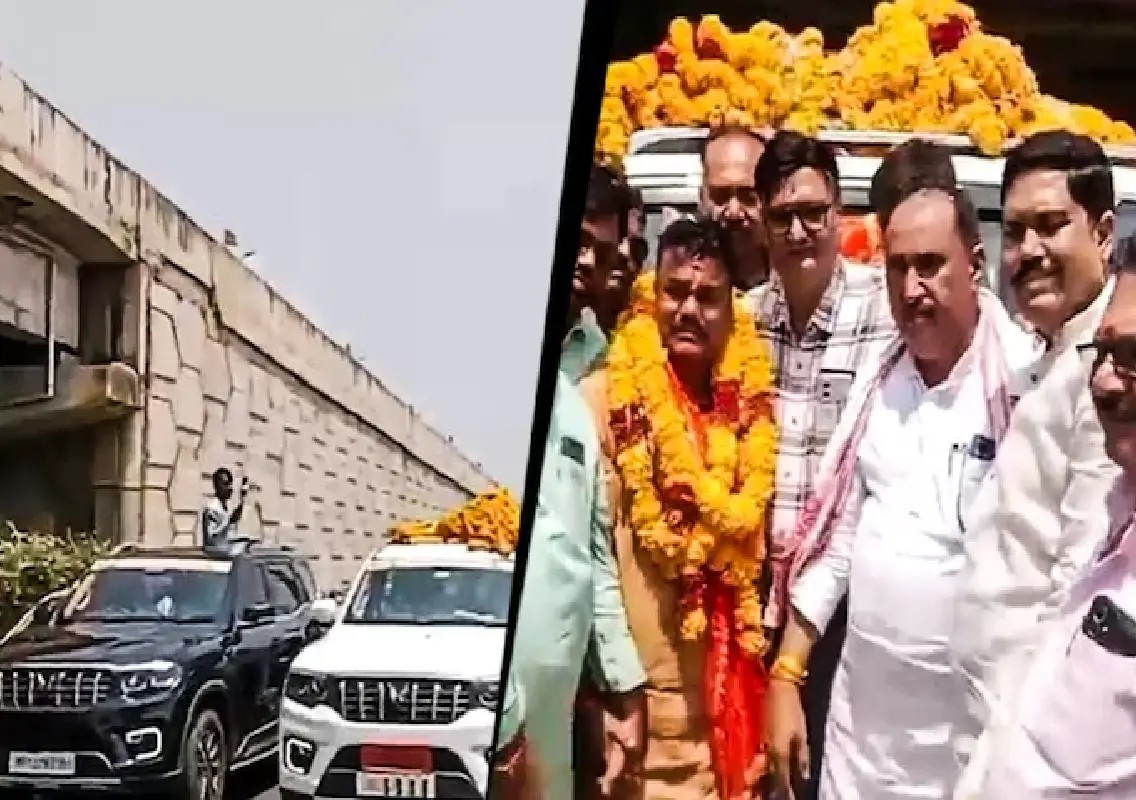


Bhopal: A massive convoy involving nearly 50 vehicles accompanying a BJP leader in Madhya Pradesh has triggered political debate and public criticism after the visuals surfaced just days after Prime Minister Narendra Modi appealed to citizens to reduce fuel consumption amid global tensions linked to the Iran conflict.
The convoy belonged to BJP leader Saubhagya Singh Thakur, who recently took charge as chairman of the Madhya Pradesh Textbook Corporation.
Thakur travelled from Ujjain to Bhopal accompanied by a long procession of SUVs and supporter vehicles as he headed to formally assume office in the state capital.
Videos of the convoy quickly spread across social media platforms, drawing attention due to the timing of the event and the Prime Minister’s recent public appeal for restraint in fuel usage.
Convoy reportedly caused traffic disruption
According to reports, the convoy stretched across a significant section of the highway connecting Ujjain and Bhopal.
Supporters reportedly halted at several locations during the journey to welcome the BJP leader with garlands and celebrations.
These repeated stoppages allegedly disrupted traffic movement at multiple points and caused inconvenience to commuters travelling along the route.
Visuals circulating online showed dozens of vehicles moving together in a coordinated procession, with some users comparing the convoy to a political roadshow.
The incident immediately sparked debate over whether public representatives and political workers were adhering to the Prime Minister’s message on fuel conservation.
PM Modi had urged citizens to reduce fuel use
The controversy gained momentum because it came shortly after Prime Minister Modi publicly appealed to citizens to minimise unnecessary fuel consumption in light of ongoing geopolitical tensions in West Asia and their potential economic impact on India.
Addressing a BJP rally in Telangana on Sunday, Modi urged people to adopt fuel-saving measures such as:
- Using public transport
- Increasing carpooling
- Relying more on metro services
- Choosing electric vehicles where possible
The Prime Minister also encouraged greater use of work-from-home practices, virtual meetings and video conferencing methods similar to those widely adopted during the COVID-19 pandemic.
“The need of the hour is to resume those methods,” Modi had reportedly said while stressing the importance of conserving foreign exchange and reducing economic pressure during uncertain global conditions.
He also advised people to avoid unnecessary foreign travel and discretionary spending while promoting Swadeshi products and natural farming.
Opposition attacks BJP over ‘double standards’
The convoy controversy quickly escalated into a political confrontation between the BJP and Congress.
Congress leader Rahul Gandhi criticised the Prime Minister’s appeal, arguing that asking citizens to make sacrifices reflected governance failures.
In a post on social media platform X, Rahul Gandhi said the government was shifting responsibility for economic challenges onto ordinary citizens.
Opposition leaders and social media users also questioned whether leaders within the ruling party were themselves following the Prime Minister’s appeal for restraint and fuel conservation.
Several Congress supporters accused the BJP of promoting symbolic public messaging while political leaders continued displaying extravagance through large convoys and events.
BJP defends PM’s remarks
The BJP strongly defended the Prime Minister’s appeal and rejected criticism from opposition parties.
BJP national spokesperson Sudhanshu Trivedi said India imports nearly 85 per cent of its energy requirements and therefore responsible energy usage was necessary to protect the economy from global shocks.
He argued that the government’s advisory was similar to precautionary measures issued during natural disasters and international crises.
BJP IT cell chief Amit Malviya also defended Modi’s remarks, saying the Prime Minister had only urged citizens to make “conscious choices in the national interest.”
According to BJP leaders, the appeal focused on encouraging self-reliance, energy conservation and economic discipline during uncertain global conditions.
Debate over political optics intensifies
Political observers noted that the convoy incident has once again highlighted the role of optics in modern political communication.
While supporters defended the convoy as a spontaneous celebration organised by party workers, critics argued that public representatives must set an example when national appeals for restraint are being made.
The controversy also sparked wider discussions on political culture, VIP convoys and public expenditure at a time when governments are encouraging citizens to adopt austerity measures.
Social media platforms witnessed a flood of reactions, with users sharing videos and memes related to the convoy and comparing it with the Prime Minister’s recent speeches on fuel conservation.
Focus shifts to public accountability
Analysts said the incident reflects the increasing public scrutiny faced by political leaders in the era of viral videos and instant social media reactions.
Even symbolic actions by public figures are now quickly compared against official messaging and government campaigns.
The convoy controversy is expected to remain part of the ongoing political debate surrounding economic challenges, fuel prices and energy security in India.
As global tensions continue affecting crude oil markets, the issue of fuel conservation and public accountability is likely to remain politically sensitive in the coming weeks.