


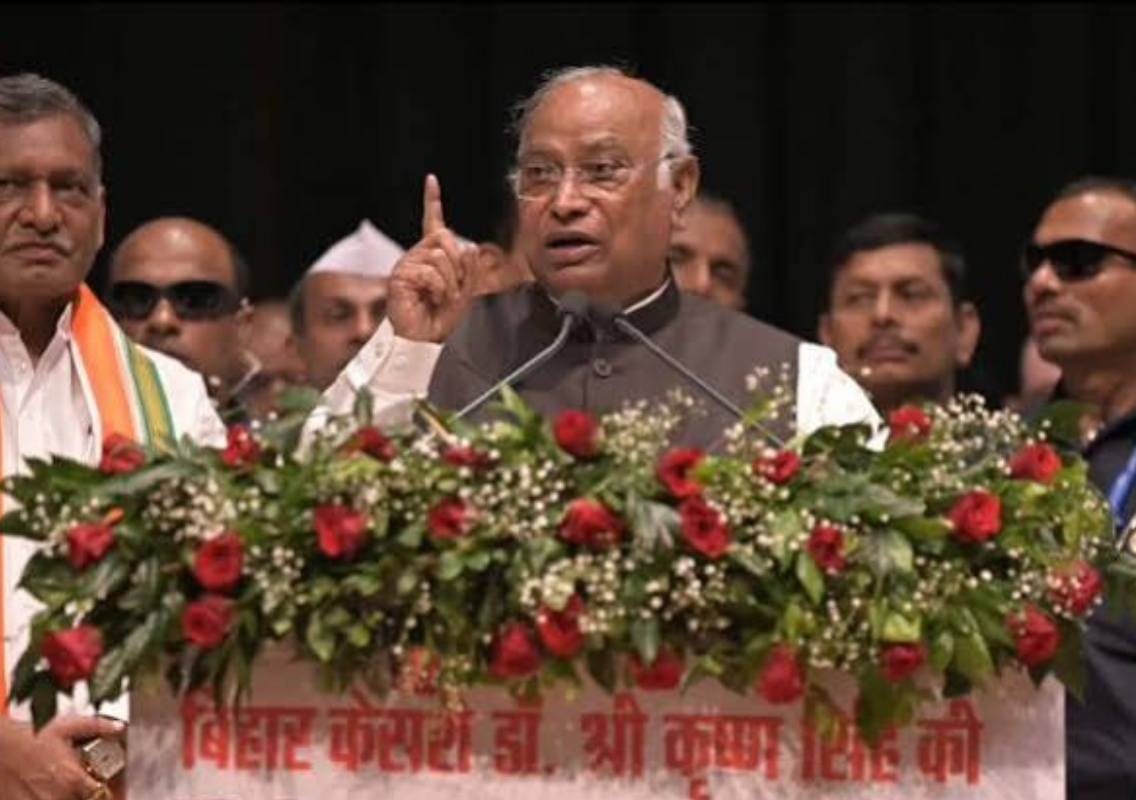


New Delhi: The Bharatiya Janata Party (BJP) on Sunday criticised Congress president Mallikarjun Kharge for describing Diwali as “Khushiyon Ka Eid”, accusing the opposition party of appeasement politics. The BJP also linked his festive greeting to former Congress president Sonia Gandhi‘s recent remarks about the demolition of the Babri Masjid in 1992, bringing two separate comments into a fresh political controversy.
Kharge made the remark while speaking to reporters on the occasion of Diwali. The BJP objected to his description of the festival and alleged that the Congress was attempting to appeal to particular voter groups even during a Hindu festival.
BJP spokesperson Pradeep Bhandari described the Congress president’s words as evidence of what he called the party’s appeasement politics. He also used the occasion to criticise the Congress over Gandhi’s comments on the Babri Masjid demolition.
The exchange has once again brought questions of religious identity, secularism and political messaging into the public debate.
BJP accuses Congress of appeasement politics
Reacting to Kharge’s Diwali remark, Bhandari took to social media platform X and accused the Congress of prioritising vote-bank politics.
“Congress President calls Diwali ‘Khushiyon Ka Eid’! Even on Diwali, Congress thinks of appeasement & vote bank! Yesterday Sonia Gandhi cried for Babri, today Mr Kharge appeases in his Diwali message! Congress is Anti-Sanatan!” Bhandari wrote.
The BJP spokesperson’s post connected Kharge’s greeting with Gandhi’s recollection of the Babri Masjid demolition, portraying the two statements as part of what the party alleges is the Congress’s approach towards religious communities.
The phrase “anti-Sanatan” was used by Bhandari as a political criticism of the Congress. It represents the BJP spokesperson’s characterisation and not an established description of the party’s position.
Kharge’s comment and the BJP’s response have highlighted how greetings and public statements during religious festivals can become subjects of political debate. While the Congress president’s words were made in the context of Diwali, the BJP interpreted them as an attempt at political appeasement.
Sonia Gandhi’s remarks on Babri Masjid demolition
The BJP also referred to comments made by Sonia Gandhi in an interview with British newspaper The Guardian. The interview was published ahead of the release of her memoir, Belonging: A Journey of Love.
Gandhi recalled the events of December 6, 1992, when the Babri Masjid in Ayodhya was demolished. She said she cried after watching the incident unfold on television.
She also reflected on the implications of the demolition for India’s secular foundations, saying that the country faced a long struggle to preserve its secular character.
In the interview, Gandhi acknowledged that the Congress had been complacent in several ways and that this had partly contributed to the rise of the BJP and its Hindutva politics.
Her recollections prompted criticism from BJP leaders, who questioned the Congress’s position and accused the party of showing sympathy towards the Mughal ruler Babur.
The remarks have become part of a wider political exchange over the historical event and the competing interpretations of its significance for Indian politics.
Sudhanshu Trivedi questions Congress’s position
Rajya Sabha MP and BJP spokesperson Sudhanshu Trivedi also criticised Gandhi’s comments.
Speaking to reporters in Delhi, Trivedi alleged that the Congress continued to harbour sympathy towards Babur.
“This shows that Babar was in the heart of the Congress party back then, and he remains in its heart even today,” Trivedi said.
His statement was part of the BJP’s response to Gandhi’s recollection of the demolition and her comments about the Congress’s political approach.
The BJP’s criticism has focused on Gandhi’s emotional response to the demolition and her assessment of the consequences for India’s secular foundations. The Congress’s acknowledgement of past political complacency, meanwhile, formed another part of the interview.
Diwali greeting becomes part of a wider political exchange
The latest controversy brings Kharge’s Diwali greeting and Gandhi’s comments on the Babri Masjid demolition into the same political debate, although the statements were made in different contexts.
Kharge’s description of Diwali as “Khushiyon Ka Eid” prompted the BJP to accuse the Congress of appeasement. Bhandari then drew a connection with Gandhi’s interview, using it to reinforce the party’s criticism.
The exchange reflects continuing political disagreements between the BJP and the Congress over religion, secularism and the interpretation of historical events.
For now, the BJP’s response has placed the Congress leadership’s festival messaging and Gandhi’s comments on the 1992 demolition at the centre of a fresh political confrontation. The competing statements underline how religious and historical references continue to feature prominently in the public debate between the two parties.