







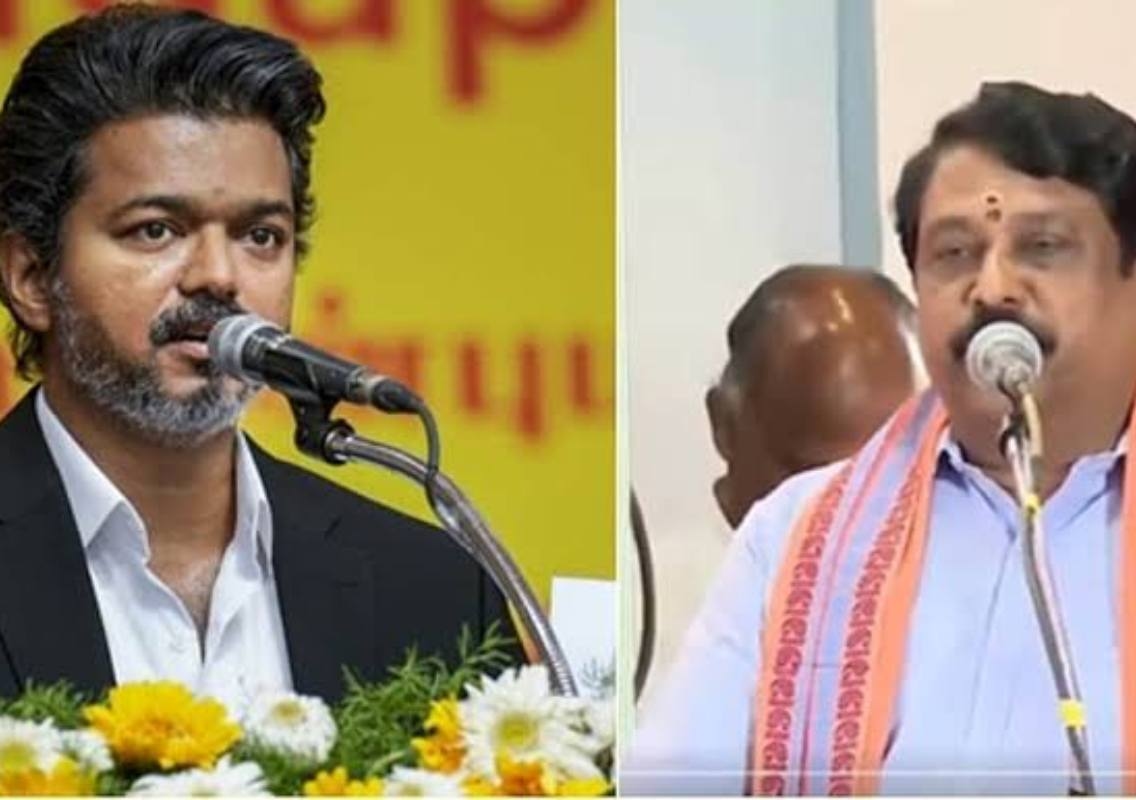


Madurai: Tamil Nadu BJP president Nainar Nagendran on Tuesday intensified the political confrontation over the Karthigai Deepam lighting ritual at Tirupparankundram, targeting Chief Minister C Joseph Vijay and invoking his religious identity amid the dispute over implementing a Supreme Court order.
Nagendran warned that if the traditional lamp was not lit at the Deepathoon atop Tirupparankundram hill despite the Supreme Court’s permission, he would view Vijay as acting in his capacity as a Christian. He also accused the Chief Minister of potentially defying the judiciary if the state administration failed to implement the court’s directive.
The BJP leader announced that he would visit Tirupparankundram on Tuesday afternoon to see whether the lamp was lit, insisting that his visit was intended to ensure compliance with the Supreme Court’s decision.
Nagendran invokes Vijay’s religion over lamp lighting
Speaking about the controversy, Nagendran said the BJP wanted the traditional lamp to be lit at Deepathoon and argued that the Supreme Court’s directive should be implemented.
“We want to light the lamp at Tirupparankundram. I will see him as a Christian if he does not allow us to light the lamp. This is a Supreme Court order. Not allowing the lamp to be lit would amount to disrespecting the Supreme Court’s order. There is no need for all this panic,” he said.
The BJP state president further criticised Vijay, saying that refusing to implement the court’s decision would raise questions about the Chief Minister’s approach to governance and the judicial system.
“If the Chief Minister of Tamil Nadu does not light the lamp today and says he has refused to do so despite the Supreme Court’s order, he can only be seen as someone acting entirely in his capacity as a Christian,” Nagendran added.
He also claimed that such a refusal could make Vijay the first Chief Minister to openly defy a Supreme Court order.
“More importantly, if he refuses to light the lamp despite the Supreme Court’s verdict, he would be the first Chief Minister to openly defy a Supreme Court order. This would either make him a Chief Minister who disrespects the Supreme Court’s ruling or one who does not understand how the administration functions. That is our view,” he said.
Nagendran confirmed that he would travel to Tirupparankundram in the afternoon, reiterating that the visit was linked to the implementation of the court’s verdict.
Supreme Court permits one-time lighting of Karthigai Deepam
The controversy centres on the traditional lighting of the Karthigai Deepam lamp at Deepathoon, a stone pillar located atop Tirupparankundram hill in Madurai. The site is near a mosque and a dargah, and the location of the ritual has been a subject of dispute.
Hindu devotees have sought permission to light the traditional lamp at the hilltop pillar, while the Tamil Nadu government has opposed the move, leading to a legal and political confrontation.
The Supreme Court recently permitted the lamp to be lit at Deepathoon on November 24 as a one-time measure for this year, subject to safeguards. The decision came while the underlying dispute remains under consideration. The Indian Express
The interim order has become the focal point of the political debate, with the BJP insisting that the state government must comply with the court’s directive and the government challenging the decision through legal proceedings.
Tamil Nadu government seeks review of Supreme Court order
Following the Supreme Court’s permission, the Tamil Nadu government moved to seek a review of the decision.
The commissioner of the state’s Hindu Religious and Charitable Endowments (HR&CE) Department filed a review petition in the Supreme Court on Saturday, a day after the top court allowed the one-time ritual.
The review petition has further intensified the dispute, with BJP leaders accusing the Vijay-led administration of attempting to prevent the implementation of the judicial directive.
However, the state government’s opposition and its decision to seek a review have not, by themselves, settled the question of whether the ritual would be permitted at the location on Tuesday.
The government has yet to publicly clarify whether the lamp will be lit at Deepathoon in accordance with the Supreme Court’s interim order.
BJP leaders step up criticism of state government
The controversy has also drawn criticism from other BJP leaders, who have accused the Tamil Nadu government of restricting Hindu religious practices.
BJP national general secretary (organisation) BL Santhosh said Hindus in Tamil Nadu were being forced to fight for the right to practise their religious traditions.
“Hindus have to fight for every ritual, festival, procession in Tamil Nadu,” he said in a post on X.
BJP spokesperson Sudhanshu Trivedi also criticised the state government, accusing it of being unwilling to implement the Supreme Court’s decision.
“It is very unfortunate that the INDI Alliance government of Tamil Nadu is hell-bent on not implementing the Supreme Court’s judgment,” Trivedi told reporters.
The BJP has maintained that the court’s permission for the one-time lighting of the lamp should be implemented without delay, while the state’s review petition has added another dimension to the legal dispute.
Deepathoon dispute becomes political flashpoint
The Deepathoon controversy has emerged as a politically sensitive issue in Tamil Nadu, with religious traditions, judicial directions and the state’s administrative position becoming intertwined.
The dispute involves the location of the Karthigai Deepam ritual, the interpretation and implementation of the Supreme Court’s interim decision, and the government’s attempt to seek a review.
The BJP has used the controversy to criticise the state administration and question Vijay’s position, while the legal proceedings remain ongoing.
With the Supreme Court’s one-time permission tied to November 24 and the government’s review petition pending, the issue has drawn attention to the balance between judicial directions, administrative decisions and religious practices in the state.