







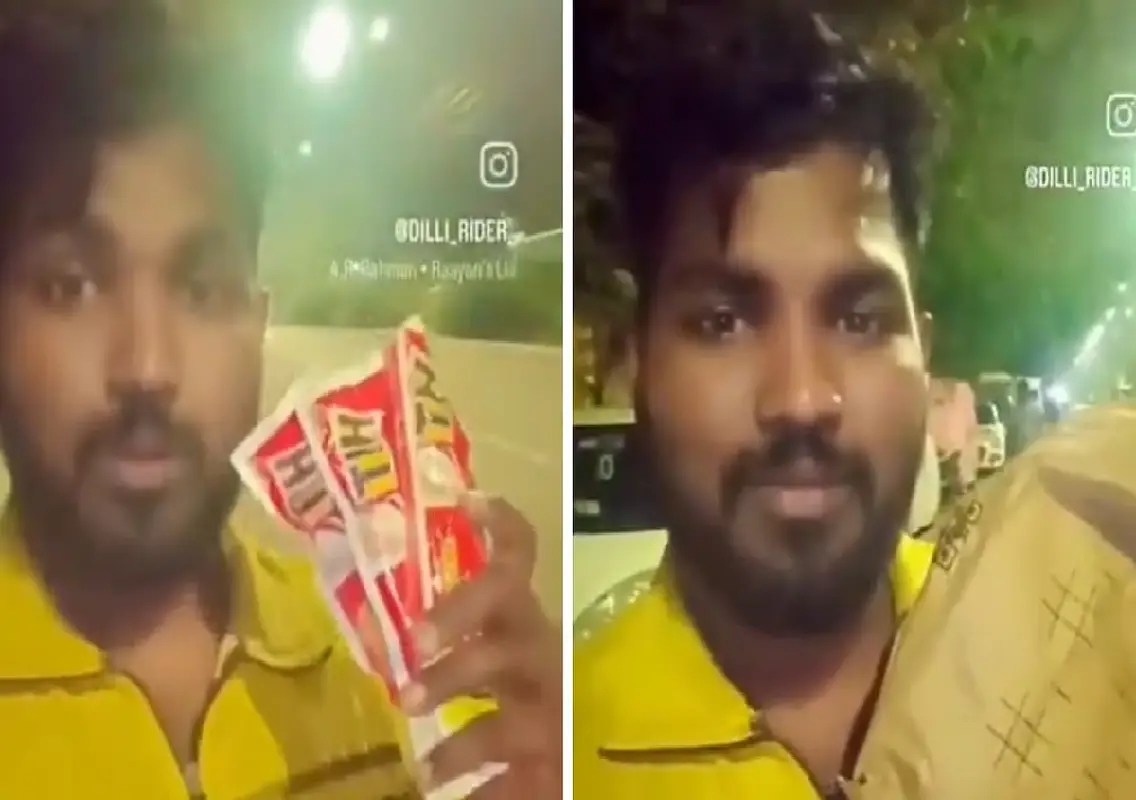


Chennai: In an incident that has drawn widespread praise on social media, a Blinkit delivery agent in Tamil Nadu is believed to have averted a possible suicide by refusing to deliver rat poison to a distressed woman and persuading her to cancel the order. The humane intervention, captured in a video later shared online by the delivery agent himself, has gone viral for highlighting empathy and presence of mind beyond routine professional duty.
The incident reportedly occurred late at night when the delivery agent was assigned an order for three packets of rat poison. Even before reaching the customer’s location, he sensed that something was amiss during a phone conversation with the woman. According to his account, she was crying while speaking to him, which immediately raised concern.
Delivery agent senses distress
In the video, the delivery agent explains that the woman’s emotional state during the call made him uneasy. He said her voice and tone suggested distress rather than a routine purchase, prompting him to be cautious.
“I could sense that something was wrong even before I reached her house,” the agent said in the video. He added that the timing of the order — close to midnight — further contributed to his suspicion.
When he arrived at the location, he found the woman visibly upset and crying, reinforcing his fear that the rat poison might be intended for self-harm rather than pest control.
Refusal to hand over rat poison
Upon meeting the woman, the delivery agent made the decision to refuse delivery of the rat poison. He questioned her directly about the purpose of the order and urged her not to take any extreme step.
“No matter what problem you have, please don’t commit suicide,” he is heard saying in the video. He recounted asking her plainly whether the rat poison was ordered with the intention of ending her life. Although the woman denied it, the agent said he was not convinced.
He pointed out that if the poison was genuinely needed to deal with rats, it could have been ordered earlier in the evening or even the next day. “Why order it at midnight?” he asked her, urging her to be honest and to think about her own safety.
Convincing the woman to cancel the order
The delivery agent said he continued speaking to the woman calmly and firmly, emphasising that no problem was big enough to justify taking one’s life. After a brief but intense conversation, he succeeded in convincing her to cancel the order herself.
Only after ensuring that the order was cancelled did the agent leave the location. In the video, he reflects emotionally on the incident, saying, “Today, I feel like I really accomplished something big in my life.”
While there has been no official confirmation from authorities regarding the woman’s condition or subsequent events, the agent’s actions have been widely interpreted as a potentially life-saving intervention.
Viral video and public reaction
The video shared by the delivery agent quickly went viral across social media platforms, drawing thousands of views, likes, and comments. Netizens across the country praised his courage, empathy, and willingness to prioritise humanity over protocol.
One user commented, “That’s nice, good presence of mind.” Another wrote, “Not all heroes wear capes.” A third user described him as “a guardian angel in a green jacket,” adding that the incident showed how humanity can prevail even in high-pressure, app-driven work environments.
Many users also applauded Blinkit delivery personnel in general, noting that delivery agents often work under strict timelines and performance metrics, making such compassionate actions even more commendable.
Broader conversation on mental health
The incident has also sparked a broader discussion on mental health awareness and the importance of recognising signs of distress. Mental health professionals have often emphasised that timely intervention — even a simple conversation — can play a critical role in preventing self-harm.
Experts point out that easy access to harmful substances, combined with emotional distress and isolation, can increase the risk of suicide. In such situations, empathy from strangers or acquaintances can sometimes provide a crucial pause, allowing the person to reconsider and seek help.
While the delivery agent acted on instinct and compassion, mental health advocates stress the need for systemic solutions, including better access to counselling services, suicide prevention helplines, and public awareness campaigns.
Role of companies and platforms
The incident has also raised questions about the role of e-commerce and quick-commerce platforms in handling sensitive items such as poison, medicines, and chemicals. Some social media users suggested that delivery platforms should consider introducing guidelines or training modules to help delivery agents identify and respond to potentially dangerous situations.
Others cautioned that such responsibilities should not be placed solely on delivery workers, who are not trained mental health professionals. However, many agreed that basic sensitisation and emergency escalation mechanisms could help in exceptional cases.
Conclusion
The Blinkit delivery agent’s decision to refuse delivery and engage with a distressed customer has been widely hailed as an act of compassion that may have saved a life. At a time when interactions are increasingly transactional and automated, the incident stands out as a reminder of the power of human connection and empathy.
While the full outcome of the situation remains unknown, the episode has resonated deeply with the public, reinforcing the idea that alertness and kindness — even in ordinary roles — can make an extraordinary difference.