







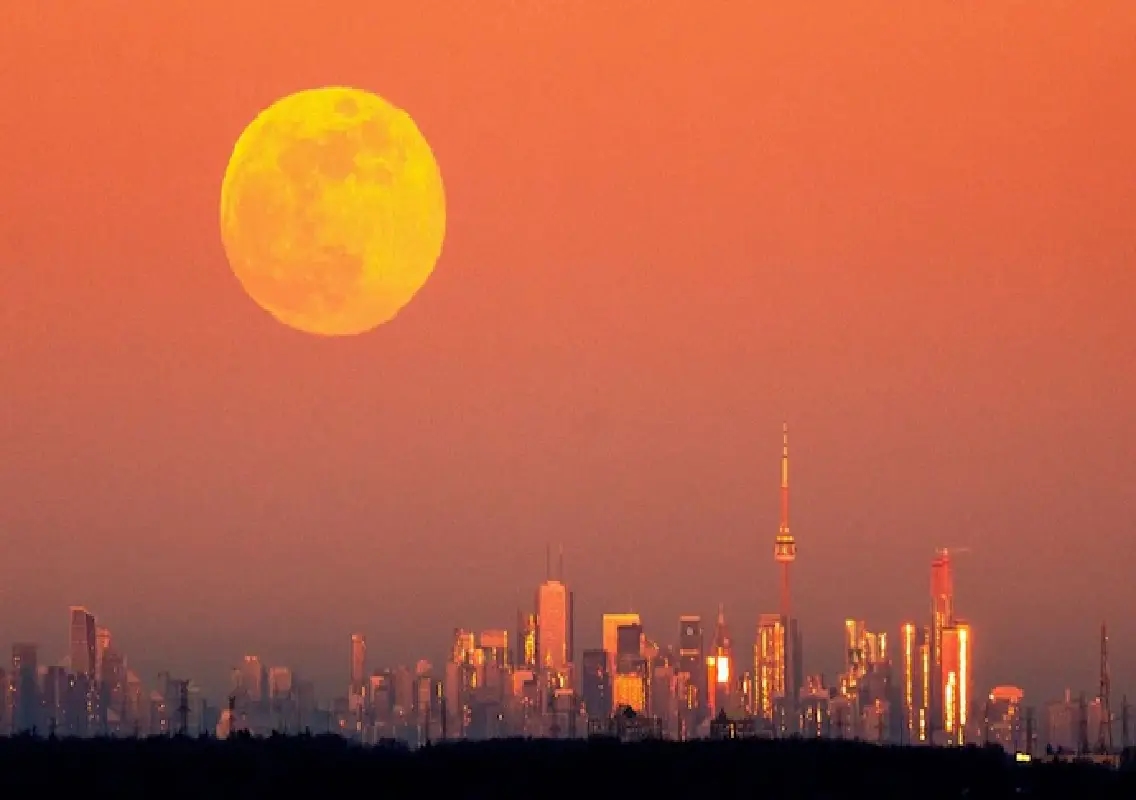


New Delhi: The night sky is set to host a spectacular celestial event on March 3 as the first total lunar eclipse of 2026 unfolds. Popularly known as a “Blood Moon”, the phenomenon will see the Moon take on a deep reddish hue as it passes through Earth’s shadow.
While skywatchers across multiple continents will enjoy a full view of the eclipse, India will witness the concluding stages of the event shortly after moonrise, depending on local weather conditions.
What is a total lunar eclipse?
A total lunar eclipse occurs when the Earth passes directly between the Sun and the Moon, causing the Moon to move into the darkest part of Earth’s shadow, known as the umbra. During this alignment, direct sunlight is blocked from reaching the lunar surface.
However, the Moon does not disappear from view. Instead, it turns a rusty red colour. This happens because Earth’s atmosphere bends and scatters sunlight. Shorter blue wavelengths are filtered out, while longer red wavelengths pass through and illuminate the Moon’s surface — creating the dramatic “Blood Moon” effect.
Unlike a solar eclipse, a lunar eclipse is completely safe to watch with the naked eye. No special filters or protective glasses are required.
Timing in India: A race against the clock
For viewers in India, the eclipse will already be underway when the Moon rises. According to astronomical calculations, the partial phase of the eclipse will begin at 3:20 PM IST, and totality — the period when the Moon is fully within Earth’s umbra — will start at 4:34 PM IST.
However, most Indian cities will see the Moon only after sunset. In New Delhi, moonrise is expected at approximately 6:22 PM IST, while in Mumbai it will be around 6:40 PM IST. Since the eclipse is scheduled to end at 6:47 PM IST, viewers in these cities will have only a brief window — roughly seven to 25 minutes — to glimpse the crimson glow before the Moon gradually returns to its usual brightness.
Skywatchers are advised to look towards the eastern horizon at dusk and find an unobstructed vantage point for the best possible view.
Best Indian cities for viewing
Eastern and north-eastern regions of India will have comparatively better visibility. Because the Moon rises earlier in the eastern part of the country, cities such as Itanagar, Guwahati and Siliguri are expected to witness a longer portion of the eclipse.
Kolkata is also likely to have improved visibility compared to cities in western India, given its geographical position. Local weather conditions, including cloud cover, will ultimately determine how clearly the eclipse can be seen.
Astronomy enthusiasts and amateur skywatchers across India are expected to gather at parks, terraces and open grounds to observe the event.
Global cities with prime views
While India will witness only the final phase, several parts of the world will enjoy the entire eclipse from start to finish.
In the United States, cities such as Los Angeles and San Francisco will see the complete eclipse in the early morning hours. New York and Washington DC will observe the Moon setting while still in totality.
Across Asia-Pacific, Tokyo and Seoul will have an excellent evening view, with totality occurring between 8:04 PM and 9:02 PM local time. Cities such as Sydney and Auckland are also well positioned for a late-night spectacle.
The eclipse will be visible across North and South America, Europe, Africa and East Asia, making it a truly global event.
A celestial reminder
Lunar eclipses typically occur about 14 days before or after a solar eclipse, as part of the same eclipse season. Such astronomical alignments serve as reminders of the intricate celestial mechanics governing the Earth-Moon-Sun system.
Astronomers emphasise that eclipses are predictable natural events rooted in orbital dynamics and should not be associated with myths or superstitions.
For millions of skywatchers, the March 3 Blood Moon will be an opportunity to pause and witness a rare natural spectacle. Even if India catches only the tail end, the sight of a crimson Moon rising over the eastern horizon promises to be a memorable experience.