







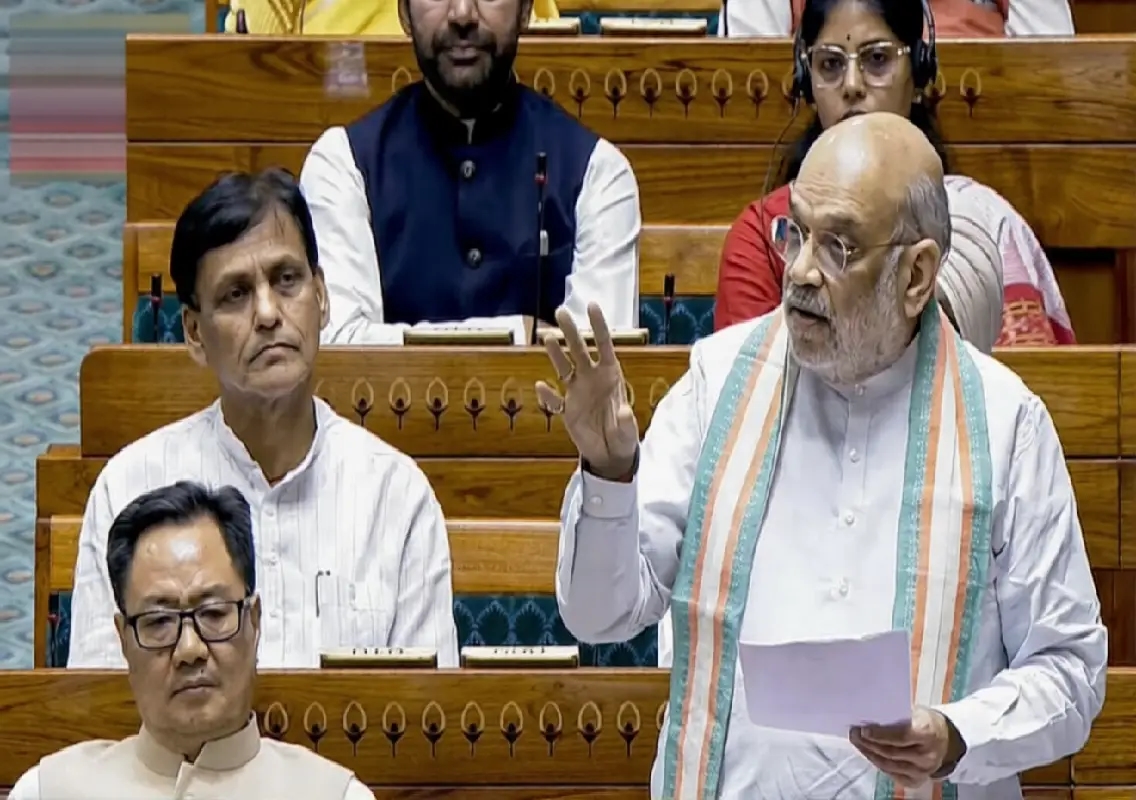


New Delhi: The Union government on Wednesday deferred discussion on the contentious Foreign Contribution (Regulation) Amendment Bill, 2026, which was introduced in the Lok Sabha on March 25, amid mounting opposition and political sensitivities ahead of the Kerala Assembly elections.
The proposed legislation seeks to amend the existing framework governing foreign funding under the Foreign Contribution (Regulation) Act, 2010, with the stated aim of strengthening oversight and ensuring that such funds do not adversely impact national interest, public order, or national security.
However, the Bill has triggered sharp reactions from Opposition parties and civil society groups, particularly in Kerala, where it has become a key political issue ahead of polling on April 9.
Government cites legislative priorities
Although the Bill was listed for consideration in the Lok Sabha agenda on Wednesday, it was not taken up for discussion. Parliamentary Affairs Minister Kiren Rijiju clarified that the deferment was due to legislative priorities rather than political considerations.
The move comes at a time when concerns are being raised over the potential impact of the proposed amendments on non-governmental organisations (NGOs), religious institutions, and charitable bodies that rely on foreign contributions.
Understanding the FCRA framework
The FCRA was first enacted in 1976 during the Emergency period amid concerns over foreign interference in India’s internal affairs. It was later comprehensively revised in 2010 to regulate the acceptance and utilisation of foreign contributions by individuals, associations, and NGOs.
Under the current law, organisations must register or seek prior permission to receive foreign funds, which are permitted for cultural, economic, educational, social, and religious purposes. The Act has been amended multiple times, including significant tightening of norms in 2020 to enhance scrutiny over foreign funding.
According to official data, nearly 16,000 associations are currently registered under the Act, collectively receiving around ₹22,000 crore annually.
Key provisions in the 2026 amendment
The most significant proposal in the 2026 amendment is the creation of a “designated authority” to be appointed by the Union government. This authority would take control of foreign funds and assets of organisations whose FCRA registration is cancelled, surrendered, or lapses.
The amendment outlines several scenarios under which such control would be exercised, including failure to renew registration, denial of renewal, or expiry without application. In such cases, the designated authority would manage and supervise the assets.
The Bill also provides that unutilised funds may be returned if an organisation successfully renews or obtains fresh registration. However, in cases where the entity becomes defunct or fails to regain registration within a prescribed timeframe, the authority may permanently transfer or dispose of assets. These assets could be reassigned to government bodies or sold through prescribed processes.
A specific provision also addresses places of worship, stating that their religious character must be preserved even if management is transferred.
Opposition raises concerns
The proposed changes have drawn strong criticism from Opposition leaders and minority groups. Kerala Chief Minister Pinarayi Vijayan has expressed concern that the provisions could create uncertainty for religious and charitable institutions.
Congress leader Rahul Gandhi has argued that the Bill could leave community welfare organisations vulnerable to government control. Similarly, senior Congress leader K C Venugopal likened the proposal to other controversial legislative measures, suggesting it could centralise authority excessively.
The Catholic Bishops’ Conference of India has also warned that the amendments may threaten the functioning of minority-run institutions dependent on foreign contributions for social and educational activities.
Government defends intent
The Union government has maintained that the amendment is intended to address operational and legal gaps in the current system. Officials have pointed to issues such as lack of clarity in asset management, inconsistent penalties, and absence of clear timelines for utilisation of funds.
While introducing the Bill, Minister of State Nityanand Rai stated that the proposed law would act against entities misusing foreign funds for unlawful activities, including forced religious conversions.
Kerala elections add political context
The controversy has gained particular traction in Kerala, where the Assembly elections are scheduled for April 9. With Christians forming a significant portion of the state’s population—over 61 lakh as per the 2011 Census—the issue has become politically sensitive.
The BJP has also sought to address concerns, with state leaders indicating that the Bill should be discussed and clarified before being passed to avoid misunderstandings among affected communities.
Conclusion
The deferment of the FCRA Amendment Bill, 2026 highlights the complexities surrounding regulation of foreign funding in India. While the government argues that the changes are necessary to plug loopholes and safeguard national interests, Opposition parties and civil society groups remain wary of potential overreach.
With the Kerala elections approaching, the future course of the Bill is likely to be shaped not only by legislative debate but also by political considerations and public perception.