









Ahmedabad: India’s Chandrayaan-2 mission may have made one of the most important discoveries in the global search for lunar water after scientists identified strong evidence of subsurface water ice hidden beneath ultra-cold craters near the Moon’s south pole.
The findings, published in the journal npj Space Exploration, are based on radar observations collected by Chandrayaan-2’s orbiter and analysed by researchers from the Physical Research Laboratory (PRL).
Scientists believe the discovery could play a major role in shaping future human missions and long-term lunar exploration plans.
Study focused on Moon’s south pole
The research team included scientists Rishitosh Sinha, Rajiv Bharti, Kinsuk Acharyya, Sanjay Mishra, Neeraj Srivastava and Anil Bhardwaj from the Physical Research Laboratory.
The team analysed data gathered using Chandrayaan-2’s Dual Frequency Synthetic Aperture Radar (DFSAR), a sophisticated instrument capable of probing a few metres below the lunar surface.
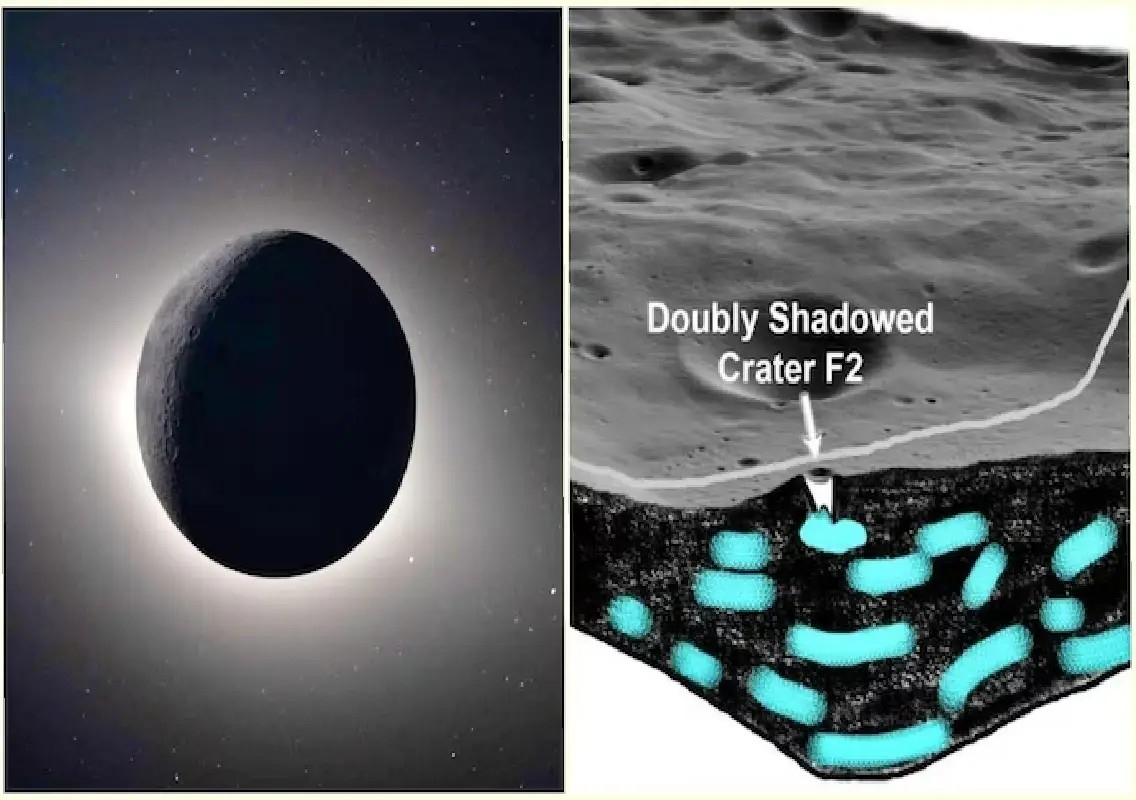
The study specifically examined nine “doubly shadowed craters” situated inside larger permanently shadowed craters near the Moon’s south pole.
Unlike ordinary craters, these regions remain in near-total darkness for billions of years because their steep walls block sunlight as well as reflected heat and radiation.
Scientists say these conditions create some of the coldest known environments in the Solar System.
Temperatures drop below minus 248°C
According to researchers, temperatures inside these craters can plunge to nearly minus 248 degrees Celsius.
Such extreme cold is believed to allow water ice delivered through comets, asteroids or ancient volcanic activity to remain preserved beneath the lunar surface for billions of years.
The ultra-cold environment effectively acts as a natural freezer, preventing the ice from evaporating into space.
Researchers have long suspected the presence of water ice in permanently shadowed lunar regions, but distinguishing ice deposits from rocky terrain has remained a major scientific challenge.
Four craters showed strong ice signatures
The study found that four of the nine craters analysed displayed radar signatures strongly consistent with underground water ice deposits.
The strongest evidence reportedly came from a crater named F2 located inside the larger Faustini crater near the lunar south pole.
According to the researchers, the crater exhibited unusually high circular polarisation ratio (CPR) values combined with low depolarisation signals.
Scientists explained that these radar characteristics are generally associated with radar waves interacting with buried icy material rather than rough rock surfaces.
New method may help identify lunar ice
One of the major contributions of the study is the development of a refined approach to distinguish subsurface water ice from rocky terrain using radar data.
The researchers concluded that the combination of high CPR values and a very low degree of polarisation can serve as a reliable indicator of buried lunar ice.
The finding is considered important because scientists have debated for years whether radar reflections observed near the Moon’s poles were caused by ice deposits or by rough geological formations.
The new analysis strengthens the case for the presence of genuine subsurface ice reserves in some lunar craters.
Discovery crucial for future Moon missions
Water on the Moon is regarded as one of the most valuable resources for future space exploration.
Scientists believe lunar ice could potentially be converted into:
- Drinking water for astronauts
- Oxygen for breathing
- Hydrogen-based rocket fuel for deep-space missions
The discovery could therefore become highly significant for future lunar bases and long-duration human missions.
Global race intensifies around lunar south pole
The Moon’s south pole has become the focus of growing international interest as multiple space agencies plan future missions to the region.
Countries including India, the United States and China are actively exploring the possibility of establishing a long-term presence near the lunar south pole due to its potential ice reserves.
NASA, China’s lunar programme and India’s future missions are all expected to prioritise this region in coming years.
Scientists noted that the newly discovered ice deposits appear unevenly distributed, indicating that some craters may contain significantly larger reserves than others.
Researchers say this insight could influence future astronaut landing locations and mission planning strategies on the Moon.
The findings from Chandrayaan-2 now provide some of the strongest evidence yet that ancient water ice may be hidden beneath the Moon’s frozen southern craters.