







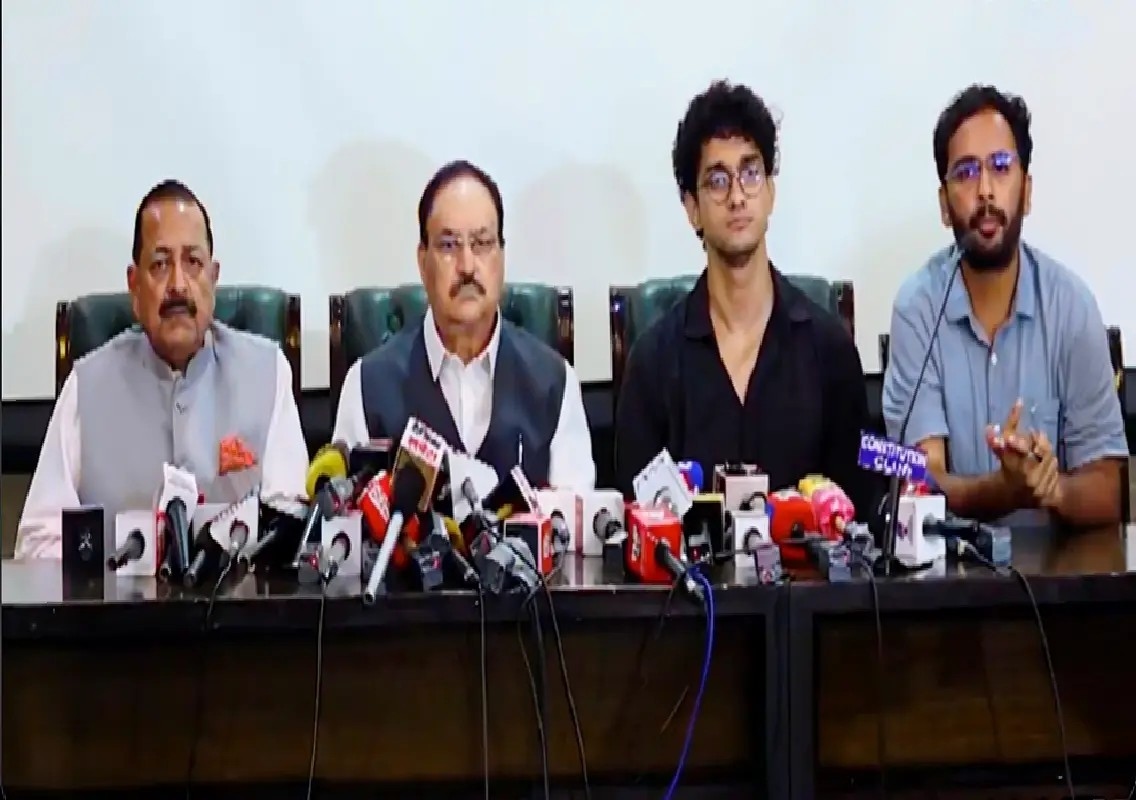


New Delhi: The Cockroach Janata Party (CJP) on Saturday withdrew its 36-day protest at Delhi’s Jantar Mantar after the Union government agreed to its key demands following multiple rounds of negotiations over alleged irregularities in the education system, including the NEET paper leak controversy.
The decision was announced during a joint press conference attended by Union Ministers J.P. Nadda and Jitendra Singh along with members of the CJP delegation. The organisation said it was ending the agitation in good faith after receiving assurances that the agreed measures would be implemented within the stipulated timeframe.
CJP announces end to agitation
Addressing the media, CJP spokesperson Saurav Das said the organisation had decided to withdraw the protest after the Centre accepted all its demands.
He said the party trusted that the commitments made during the discussions would be implemented within the agreed timeline and appealed to protesters gathered at Jantar Mantar to end the agitation peacefully and return home.
Das added that the organisation would announce its future strategy, if required, after monitoring the implementation of the government’s assurances.
Government accepts key demands
Union Minister J.P. Nadda said the Centre had sympathetically considered the demands placed by the CJP delegation and agreed to them.
According to Nadda, the government assured the protesters that no retaliatory police action would be taken against participants in the agitation. He also said copies of all FIRs registered in connection with the protests would be shared with the organisation, and the process of withdrawing the cases would be initiated.
The minister further stated that the government had agreed to provide compensation to the families of students who allegedly died by suicide in connection with the NEET controversy, in accordance with applicable rules and regulations.
He added that the Centre would extend the maximum possible assistance permitted under existing provisions.
Five-point reform charter submitted
During the discussions, the CJP also presented a five-point charter seeking reforms in the country’s education and examination system.
Nadda said the government would study the proposals in detail and hold further discussions with the organisation’s representatives before taking an appropriate decision.
He noted that the Centre was committed to examining the suggested reforms with due seriousness and would consider measures aimed at improving transparency and accountability in the examination process.
Protest followed resignation of education minister
The Centre’s agreement came shortly after Union Education Minister Dharmendra Pradhan resigned amid nationwide protests over the alleged NEET paper leak.
Pradhan said he had stepped down in view of the situation arising from the protests across the country. He noted that the government had responded promptly after allegations of irregularities in the NEET-UG examination surfaced by transferring the investigation to the CBI, cancelling the examination and announcing a re-test.
Despite the resignation, the CJP initially declared that the agitation would continue until its remaining demands were addressed.
Three rounds of talks lead to breakthrough
Following Pradhan’s resignation, CJP founder Abhijeet Dipke reiterated demands for ₹1 crore compensation for the families of students who allegedly died by suicide and sought action over the reported police crackdown on protesters.
Subsequently, three rounds of discussions were held between the CJP delegation and Union government representatives.
After the negotiations, the organisation announced the immediate withdrawal of its 36-day protest, stating that the government had accepted its remaining demands while agreeing to consider the proposed examination reform charter.
Protest concludes peacefully
The protest, which began at Jantar Mantar and later drew nationwide support, concluded peacefully after the announcement.
With the agitation ending, attention is now expected to shift towards the implementation of the government’s assurances, including compensation, withdrawal of police cases and discussions on long-term reforms to India’s education and examination system.