







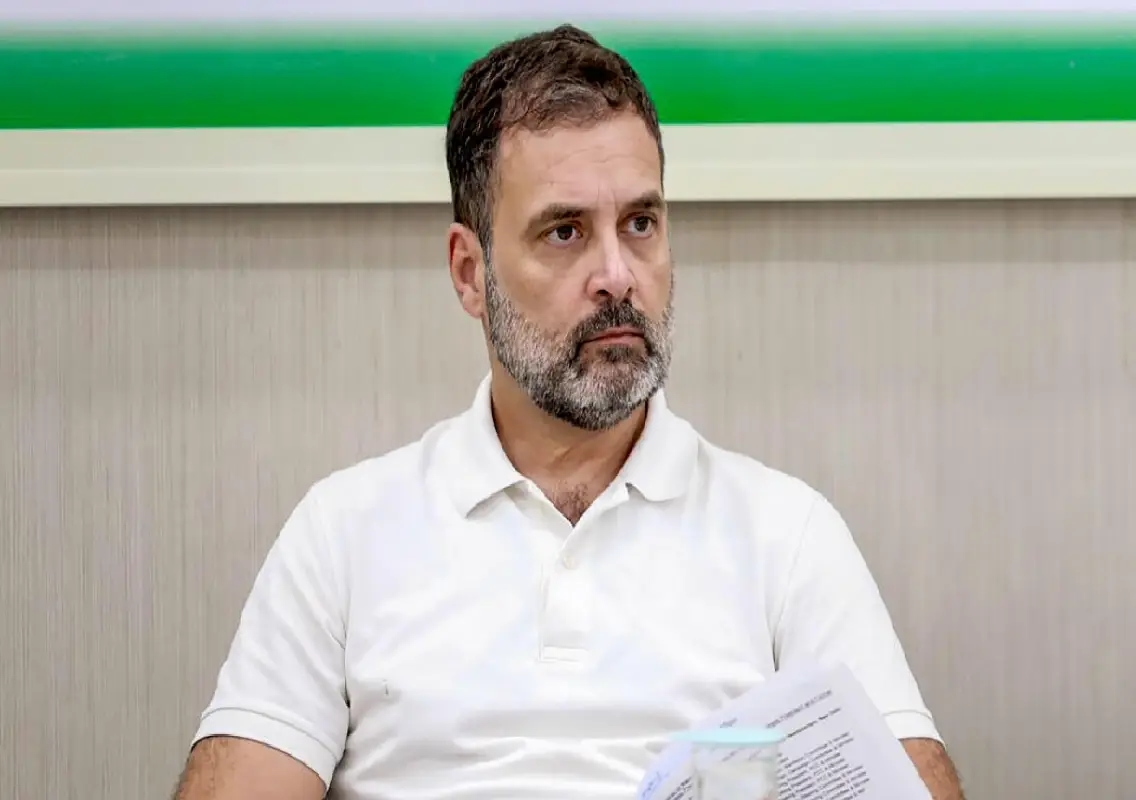


New Delhi: With several key bills expected to come up for discussion and passage in Parliament over the next couple of days, the Congress has issued a three-day whip directing all its Members of Parliament to remain present in the House. The move underlines the party’s intent to mount a strong challenge to the government, particularly over its proposal to rename the Mahatma Gandhi National Rural Employment Guarantee Act (MGNREGA). However, the absence of Congress leader Rahul Gandhi, who is currently on a visit to Germany, has already triggered sharp political exchanges.
According to sources, the Congress whip applies for the next three days, coinciding with what is expected to be a crucial phase of the ongoing winter session of Parliament. The Bharatiya Janata Party (BJP) has also issued instructions to its members, asking them to be present in Parliament from December 15 to 19 to ensure smooth passage of government business.
Rahul Gandhi’s absence sparks political debate
While Rahul Gandhi’s absence is not expected to affect the numerical outcome of any vote, it has given the BJP an opportunity to target the Congress. In the 543-member Lok Sabha, the Congress has 99 MPs, while the combined Opposition has 234 seats. This is still short of the National Democratic Alliance’s strength of 291 MPs.
Despite this, Gandhi’s absence during an important parliamentary week has drawn criticism from the ruling party, which has repeatedly questioned his commitment to parliamentary responsibilities.
BJP spokesperson Shehzad Poonawalla took a swipe at the Congress leader, saying that the post of Leader of the Opposition (LoP) now stands for “Leader of Paryatan (tourism)”. “Rahul Gandhi is a non-serious politician. People are in work mode, he is in permanent vacation mode,” Poonawalla said, referring to Gandhi’s overseas visit during the session.
Union Minister Pralhad Joshi also criticised Gandhi, calling him a “part-time, non-serious leader” and alleging that he frequently travels abroad when Parliament is in session, only to later complain that he does not get sufficient opportunities to speak.
Congress defends Gandhi, cites procedural norms
The Congress, however, has defended Rahul Gandhi, asserting that there is no violation of party discipline. Party sources said there are well-recognised exceptions to the whip convention. Illness is one such exception, and another is when an MP is absent after giving prior notice to the party’s parliamentary office.
According to sources, Rahul Gandhi had informed the party’s parliamentary office about his Germany visit before the whip was issued. Since the travel was pre-planned and communicated in advance, the whip does not apply to him in this instance, and no disciplinary action will be taken.
Party leaders also pointed out that the whip is not explicitly mentioned in the Constitution or in the formal rules and procedures of Parliament. Instead, it operates as a political convention, and any action for its violation is taken at the discretion of the party concerned.
Whip and the anti-defection law
Despite being a convention, the whip assumes critical importance under the anti-defection law enshrined in the Tenth Schedule of the Constitution. Violating a whip issued by a political party during crucial votes can lead to disqualification of an MP on grounds of defection.
This legal backdrop makes party whips especially significant during important legislative business, as parties seek to ensure unity and discipline among their MPs.
Crucial week for Congress and Opposition
The ongoing week of the winter session is particularly important for the Congress and the Opposition. One of the major flashpoints is the government’s move to rename the MGNREGA, a flagship welfare scheme launched during the United Progressive Alliance (UPA) government.
The proposed new name—Viksit Bharat Guarantee for Employment and Livelihood Mission (Rural) Bill, abbreviated as G Ram G—has drawn strong objections from the Congress. The party has accused the BJP of attempting to erase the legacy of Mahatma Gandhi by removing his name from the scheme.
Congress president Mallikarjun Kharge, in a post on X, said that removing Gandhi’s name reflected the BJP’s long-standing discomfort with Mahatma Gandhi’s ideals. “Erasing Gandhi’s name on the centenary of the Sangh shows how hollow and hypocritical those are who, like Modi ji, offer flowers to Bapu on foreign soil,” Kharge said.
Wider legislative agenda adds to tensions
Apart from the MGNREGA renaming, Parliament is also expected to discuss a bill related to allowing private investment in nuclear energy, among other legislative proposals. The Congress has indicated that it will oppose several aspects of the government’s agenda, arguing that these measures dilute the rights of the poor and marginalised.
Congress MP Ranjeet Ranjan said the BJP had earlier targeted leaders like Jawaharlal Nehru and Indira Gandhi, and was now moving against Mahatma Gandhi. “Now the country is watching that they have a problem with Bapu,” she remarked.
Congress leader Priyanka Gandhi Vadra also criticised the government, questioning the priorities of Parliament. “Mahatma Gandhi is considered the greatest Indian leader ever. I don’t understand what the objective is. Parliament is not functioning properly, pressing issues are not being discussed, and public money is being wasted,” she said.
BJP counters with comparisons
In response to criticism over Rahul Gandhi’s absence, the Congress has pointed to Prime Minister Narendra Modi’s frequent foreign visits, arguing that international engagements are a routine part of leadership responsibilities and should not be selectively criticised.
The BJP, however, has maintained that the issue is not travel per se, but the timing of the visit during a crucial parliamentary session and while holding the constitutional position of Leader of the Opposition.
Conclusion
As Parliament enters a decisive phase of the winter session, the Congress whip reflects the party’s intent to present a united front against key government proposals, particularly the renaming of MGNREGA. While Rahul Gandhi’s absence may not alter voting arithmetic, it has added a political edge to the proceedings, with both sides trading sharp barbs. With contentious bills on the agenda and tempers running high, the coming days are likely to witness intense debate and political confrontation inside and outside Parliament.