







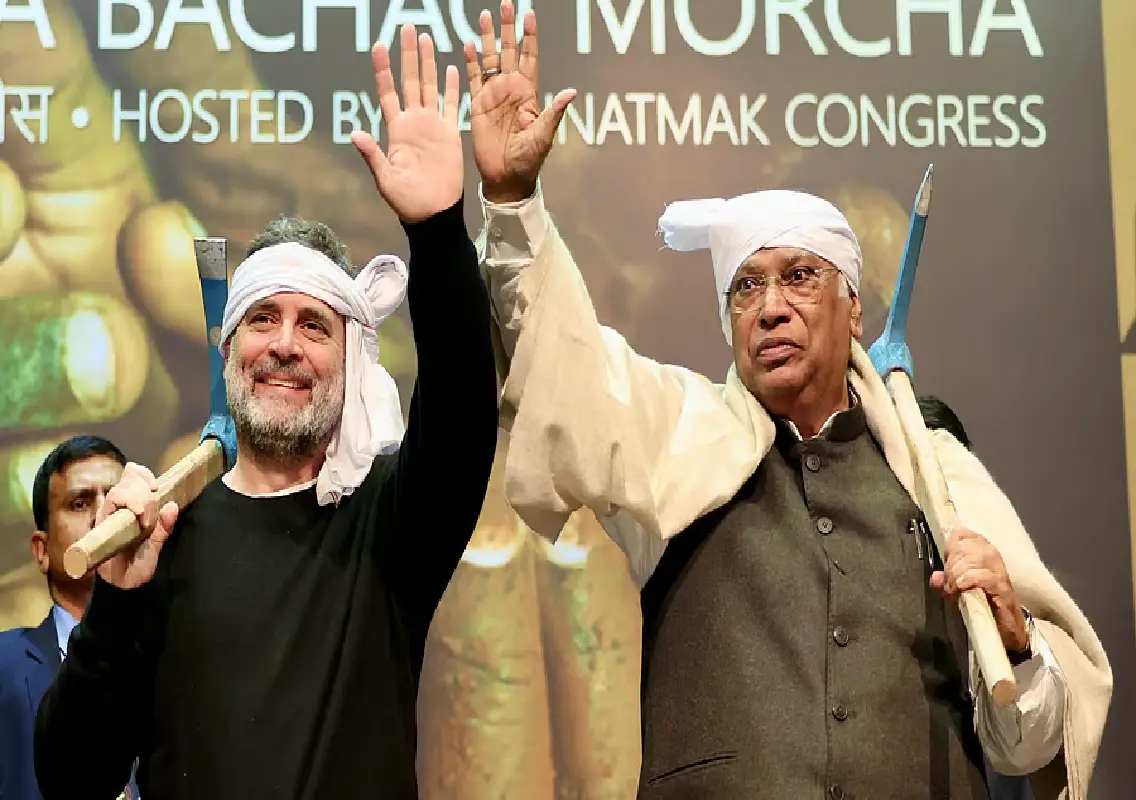


New Delhi: The Congress on Thursday called on workers across the country to unite against the repeal of the Mahatma Gandhi National Rural Employment Guarantee Act (MGNREGA), drawing parallels with the farmers’ movement that forced the rollback of the three contentious farm laws. Addressing the National MGNREGA Workers’ Convention, Leader of Opposition in the Lok Sabha Rahul Gandhi said the Modi government’s intent behind repealing MGNREGA was no different from its approach while introducing the “black” farm laws, which were eventually withdrawn after sustained protests.
The convention was organised by the ‘Rachnatmak Congress’ and was attended by senior party leaders, including Congress president Mallikarjun Kharge, general secretaries Jairam Ramesh and K C Venugopal, and Rachnatmak Congress chairperson Sandeep Dikshit. The event focused on mobilising opposition to the newly introduced VB-G RAM G Act, which the Congress claims effectively dismantles MGNREGA.
Rahul Gandhi draws parallels with farmers’ protest
Rahul Gandhi emphasised that MGNREGA was conceived as a rights-based programme aimed at ensuring dignity and livelihood security for the rural poor. He said the core idea of the scheme was that anyone in need of work should be able to demand it and receive employment as a legal entitlement, implemented through the Panchayati Raj system where people and workers have a voice.
“Now Modi-ji and the BJP want to destroy that concept,” Rahul Gandhi said. Recalling the nationwide farmers’ agitation, he added that a few years ago the government attempted to impose farm laws that were widely opposed. “The farmers stopped them. In Parliament and on the streets, farmers put pressure, and those laws were repealed,” he said.
According to Rahul Gandhi, the same mindset is now being applied to workers. “The same concept they tried to impose on farmers is now being imposed on workers,” he asserted, urging MGNREGA workers to take inspiration from the farmers’ unity and resistance.
Call for ‘MGNREGA Bachao Sangram’
Describing the ongoing protests as the ‘MGNREGA Bachao Sangram’, Rahul Gandhi called it a crucial opportunity for the poor and marginalised who believe in the Constitution and the idea of India. He said that if workers stood together in unity, the government would be forced to retreat, just as it did in the case of the farm laws.
“If they stand together, Modi-ji will back off and MGNREGA will be reinstated,” he said. However, he also cautioned that lack of unity remained a major weakness among the poor. “Poor people have not stood together so far; now they will have to. This is a very big opportunity,” Rahul Gandhi told the gathering.
He reiterated that collective action, sustained pressure and solidarity across states were essential to protect employment rights and prevent what he described as the erosion of hard-won social welfare legislation.
Kharge alleges attempt to erase Mahatma Gandhi
Congress president Mallikarjun Kharge launched a scathing attack on the Centre, alleging that the repeal of MGNREGA was an attempt to remove Mahatma Gandhi from public memory. He said the new legislation amounted to stripping the scheme of its original spirit and its association with Gandhi’s ideals of dignity of labour and social justice.
“This is the first time any party has dared to remove Mahatma Gandhi’s name from a scheme named after him. The nation will not tolerate this,” Kharge said. He accused the Modi government of deliberately weakening welfare programmes to the detriment of the oppressed and downtrodden.
Kharge claimed that the government’s objective was to end MGNREGA so that vulnerable sections of society could be turned into “bonded labourers” with no legal guarantee of employment. He asserted that the Congress would continue its struggle until the government withdrew the new Act and restored MGNREGA in its original form.
Parliament strategy and political message
Kharge also announced that the Congress would raise the issue forcefully during the upcoming Budget session of Parliament. He said the party would use every parliamentary platform to highlight what it sees as an attack on the rights of rural workers and the poor.
Senior leaders present at the convention echoed the leadership’s concerns, warning that dismantling MGNREGA would have far-reaching consequences for rural livelihoods, especially at a time when inflation and unemployment remain pressing challenges.
The Congress leadership maintained that MGNREGA is not merely a welfare scheme but a constitutional promise of livelihood security. By invoking the successful farmers’ movement, the party sought to frame the opposition to the repeal as part of a broader democratic resistance against policies it claims undermine the rights of ordinary citizens.
Conclusion
By drawing parallels between the repeal of MGNREGA and the now-withdrawn farm laws, the Congress has signalled its intent to turn the issue into a major political and social mobilisation. With Parliament’s Budget session approaching, the party appears poised to intensify its campaign, banking on unity among workers to pressure the government into reconsidering its decision.