







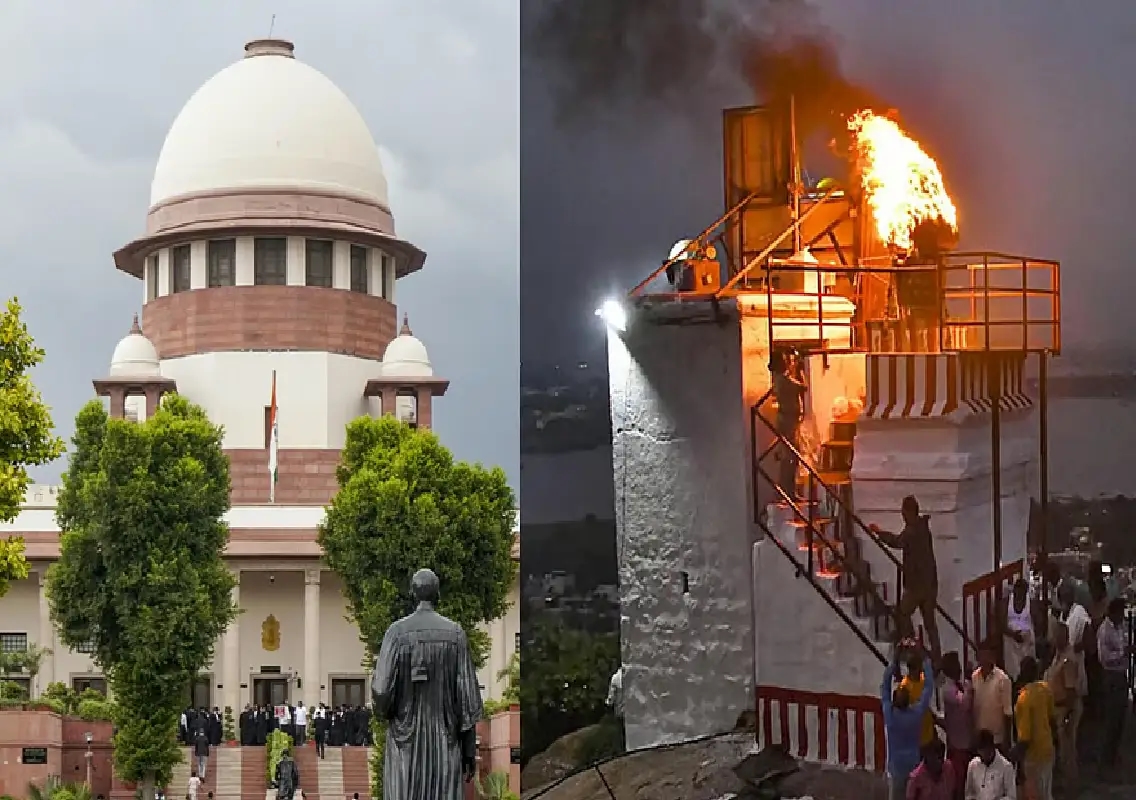


New Delhi: The Supreme Court on Friday directed that the ceremonial Karthigai Deepam lamp be lit at the Deepathoon on Thiruparankundram hill in Tamil Nadu on Saturday, November 28, taking a stern view of the alleged non-compliance with its earlier order by State authorities.
A bench of Justices Aravind Kumar and Vipul M Pancholi observed that the situation in Tamil Nadu, particularly in Madurai district, reflected prima facie “administrative chaos” and said such matters needed to be dealt with an “iron hand”.
The court directed that the lamp be lit using the flame from the Uchaipillaiyar Mandapam, if it was still burning, or through any other arrangement. It also ordered that devotees be permitted to light the lamp, subject to maintaining a distance of at least 50 metres from the Sikandar Dargah on all sides.
The Central Reserve Police Force (CRPF) was directed to provide security to both the temple and the Dargah to ensure that the ceremony takes place without disturbance.
Temple trust board suspended, former judges appointed as receivers
In a significant intervention, the Supreme Court suspended the Board of Trustees of the Arulmigu Subramania Swamy Temple and appointed two former Madras High Court judges, Justices S Vaidyanathan and V Parthiban, as receivers.
The receivers will oversee the temple administration and ensure compliance with the court’s directions.
The orders were passed while hearing contempt petitions alleging wilful disobedience of the Supreme Court’s November 20 order, which had permitted the lighting of the Karthigai Deepam at the Deepathoon near the Dargah on the hilltop.
Finding a prima facie case of non-compliance, the bench also vacated its earlier stay on the Madras High Court’s findings concerning the Deepathoon. However, it clarified that the safeguards previously ordered to protect the Dargah would remain in force.
The court’s directions seek to ensure that the lamp-lighting ceremony takes place while maintaining the prescribed security arrangements around the religious site.
Supreme Court questions Tamil Nadu administration
The bench expressed serious concern over the manner in which the State administration had responded to its earlier order.
“There is prima facie administrative chaos in the State of Tamil Nadu, at least in Madurai District,” the court observed.
It also took exception to what it perceived as political considerations influencing the conduct of executive authorities.
“Executive authorities seem to have acted on the dictates of their political bosses,” the bench remarked.
The court directed Tamil Nadu Chief Secretary M Sai Kumar to submit an affidavit explaining the sequence of events that led to the decision not to implement the November 20 order. He was also asked to produce relevant communications and emails to establish how the decision was taken.
The bench rejected the preliminary status report submitted by Madurai District Collector Nishant Krishna, describing it as “shedding crocodile tears”.
Temple board resolution comes under scrutiny
A key issue before the court was a resolution adopted by the temple’s Board of Trustees, which maintained that the ceremonial lamp could be lit only at the Uchaipillaiyar Mandapam in accordance with prevailing customs and not at the Deepathoon.
The Madurai District Collector had relied on this resolution to explain why the earlier direction had not been implemented, contending that the temple board had not authorised the ceremony at the Deepathoon.
The Supreme Court rejected this justification, observing that the resolution appeared to be an attempt to circumvent its November 20 order through a “strained interpretation” of the directions.
“The resolution on its face, firstly discloses wilful and flagrant disobedience of the interim order of this Court. Secondly, it evinces a deliberate attempt to undermine the authority of this court and the undertaking to the High Court,” the bench observed.
The judges also objected to the board’s suggestion that the court should have been informed about the temple’s traditions. The bench said the observation carried an unwarranted insinuation that the court had failed to understand the traditions despite hearing the parties in detail.
It further noted that the Board of Trustees had neither appeared before the Supreme Court nor challenged the Madras High Court’s order.
According to the bench, the failure to light the lamp, when considered alongside the board’s resolution and its reliance on tradition, prima facie indicated wilful and flagrant disobedience of the court’s directions.
Show-cause notices issued to 13 officials
The Supreme Court issued show-cause notices to 13 officials and members of the temple administration in connection with the alleged non-compliance.
Those named include Chief Secretary M Sai Kumar, Director General of Police Mahesh Agarwala, Madurai District Collector Nishant Krishna, senior officials of the Hindu Religious and Charitable Endowments (HR&CE) department, the Madurai Superintendent of Police and members of the temple’s Board of Trustees.
All those issued notices have been directed to appear personally before the court on December 15.
The Chief Secretary has also been asked to explain the administrative decision-making process and place the relevant records before the court.
Court invokes Article 144, stresses authority of judicial orders
Emphasising the obligation of authorities to comply with judicial directions, the bench referred to Article 144 of the Constitution, which requires all civil and judicial authorities in India to act in aid of the Supreme Court.
The judges said no executive or administrative authority could treat a judicial order as open to negotiation.
“An order of this court is not an invitation to negotiate. It binds all authorities, until this court itself modifies,” the bench said.
Warning against attempts to undermine the judicial process, the court observed: “Any attempt to pollute the stream of justice, by anyone, whosoever high, will not be tolerated.”
It further said that the time had come to deal firmly with situations involving alleged defiance of judicial orders, warning that failure to do so could lead to constitutional chaos.
The directions place the responsibility on the Tamil Nadu administration and the newly appointed receivers to ensure that the lamp is lit at the Deepathoon on November 28, with the CRPF providing security to both the temple and the Dargah.