


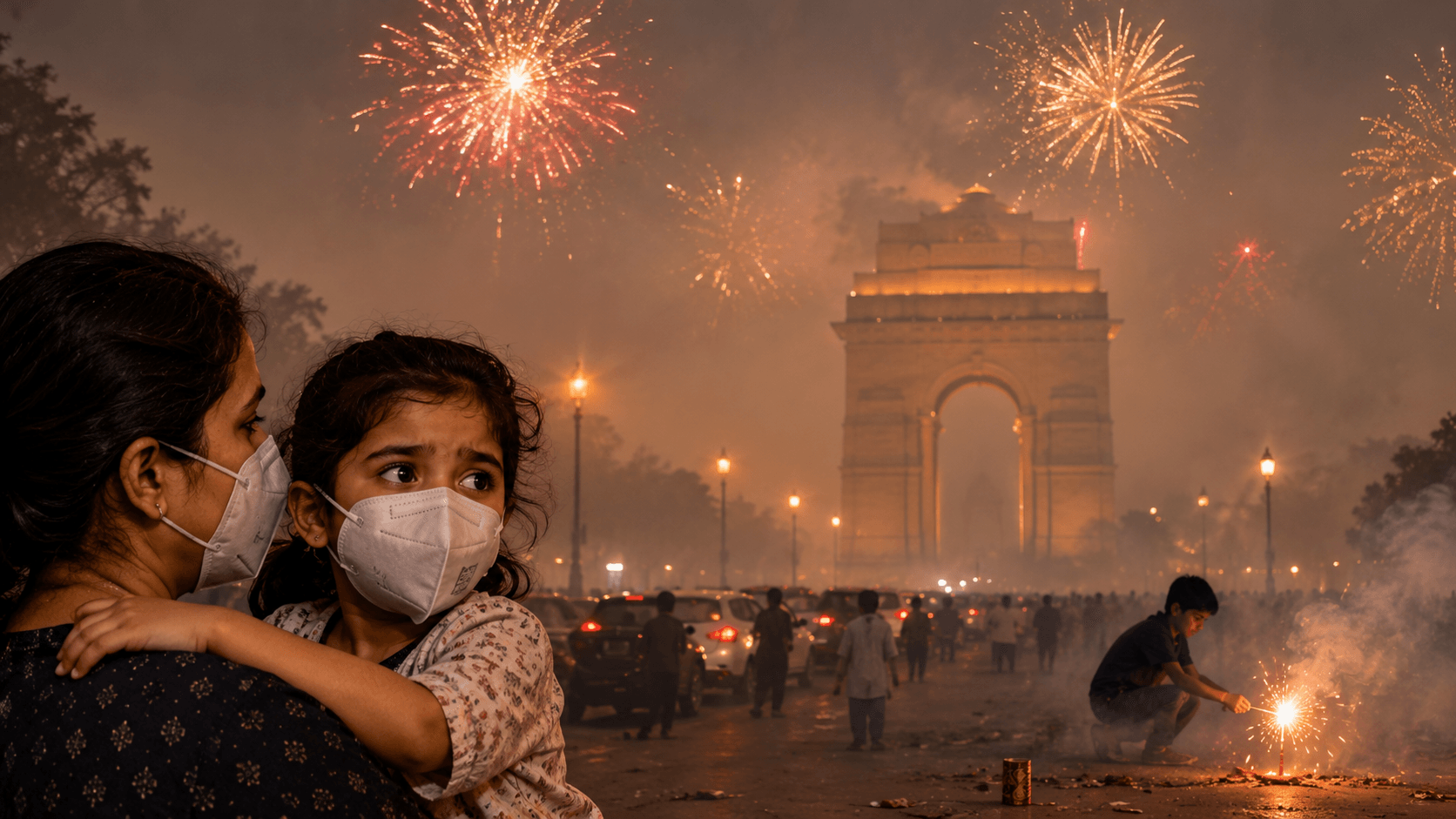


New Delhi: Delhi recorded its most polluted Diwali in five years on November 8, with the city’s average Air Quality Index (AQI) reaching 376, according to Central Pollution Control Board (CPCB) data. Air quality remained extremely poor the following morning, with the overall AQI standing at 371 at 10 am as a thick layer of smog and fog covered the national capital.
The post-Diwali AQI reading of 371 was the highest recorded on the day after the festival since 2021. Of the 51 monitoring stations that reported data, 14 recorded air quality in the severe category, four were in the poor category and the remaining 33 registered very poor conditions.
Delhi Technological University (DTU) recorded the highest AQI among the monitoring stations, at 439. The city’s overall AQI had stood at 370 at 8 am before rising marginally to 371 by 10 am.
The figures highlight the deterioration in air quality despite restrictions on firecracker use during the festival. Several neighbourhoods continued to witness fireworks beyond the permitted hours, while unfavourable weather conditions limited the dispersal of pollutants.
Diwali pollution reaches five-year high
The CPCB data showed that Delhi’s average AQI of 376 on Diwali was the highest recorded on the festival day since 2021, when the reading stood at 382.
The comparison with recent years shows that pollution levels during this year’s celebrations were considerably higher than in 2022, 2023, 2024 and 2025.
Delhi recorded an average Diwali AQI of 345 in 2025, 328 in 2024, 218 in 2023 and 312 in 2022. The corresponding figure in 2021 was 382.
Diwali falls on different dates each year, depending on the Hindu lunar calendar. This year’s celebrations took place on November 8, compared with October 20 in 2025, October 31 in 2024, November 12 in 2023, October 24 in 2022 and November 4 in 2021.
The pollution levels also remained high on the day after Diwali. The full-day average AQI on the post-festival day was 351 in 2025, 338 in 2024, 360 in 2023, 302 in 2022 and 462 in 2021.
Although the post-Diwali reading this year was below the 2021 figure, it was the highest for the corresponding day since then.
14 monitoring stations record severe air quality
The monitoring data indicated widespread pollution across Delhi on Monday morning. Of the 51 stations that recorded readings, 14 were classified in the severe category, while 33 reported very poor air quality.
Four stations were in the poor category. DTU recorded the worst reading at 439, placing it in the severe category.
Several residential and commercial areas continued to experience high pollution levels following the festival. Bawana, Burari, Jahangirpuri, Sonia Vihar, Punjabi Bagh, Okhla and Rohini were among the locations reporting severe air quality on Monday.
The readings suggested that pollution remained elevated across several parts of the city rather than being confined to a few localised pockets.
Real-time monitoring platforms also reported high pollution levels, although their readings differed from those of the CPCB network. Swiss air quality monitoring platform IQAir recorded Delhi’s AQI at 245 at 8.30 am on Monday, classifying conditions as very unhealthy.
Meanwhile, AQI.in reported a reading of 2,283 in Delhi at 9 pm on Sunday and 637 on Monday morning, placing the latter in its hazardous category. These figures come from separate monitoring systems and should not be directly compared with CPCB’s official citywide average.
Smog and fog reduce visibility across Delhi
Delhi woke up to a thick layer of smog and fog on Monday, with visibility dropping sharply at both Safdarjung and Palam, the city’s major weather monitoring stations.
At Safdarjung, visibility fell to 50 metres at 6.30 am, placing conditions in the dense fog category. This was a significant reduction from 700 metres recorded a day earlier.
At Palam, visibility stood at 400 metres, indicating moderate fog, compared with 800 metres on Sunday.
Conditions improved gradually during the morning. At 8.30 am, visibility increased to 100 metres at Safdarjung and 600 metres at Palam. By 9 am, the readings had improved to 500 metres and 900 metres, respectively, with both stations reporting shallow fog.
According to India Meteorological Department (IMD) data, Safdarjung experienced shallow fog from 10.30 pm to 2.30 am before dense fog developed. Dense fog continued from 2.30 am until 9 am, lasting six hours and 30 minutes. Shallow fog was reported again after 9 am.
At Palam, shallow fog was recorded between midnight and 5 am. Moderate fog followed from 5 am to 8.30 am, lasting three hours and 30 minutes, before conditions returned to shallow fog.
IMD officials described the conditions as a combination of smog and fog. They attributed the hazy conditions and changes in AQI to dry weather and calm winds.
Winds remained calm over both Safdarjung and Palam during the previous evening, limiting the movement and dispersal of pollutants.
IQAir reports high PM2.5 concentration
The IQAir platform recorded an AQI of 245 for Delhi at 8.30 am on Monday, placing the city’s air quality in the very unhealthy category.
Its data showed a PM2.5 concentration of 170 micrograms per cubic metre, approximately 34 times the World Health Organisation’s annual guideline value.
PM2.5 refers to fine particulate matter that can penetrate deep into the lungs and enter the bloodstream. Exposure to high concentrations can have serious health consequences, making it one of the major pollutants of concern during episodes of severe air pollution.
The platform also recorded PM10 concentration at 126 micrograms per cubic metre. Other pollutant readings included ozone at 31, nitrogen dioxide at 44.6 and sulphur dioxide at 32. Carbon monoxide concentration was recorded at 1,461.5 micrograms per cubic metre.
IQAir’s dashboard displayed an air quality alert for Delhi, using information from 32 monitoring stations provided by 12 contributors.
The different readings reported by CPCB, IQAir and AQI.in reflect the use of separate monitoring networks and measurement systems. However, all three indicated that Delhi was experiencing significant pollution after Diwali.
Firecrackers reportedly burst beyond permitted hours
Despite restrictions on firecracker use, several parts of Delhi witnessed fireworks on Sunday evening. Reports of firecrackers being burst emerged from Pitampura, Burari, Mayur Vihar and parts of Lutyens’ Delhi.
The District Magistrate (East) had permitted the use of green firecrackers only on November 7 and 8. The authorised timings were 6 am to 7 am and 8 pm to 10 pm.
However, residents reported that fireworks continued beyond the permitted evening window. The intensity was particularly high in Pitampura and Burari in outer Delhi, as well as Mayur Vihar.
The restrictions also prohibited firecracker use within 300 metres of hospitals, nursing homes, health centres, old-age homes, educational institutions and other notified silence zones.
Only green firecrackers certified by the Council of Scientific and Industrial Research–National Environmental Engineering Research Institute (CSIR-NEERI) were permitted for sale. Their sale was restricted to locations designated by the Delhi Police in coordination with the district administration.
Authorities had also announced joint patrolling and enforcement teams to prevent the unauthorised sale and use of prohibited firecrackers.
The reports of fireworks continuing beyond the permitted hours have raised questions about compliance and enforcement during the celebrations.
Weather conditions likely to keep pollution high
According to the Air Quality Early Warning System (EWS), Delhi’s air quality is likely to remain in the severe category over the next few days.
The system has warned that unfavourable meteorological conditions could prevent pollutants from dispersing effectively. A ventilation index below 6,000 square metres per second, combined with an average wind speed of less than 10 kilometres per hour, is considered unfavourable for pollution dispersion.
Several factors are expected to contribute to the deterioration, including vehicular emissions, Diwali celebrations and the ongoing peak stubble-burning season in neighbouring states.
The combination of emissions and weather conditions can cause pollutants to remain concentrated over the region. Calm winds and limited ventilation make it difficult for polluted air to move away, while additional emissions from vehicles and agricultural fires add to the burden.
The post-Diwali pollution spike has therefore renewed concerns about the national capital’s air quality as winter approaches.
Delhi faces another difficult pollution spell
The average AQI of 376 on Diwali marked Delhi’s most polluted festival day in five years. The following morning’s reading of 371, along with severe conditions at 14 monitoring stations, showed that the pollution had persisted beyond the celebrations.
The sharp reduction in visibility, high PM2.5 concentration and reports of fireworks outside permitted hours have added to concerns over public health and enforcement.
With the EWS forecasting severe air quality over the next few days, Delhi faces the challenge of managing emissions while unfavourable weather conditions continue to restrict pollutant dispersal. The latest figures underline the need for effective enforcement of firecracker restrictions and sustained measures to address vehicular and other pollution sources.