


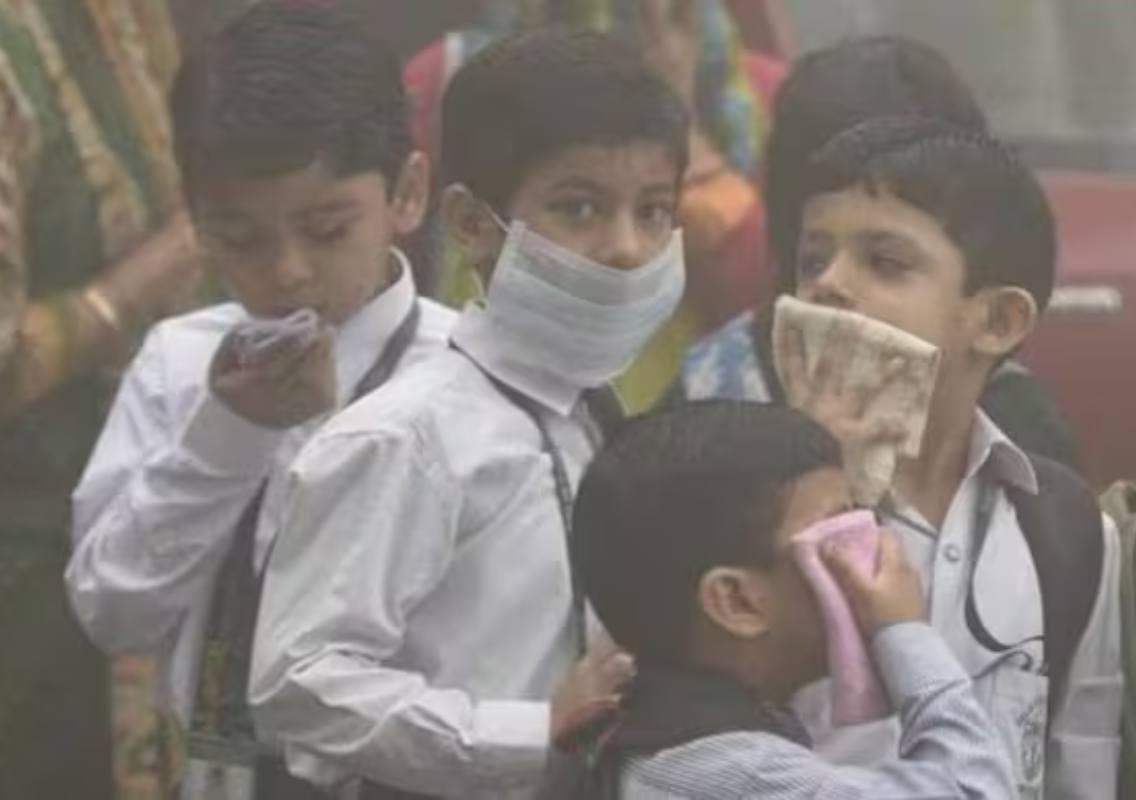


New Delhi: Schools across Delhi have been directed to adopt hybrid learning for students up to Class 5 as air pollution levels deteriorate ahead of Diwali. The arrangement allows children to attend physical classes or opt for online lessons wherever schools have the necessary facilities.
The decision comes after the Commission for Air Quality Management (CAQM) invoked Stage III of the Graded Response Action Plan (GRAP) across Delhi-NCR, anticipating a further decline in air quality. Delhi recorded a 24-hour average Air Quality Index (AQI) of 382 on Friday, placing the capital in the ‘very poor’ category and close to the threshold for ‘severe’ pollution.
The hybrid-class direction covers government schools, government-aided institutions and recognised private schools operating under the Delhi Directorate of Education. Schools managed by the Municipal Corporation of Delhi (MCD), New Delhi Municipal Council (NDMC) and Delhi Cantonment Board are also included.
Authorities have instructed schools to inform parents about the new arrangement. Officials will conduct inspections to ensure that institutions comply with the directions.
The decision is intended to reduce children’s exposure to polluted outdoor air without completely stopping classroom education. Schools will continue to operate physically, but families can choose online learning if the facility is available.
Why Delhi schools have been asked to adopt hybrid learning
The decision follows a deterioration in Delhi’s air quality at a time when pollution levels are expected to remain a concern ahead of Diwali.
The capital’s AQI reached 382 on Friday, placing it firmly in the very poor category. The reading was close to the severe threshold, which begins at 401.
Although Stage III GRAP measures are generally associated with severe air quality, the CAQM decided to implement the restrictions in advance. The move followed concerns that unfavourable weather conditions could prevent pollutants from dispersing effectively.
The commission cited adverse meteorological conditions and weak dispersion of pollutants while announcing the stricter measures. Forecasts also indicated that Delhi’s air quality could deteriorate further and enter the severe category over the following days.
The timing is significant because pollution levels in the capital often become a major public concern around the festive period. Firecracker emissions, dust, vehicle exhaust and other sources can add to the pollution burden, while weather conditions may influence how quickly pollutants disperse.
The hybrid-learning arrangement gives parents the option of keeping younger children away from classrooms on days when they consider outdoor exposure a concern, provided their schools can conduct online lessons.
Which schools are covered by the order?
The latest direction applies to a wide range of educational institutions across Delhi. It includes government schools, government-aided schools and recognised private schools under the Directorate of Education.
Institutions managed by the MCD, NDMC and Delhi Cantonment Board have also been brought under the arrangement.
Schools have been asked to communicate the details to parents so that families understand how the hybrid system will operate. The availability of online classes will depend on the facilities offered by individual institutions.
Importantly, the order does not direct schools to shut down. Physical classes can continue, and students whose parents prefer classroom learning can attend school as usual.
The option of online attendance is intended to provide flexibility to families while pollution levels remain high.
Officials are also expected to inspect schools to check whether the directions are being followed. The monitoring process is aimed at ensuring that institutions communicate the arrangement and provide the available learning options to parents.
Hybrid classes also mandated in other NCR cities
The hybrid-learning arrangement is not limited to Delhi. Under the Stage III GRAP framework, hybrid classes up to Class 5 have also been mandated in Gurugram, Faridabad, Ghaziabad and Gautam Buddha Nagar.
Gautam Buddha Nagar includes Noida and Greater Noida, two major urban centres in the National Capital Region.
Other NCR districts may also introduce similar measures depending on local pollution levels and the prevailing conditions.
The wider implementation reflects the regional nature of air pollution. Pollutants do not remain confined to administrative boundaries, and air quality in one part of the National Capital Region can be influenced by conditions elsewhere.
The inclusion of neighbouring cities is therefore part of the broader effort to reduce exposure and control pollution across the region.
What Stage III GRAP restrictions mean
GRAP is a series of emergency measures implemented according to the severity of air pollution in Delhi-NCR. Stage III introduces stricter restrictions on activities that contribute to the deterioration of air quality.
Under this stage, several construction and demolition activities that generate dust are restricted. These include excavation, demolition work and road construction or repair activities.
Certain essential and public-interest infrastructure projects are exempt from the restrictions. The exemptions allow important work to continue where authorities consider it necessary, subject to the applicable conditions.
The restrictions also cover the operation of certain older vehicles. BS-III petrol and BS-IV diesel four-wheelers are barred from operating in Delhi and specified NCR districts, subject to permitted exemptions.
Mining operations and stone-crushing activities across the region are also ordered to stop under the Stage III measures.
These restrictions are intended to reduce emissions and dust from transport, construction and industrial activities, which contribute to the region’s pollution levels.
Offices may also face work-from-home measures
Apart from restrictions on vehicles and construction activities, Stage III GRAP gives authorities the option of considering additional steps to reduce daily movement.
Government, municipal and private offices may be asked to operate with reduced physical attendance. Authorities can consider allowing a portion of the workforce to work from home, depending on the prevailing situation.
Such measures can help reduce the number of vehicles on roads and limit commuting-related emissions.
However, the decision to implement reduced office attendance is a separate measure that authorities may consider. It should not be confused with the hybrid-class direction already issued for younger school students.
Pollution concerns rise ahead of Diwali
Delhi’s AQI of 382 on Friday has placed the city close to the severe pollution category, prompting authorities to strengthen preventive measures.
The CAQM’s decision to invoke Stage III GRAP reflects concerns that air quality could worsen further because of unfavourable meteorological conditions and weak pollutant dispersion.
For schools, the immediate impact is the introduction of a hybrid option for children up to Class 5. Parents will be able to choose between physical and online lessons wherever schools provide the facility.
The restrictions across Delhi-NCR also cover construction, transport and other activities that can contribute to pollution.
With the capital approaching the festive period, authorities will be watching air quality closely and monitoring compliance with the restrictions. The effectiveness of the measures will depend on their implementation and the changing weather conditions over the coming days.