


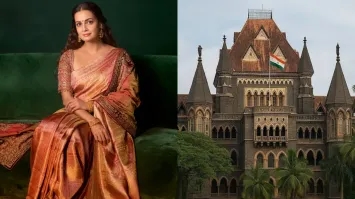


Mumbai: The Bombay High Court on Tuesday criticised the remarks made by politicians against actor Dia Mirza over an environmental awareness video and directed the Brihanmumbai Municipal Corporation (BMC) to re-upload the deleted clip. Emphasising that India is a secular country, the court said an appeal against firecrackers and pollution should not be turned into a religious controversy.
A bench of Justices Girish Kulkarni and Neela Gokhale expressed displeasure over the rhetoric used against Mirza after she appeared in a BMC awareness video urging people not to burst firecrackers on public roads. The actor had referred to a High Court order while making the appeal as part of the civic body’s campaign for an eco-friendly Diwali.
The video was removed from the BMC’s social media platforms hours after Mumbai BJP chief Ameet Satam objected to it. However, other awareness videos featuring celebrities, including actor Madhuri Dixit and cricketer Ajinkya Rahane, continued to remain on the civic body’s social media accounts.
The controversy drew criticism from the court, which said environmental awareness was an issue affecting everyone, irrespective of religion or caste. It also questioned why a campaign addressing air and noise pollution had been given a religious colour.
The bench said the BMC commissioner had been correct in selecting celebrities to communicate the environmental message and described the removal of Mirza’s video as unfortunate.
Bombay High Court says India is a secular country
During the hearing, the High Court expressed anguish over what it described as the petty mindset reflected in the objections raised against Mirza.
The bench said it was unfortunate that a video intended to create awareness about the environment, air pollution and noise pollution had become the subject of unnecessary controversy.
“We have not seen any politician or any person who made remarks yesterday put up videos spreading awareness. We are a secular country. We are really hurt by this. The issue pertains to the environment and every person, irrespective of their religion and caste, is breathing the same air,” the court said.
The judges emphasised that environmental concerns do not belong to any particular religious or social group. Pollution affects people across communities, and awareness campaigns should be viewed in that context.
The court also said public representatives should exercise restraint while commenting on individuals who participate in civic awareness initiatives. It stressed that respect must be shown to every person in society, regardless of religion, caste or creed.
The bench further observed that the Constitution expects citizens to uphold a secular spirit. It said such values should guide public discourse, particularly when the issue concerns a shared public interest such as environmental protection.
Why was Dia Mirza’s video removed?
Mirza appeared in an awareness video produced for the BMC, appealing to citizens not to burst firecrackers on public roads. The actor referred to a High Court order while urging people to celebrate Diwali in an environmentally responsible manner.
The civic body’s campaign featured several well-known personalities to spread awareness about pollution and responsible celebrations.
However, the video featuring Mirza was taken down within hours after Ameet Satam, the Mumbai BJP chief, objected to it. The removal triggered a wider political controversy, with questions being raised about the actor’s participation in the campaign.
The court noted that other videos featuring Madhuri Dixit and cricketer Ajinkya Rahane remained available on the BMC’s social media accounts. It questioned the decision to remove Mirza’s clip while retaining the other awareness videos.
The bench said the civic body commissioner had made an appropriate choice in selecting celebrities to communicate the environmental message. It described the subsequent controversy as unnecessary and said the video should not have been deleted.
The judges also made it clear that a public awareness campaign should not become a platform for targeting individuals on the basis of their perceived religious or political positions.
Mumbai Mayor and minister criticise Dia Mirza
The actor’s video drew criticism from several political figures in Maharashtra.
Mumbai Mayor Ritu Tawde alleged that Mirza had consistently taken an anti-Hindu and anti-government position. She cited this as the reason for opposing the actor’s involvement in the BMC campaign.
Maharashtra minister Nitesh Rane also questioned the actor’s participation in an awareness initiative related to Diwali.
Rane argued that Mirza had spoken about an environmentally friendly Diwali but had not made similar appeals during Eid, Muharram or Bakri Eid. He said environmental messages should also address celebrations and observances associated with other religions.
“Dia Mirza has tweeted about Diwali, but she never tweets or offers such advice during Eid, Muharram or Bakri Eid. They only talk about an environment-friendly Holi or Diwali. They should also speak about an environment-friendly Ramzan and Bakri Eid. People like her are against the Sanatan Hindu religion,” Rane said.
He added that he would discuss the issue with the Chief Minister and seek steps to prevent similar incidents in the future.
The remarks became part of the controversy surrounding the video, prompting the High Court to address the broader issue of religious rhetoric in public life.
Court says public representatives must show restraint
The High Court expressed concern over the manner in which the issue had been discussed by people holding public positions.
The bench said it was most unfortunate that remarks made against Mirza had shifted attention away from the environmental message. It cautioned those who had raised objections and emphasised the need to respect people from all communities.
“There has to be a secular spirit, and the Constitution expects citizens to foster the same. If the clip was taken off, then it would be ideal that the same should be re-uploaded,” the court said.
The judges also observed that a city such as Mumbai depends on togetherness and a strong sense of belonging among its residents. Such social bonds should not be disturbed by loose comments, the bench said.
It added that such conduct was not expected from people occupying public posts.
The court’s observations placed the focus on the responsibility of public representatives to avoid comments that could divide communities, particularly when the subject under discussion is a civic issue affecting the wider population.
Bombay High Court directs BMC to restore the video
The bench said the BMC should not have removed Mirza’s video following the controversy. It directed the civic body to re-upload the clip on its social media platforms.
The court’s direction came with a clear message that environmental awareness should not be turned into a dispute over religion or identity.
The judges also reiterated that the civic body commissioner had been right in selecting public figures to spread awareness about pollution. The campaign’s objective, the court indicated, should remain central to the discussion.
The order is significant because it addresses not only the removal of a civic awareness video but also the manner in which environmental campaigns can become entangled in political and religious arguments.
Environmental awareness remains the central issue
The controversy began with a public appeal against bursting firecrackers on roads, but the court’s intervention brought wider attention to the importance of keeping environmental issues separate from religious divisions.
Air and noise pollution affect residents across communities. Awareness campaigns around cleaner celebrations are therefore relevant to the public at large, regardless of the occasion or the person delivering the message.
The High Court’s observations underscored that public institutions should be able to communicate such messages without allowing unnecessary controversy to undermine their purpose.
By directing the BMC to re-upload Mirza’s video, the bench reaffirmed the importance of maintaining a secular approach to civic communication. Its remarks also served as a caution to public representatives against using divisive language over initiatives intended to benefit the wider community.