







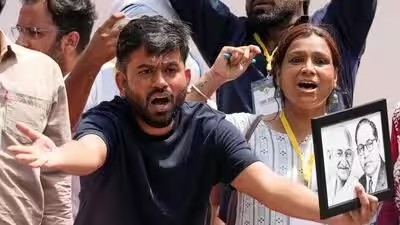


New Delhi: A key breakthrough emerged during the ‘Sansad Chalo’ protest in the national capital on Monday after Cockroach Janata Party (CJP) founder Abhijeet Dipke ended his indefinite hunger strike following the Centre’s decision to initiate talks with the organisation. The development came amid heightened tensions, heavy security deployment and clashes between protesters and police near Parliament during the Monsoon Session.
The protest witnessed detentions, allegations of baton charges and the use of tear gas after demonstrators attempted to move towards Parliament despite security restrictions. At the same time, CJP representatives left to meet Union Health Minister J.P. Nadda as part of the government’s outreach to the organisation.
Dipke calls off hunger strike
Abhijeet Dipke ended his fast after activist Sonam Wangchuk appealed to him to prioritise his health while the government agreed to hold discussions with CJP representatives.
According to party spokespersons, Saurav Das and Ashutosh Ranka proceeded to meet Union Health Minister J.P. Nadda following the Centre’s invitation for dialogue.
The CJP said ending the hunger strike should not be viewed as the end of the agitation, maintaining that its broader campaign would continue until its demands are addressed.
‘Sansad Chalo’ march turns tense
Thousands of protesters gathered at Jantar Mantar before attempting to march towards Parliament.
Delhi Police had deployed heavy security arrangements in and around Parliament Street during the Monsoon Session. As protesters approached barricaded areas, police used tear gas and mild force to disperse the crowd after some demonstrators allegedly tried to breach security barriers.
Several protesters were detained during the operation, and reports also indicated that Dipke was among those taken into custody later in the day.
Political reactions
The developments triggered sharp political reactions.
Leader of the Opposition Mallikarjun Kharge raised allegations of police action against protesters during parliamentary proceedings, while leaders of the Aam Aadmi Party visited the protest site to express support for the demonstrators.
Delhi Police, however, disputed allegations of excessive force, maintaining that security measures were implemented to prevent protesters from entering restricted areas near Parliament.
Protest movement continues
Although Dipke has ended his hunger strike, the CJP reiterated that the movement remains active.
Party leaders said they remain open to discussions with the government but expect concrete action on the issues raised during the campaign.
The protest has drawn participants from several parts of the country and has become one of the most prominent demonstrations during the ongoing Monsoon Session of Parliament.
Security tightened across central Delhi
Authorities imposed extensive security arrangements around Parliament and nearby government buildings throughout the day.
Several roads were barricaded, while temporary restrictions were imposed around parts of central Delhi to manage the protest.
The heightened security reflected concerns over maintaining law and order as large crowds assembled in the capital.
Talks could shape next phase
The meeting between CJP representatives and Union Health Minister J.P. Nadda is expected to determine the next course of the movement.
While the organisation has welcomed the government’s willingness to engage, it has indicated that protests could continue if its concerns remain unresolved.
The outcome of the dialogue will be closely watched as both sides attempt to find a resolution to one of the capital’s most closely followed protest movements in recent weeks.