


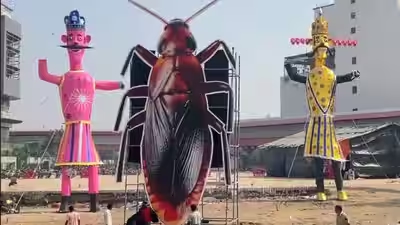


New Delhi: Abhijeet Dipke, founder of the satirical Cockroach Janta Party (CJP), has responded sarcastically to the planned burning of a 30-foot-tall cockroach effigy alongside Ravana during Dussehra celebrations in Delhi on October 20, saying, “Thank you for the free publicity.”
The Shri Keshav Ramlila Committee is preparing to burn the cockroach effigy alongside the traditional effigies of Ravana, Kumbhakarna and Meghnad at its grounds in Pitampura. The committee has said the initiative aims to raise awareness about cleanliness, dirt and unhygienic conditions in homes and public spaces.
However, the decision has attracted attention because of the emergence of the Cockroach Janta Party, a satirical movement that adopted the insect as its symbol following remarks by Chief Justice of India Surya Kant during a Supreme Court hearing. Dipke’s response has added a political dimension to an event that organisers say is intended to promote cleanliness.
Dipke takes a sarcastic dig at the effigy plan
Reacting to the proposed burning of the 30-foot cockroach effigy, Dipke thanked the organisers for what he described as free publicity. His remark appeared to draw attention to the increased visibility the event could give the CJP movement.
The planned effigy burning comes at a time when the group has been attracting attention through protests and political commentary. Its name and symbolism have become associated with a controversy surrounding the use of the word “cockroaches” during a Supreme Court hearing.
The committee, however, has presented its decision as a cleanliness initiative rather than a political statement. Its organisers have said the cockroach represents dirt and unhygienic conditions that need to be eliminated from society.
The contrast between the committee’s stated intention and the CJP’s political symbolism has brought the planned effigy burning into the spotlight ahead of the Dussehra celebrations.
What has the Shri Keshav Ramlila Committee said?
Ashok Goel Devaraha, president of the Shri Keshav Ramlila Committee and BJP MLA from Model Town, said the cockroach effigy was intended to symbolise filth and reinforce the message of the victory of good over evil.
Speaking to ANI, Devaraha said the committee had previously burnt effigies representing issues such as Naxalism and terrorism. This year, it decided to use a cockroach to highlight the need to address dirt and unhygienic conditions in homes, neighbourhoods and society.
He also denied that the initiative was politically motivated. According to him, the decision was aligned with the objectives of the Swachh Bharat and Swachh Delhi campaigns.
The committee plans to burn the cockroach effigy alongside those of Ravana, Kumbhakarna and Meghnad, which traditionally form part of Dussehra celebrations. The preparations for the event were underway ahead of the scheduled programme in Pitampura.
Dussehra is observed in many parts of India through the burning of effigies of Ravana and other figures from the Ramayana. The ritual symbolises the victory of good over evil. Organisers sometimes use the occasion to highlight contemporary social problems, adding themes relevant to public life to the traditional celebrations.
In this case, the committee has said the cockroach represents unhygienic conditions, while the CJP’s emergence has given the symbol a separate political association.
How did ‘cockroach’ become a political symbol?
The planned effigy burning comes amid growing attention around the Cockroach Janta Party, a satirical movement that emerged following remarks made by Chief Justice of India Surya Kant during a Supreme Court hearing on May 15.
During the hearing, the CJI reportedly compared certain individuals with fraudulent degrees who become social media or Right to Information (RTI) activists to “cockroaches” attacking the system.
The remarks prompted a backlash among some young people and inspired the formation of the CJP movement. The group adopted the term as part of its political identity, turning a derogatory comparison into a symbol for protests and public commentary.
The CJI later said his oral remarks had been “misquoted” and used with “malicious intent”. The clarification became another part of the controversy surrounding the original statement and the reaction it generated.
The episode illustrates how remarks made during court proceedings can travel beyond their immediate legal context and become subjects of wider public debate. In this instance, the term was adopted by a satirical group and subsequently became part of its public identity.
The planned cockroach effigy burning has brought that symbolism back into focus, even as the committee maintains that its objective is to draw attention to cleanliness.
CJP steps up protests against political figures
Since its emergence, the Cockroach Janta Party has organised protests against public figures, including former Union Education Minister Dharmendra Pradhan, according to the supplied report.
The movement is also demanding the resignation of Chief Election Commissioner Gyanesh Kumar over alleged irregularities in the Special Intensive Revision (SIR) of electoral rolls.
The SIR process concerns the revision of electoral rolls, and the CJP’s demands reflect its objections to the way the exercise has been conducted. The allegations remain the group’s claims and should not be treated as established findings.
The movement’s activities have brought together political satire, protest and criticism of public institutions. Its use of the cockroach label has also helped connect the group’s identity to the controversy that prompted its formation.
Dipke’s response to the effigy plan fits within that broader context. By thanking the organisers for free publicity, he drew attention to the possibility that an event intended to symbolise filth could also increase public awareness of the group.
Dussehra celebrations take on an unexpected dimension
The planned burning of the cockroach effigy adds an unusual element to this year’s Dussehra celebrations in Pitampura. While the traditional effigies of Ravana, Kumbhakarna and Meghnad represent familiar themes from the Ramayana, the additional figure is intended by the organisers to convey a message about cleanliness.
The committee has insisted that its decision is not politically motivated and is consistent with cleanliness campaigns. Dipke’s sarcastic response, meanwhile, has linked the event to the CJP movement and the controversy over the CJI’s remarks.
The two interpretations have placed the cockroach at the centre of an unexpected public debate ahead of the festival. The episode also demonstrates how a symbol can acquire different meanings depending on the context in which it is used.
For the committee, the effigy represents unhygienic conditions that it wants society to eliminate. For the CJP movement, the term is connected to a controversy over language, public institutions and political protest.
As the effigy-burning event goes ahead, the competing interpretations are likely to remain central to the discussion surrounding the initiative. The organisers’ stated message is cleanliness, while Dipke’s response has ensured that the political symbolism associated with the word “cockroach” remains part of the conversation.