







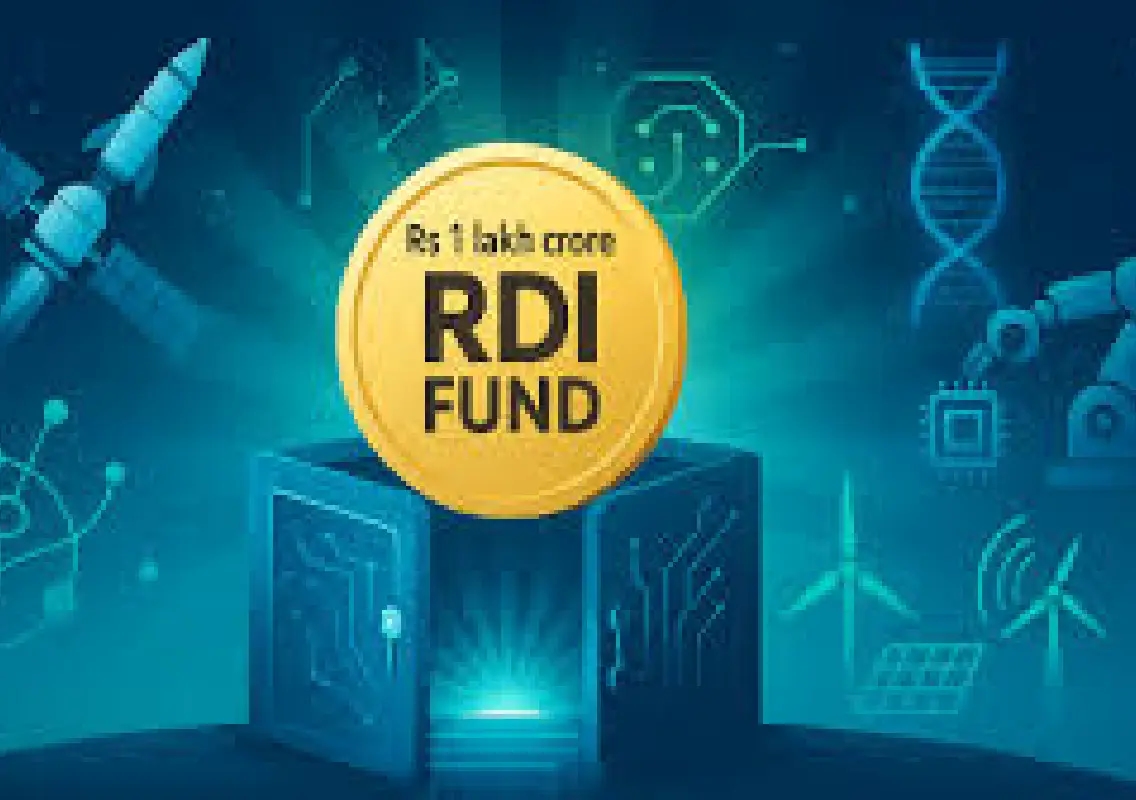


The Department of Science and Technology (DST) has established a ₹1 lakh crore Research, Development and Innovation (RDI) fund to support deeptech startups working on frontier technologies such as quantum computing, advanced communications, AI, robotics, and drones.
According to Abhay Karandikar, Secretary at DST, only about 10% of startup funding in India currently goes to deeptech ventures — a gap the new fund aims to close. “Private and venture capital investments in deeptech have been limited because the payoff cycle is longer and risks are higher. The RDI fund will bridge that gap and help innovators build products of global standards,” he told TOI on the sidelines of the IEEE Future Networks World Forum 2025 held in Bengaluru on Monday.
Target: 30–50% of startup funding for deeptech
The RDI fund is designed to provide patient capital — long-term funding that allows startups to focus on research-intensive innovation without the pressure of quick returns. The DST aims to raise the share of deeptech funding to 30–50% of total startup investment over the next five years.
Karandikar said the fund is expected to become operational within two months, adding that it would also act as a catalyst for private and venture capital participation. “We believe that once the government mitigates the initial risks, venture capital will follow. That’s what happened in the broader startup ecosystem over the last decade,” he noted.
India’s 6G ambitions gain momentum
Parallel to this deeptech push, India is seeking to take an early lead in the global 6G race — a shift from its relatively late entry into 5G. A senior official from the Department of Telecommunications said that, unlike with 5G where India joined after most standards were set, the country is now contributing to 6G specifications from the outset.
“We expect that in terms of standards-essential patents and IPRs, India has the potential to contribute in a very significant way,” the official said.
The Bharat 6G Alliance, which includes academia, startups, and private industry, is driving early-stage research aligned with the International Telecommunication Union’s (ITU) IMT-2030 framework. India’s 6G vision envisions an integrated communication ecosystem combining terrestrial, satellite, and aerial networks, enhanced with embedded AI and sensing capabilities.
“The 6G rollout will require a complete infrastructure upgrade—from base stations to devices,” Karandikar added, noting that global standards for 6G are expected to be finalised by 2030.