


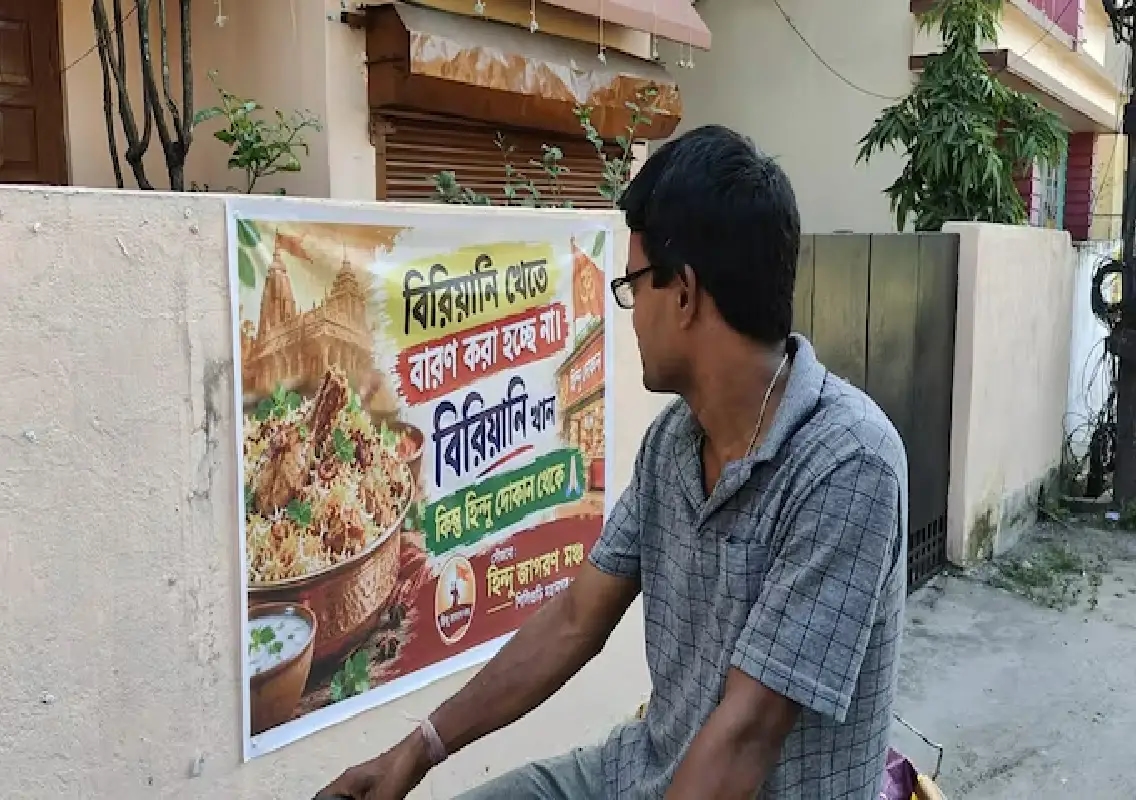


Siliguri: Posters urging people to buy meat and biryani from Hindu-owned shops have appeared at several locations in Siliguri, West Bengal, ahead of Durga Puja, triggering a political controversy over religious identity, consumer choice and communal harmony.
The posters, put up by the Hindu Jagran Manch, a local Hindu organisation, have appeared outside several Durga Puja venues across the city. One prominent location is the wall surrounding the Tarun Tirtha Club’s Durga Puja grounds in Bharat Nagar, near the residence of West Bengal Tourism Minister and Siliguri MLA Shankar Ghosh.
One poster reads, “Buy meat from Hindu-owned shops,” while another states, “There is no ban on eating biryani. Eat biryani, but buy it from a Hindu-owned shop.”
The campaign has attracted the attention of residents and passers-by, with its messages linking everyday food purchases to the religious identity of business owners. The posters have also prompted criticism from opposition leaders, who have questioned their implications for West Bengal’s tradition of religious coexistence.
Hindu Jagran Manch says campaign promotes unity
Abhishek Das, a representative of the Hindu Jagran Manch, confirmed that the organisation had put up the posters and said the campaign extended beyond Bharat Nagar to several Puja pandals across Siliguri.
“We put up these posters ourselves. It’s not just Bharat Nagar; the posters are in front of various Puja pandals across the city. Through these posters, we at the Hindu Jagran Manch wanted to convey a message of Hindu unity,” Das said.
The organisation has described the initiative as an effort to promote unity among Hindus. The messages specifically encourage consumers to purchase meat and biryani from Hindu-owned businesses rather than making their purchases solely on the basis of price, convenience or other commercial considerations.
The appearance of the posters during the festive season has added to the debate, as Durga Puja is a major cultural and religious celebration in Bengal, attracting people from different communities.
Tourism Minister distances himself from posters
Tourism Minister Shankar Ghosh said he was unaware of who had put up the posters outside the Tarun Tirtha Club Puja venue near his residence.
“I don’t know who put up these posters. Those who put them up are the ones who can say why they put up such posters,” Ghosh said.
His remarks came amid growing political discussion over the campaign and its message. The posters’ location near the residence of the Siliguri MLA has drawn attention, although Ghosh did not claim responsibility for their installation.
The campaign has raised questions about whether religious identity should influence consumer decisions and how such appeals might affect relations between communities during a period of public celebrations.
Ashok Bhattacharya criticises campaign
Former Siliguri mayor and Left leader Ashok Bhattacharya strongly criticised the posters, accusing organisations associated with the Rashtriya Swayamsevak Sangh (RSS) and the Bharatiya Janata Party (BJP) of encouraging religious divisions.
“Organisations like these are run by the RSS. The BJP is a party that follows the RSS’s fascist policies. These parties spread hatred among people in the name of caste and religion,” Bhattacharya said.
His remarks reflected his opposition to campaigns that, in his view, encourage people to distinguish between businesses based on religious identity.
Bhattacharya argued that food choices and purchasing decisions should remain matters of individual freedom. He said people should be able to decide what they eat and where they buy it, regardless of whether they are Bengali, Hindu, Muslim, Bihari or Marwari.
“We have never faced such despicable propaganda before. We are facing it now, and the BJP is behind it,” he said.
Bhattacharya also linked the campaign to the broader political atmosphere in West Bengal, alleging that the language used by Chief Minister Mamata Banerjee was emboldening organisations involved in such activities. He urged the police to remove the posters, arguing that they could threaten social harmony.
His allegations against the BJP and RSS are political claims and have not been independently established in the information available about the incident.
Gautam Deb calls posters unfortunate
Another former Siliguri mayor, Gautam Deb, also criticised the campaign, describing the posters as unfortunate in a state known for its diverse communities and tradition of religious coexistence.
“Let the people judge. I find it somewhat amusing. Ours is a secular state. Putting up such posters right before the Puja, in disregard of that Constitution, is very unfortunate,” Deb said.
He argued that appeals encouraging people to make purchases on religious grounds were inconsistent with Bengal’s tradition of communal harmony.
“This kind of campaign is never acceptable in a Bengal that stands for the harmony of all religions. The people of Bengal are politically aware; they will understand everything,” he said.
Deb added that the police should take appropriate action if the posters were found to be unconstitutional.
Food choices and communal harmony at the centre of debate
The controversy has placed the relationship between religious identity, commercial activity and personal choice at the centre of a political debate in Siliguri ahead of Durga Puja.
The Hindu Jagran Manch has defended the posters as a message of Hindu unity, while opposition leaders have criticised the campaign as divisive and called for police intervention.
The statements from political leaders also reflect the wider contest in West Bengal over secularism, religious identity and the role of political organisations in shaping public discourse.
There has been no reported confirmation in the supplied account of police action against the posters or an official determination regarding their legality.
As Durga Puja approaches, the debate is likely to remain focused on whether such campaigns represent a legitimate appeal to consumers or risk deepening religious divisions in a state where the festival is closely associated with shared cultural traditions.