







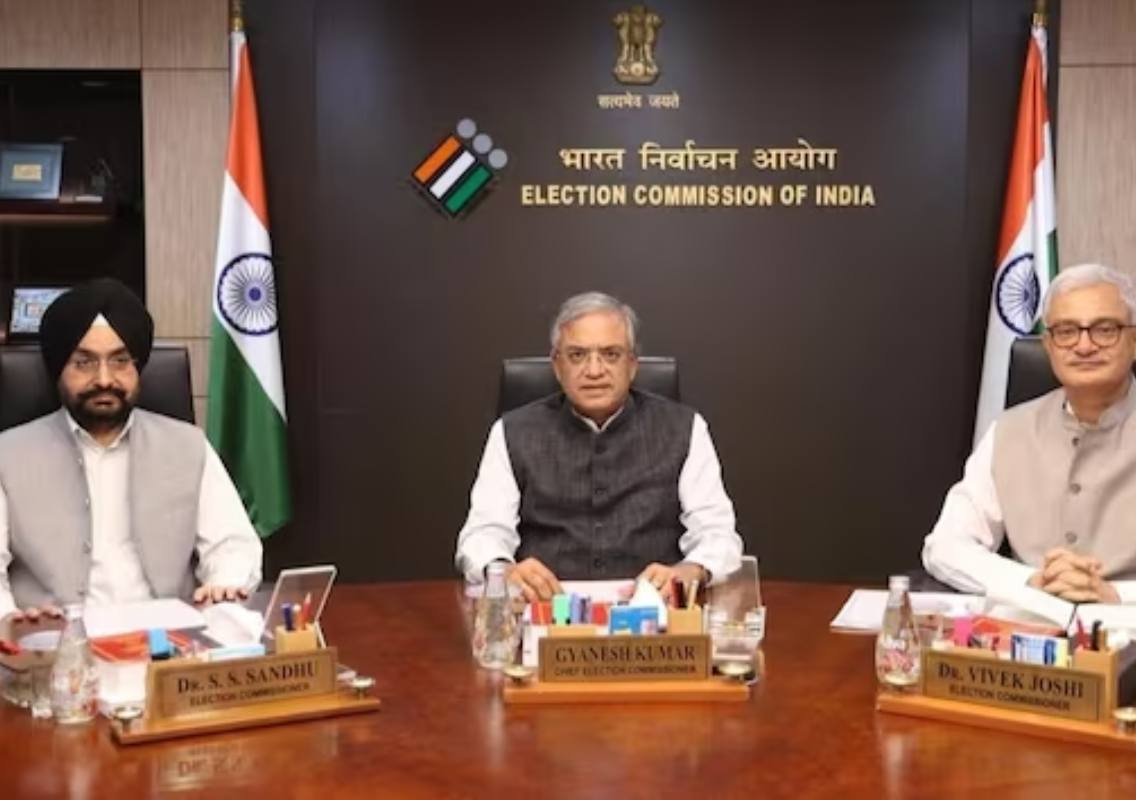


New Delhi: Chief Election Commissioner Gyanesh Kumar and Election Commissioners Sukhbir Singh Sandhu and Vivek Joshi met at the Election Commission headquarters on Saturday amid reports of differences within the poll panel over decisions linked to the Special Intensive Revision (SIR) of electoral rolls.
The meeting, which began at 3 pm, was followed by a detailed statement from the Election Commission addressing the SIR process, voter verification, Form 6, ECINet, an internal communication involving the Cabinet Secretary and the functioning of the Commission.
The meeting came days after reports that Sandhu and Joshi had raised objections to certain decisions and changes linked to SIR and the electoral roll management system. The Commission has maintained that differences in views do not amount to differences in the decisions ultimately taken by the three-member panel.
In Saturday’s clarification, the EC said the SIR orders and subsequent schedules were approved unanimously by the full Commission.
EC says SIR decisions were unanimous
The Election Commission said the SIR order issued on June 24, 2025, covering all states and Union Territories, was approved unanimously.
The exercise began with Bihar and was subsequently extended to West Bengal and other states and Union Territories. The Commission also said the Supreme Court upheld the SIR order on May 27, 2026.
According to the EC, schedules issued for 12 states and Union Territories in October 2025 and another 19 states and Union Territories in May 2026 were also approved unanimously.
The clarification is significant because reports of differences between the three Election Commissioners had focused partly on the manner in which decisions concerning SIR were taken.
The Commission’s position is that individual views expressed during internal deliberations should not be treated as formal decisions of the poll panel.
EC explains Cabinet Secretary communication
The Commission also responded to questions surrounding an internal communication sent to the Cabinet Secretary.
It said the communication was not connected to any policy decision of the Commission or its IT division. According to the EC, the issue concerned the functioning of an officer on deputation to the Commission.
The poll panel said work redistribution orders issued by the officer were not implemented after directions from two Election Commissioners. It also said oversight of the IT division by the Deputy Election Commissioner was never actually withdrawn.
The clarification came after reports raised questions about the administration and control of the Commission’s technology operations.
The Election Commission used Saturday’s statement to put its position on record and explain the administrative sequence behind the disputed communication.
New process for voters receiving SIR notices
One of the key decisions announced after the meeting concerns voters who receive notices because they have been classified as “unmapped” or have been flagged for logical discrepancies.
Under the revised process, Booth Level Officers (BLOs) will visit the homes of such voters to collect the required documents.
The documents will then be uploaded on the ECINet system for consideration by the Electoral Registration Officer (ERO).
The Commission said such voters will generally not have to appear personally before the ERO or Assistant Electoral Registration Officer (AERO).
Hearings will be conducted only in exceptional circumstances, based on the decision of the ERO, and the EC said such hearings should preferably be held online.
An adult member of the elector’s family can also be authorised to attend the hearing on the voter’s behalf when required.
The change is intended to reduce the need for voters to travel to election offices simply to respond to verification notices.
Help desks and special camps for vulnerable voters
The Commission has also directed District Election Officers to establish adequate help desks and organise special camps for groups that could face difficulties in completing the verification process.
The directions specifically include people living in night shelters, labourers, poor citizens and homeless persons.
The EC said these arrangements should help eligible voters submit documents and address discrepancies without facing unnecessary difficulties.
The decision comes as the SIR process has generated questions about how voters who receive notices will establish their eligibility and whether the verification process could create difficulties for vulnerable sections.
EC clarifies Form 6 rules
The Commission also addressed the controversy surrounding Form 6, which is used for applying for inclusion of a name in the electoral roll.
The EC said the declaration attached to Form 6 for the SIR exercise had been upheld by the Supreme Court.
For periods when SIR is not being conducted, the Commission said the forms prescribed under the Registration of Electors Rules, 1960, would continue to be used.
The issue had attracted attention after changes to the online version of Form 6 on the ECINet platform introduced questions linked to earlier SIR records. Reports had said Election Commissioners Sandhu and Joshi objected to the changes.
The Commission said SIR has already been completed in 20 states and Union Territories, including Bihar and West Bengal.
People whose names were left out during the exercise, as well as young and first-time voters, can seek inclusion through continuous updation by approaching the concerned ERO.
Chief Electoral Officers, District Election Officers and EROs have been directed to conduct special enrolment drives.
Goa example cited by Election Commission
The EC also cited Goa as an example of the enrolment process being used for voters who were left out of electoral rolls.
According to the Commission, BLOs were directed to visit such voters and collect their forms.
Of 97 voters identified in this category, 81 had already submitted Form 6 applications for inclusion, the EC said.
The example was cited to underline the Commission’s position that voters left out of the rolls can seek inclusion through the prescribed process.
Panel to review ECINet system
The Election Commission also announced a review of ECINet, its digital platform for election-related services and electoral management.
The Commission said field officers have role-based access to ECINet according to their statutory powers.
A committee headed by a Senior Deputy Election Commissioner will review the platform, with an independent expert from an IIT or IIIT also included.
The purpose of the review is to double-check whether the system complies with relevant laws and rules.
The EC said several upgrades had already been made based on feedback from state Chief Electoral Officers.
Going forward, all new initiatives involving IT modules and portals will be discussed by a Committee of Officers before being placed before the Commission for approval.
ECINet was launched by the Election Commission in January 2026 as a unified digital platform bringing together election-related applications and services.
SIR deadlines extended in Delhi and Maharashtra
The Commission also extended deadlines for claims and objections in Delhi and Maharashtra.
In Delhi, voters can now file claims and objections until October 30. The deadline for disposal of notices and claims and objections has been extended until November 30.
In Maharashtra, the filing deadline has been extended until October 12, while the disposal deadline has been extended until November 10.
The extensions provide additional time for voters and other stakeholders to respond to notices and raise objections during the electoral roll revision process.
EC introduces additional internal measures
The Commission also announced changes to its internal working procedures.
Agendas for Commission meetings will now be circulated in advance, while minutes of meetings will be issued subsequently.
The EC also said officers’ Annual Performance Appraisal Reports will be completed by December 31 every year.
Foreign trips by officials will require Commission approval, while directions issued by Election Commissioners to officers will have to be complied with.
These measures come amid wider scrutiny of the Commission’s internal decision-making and administrative functioning.
Political controversy continues
The Election Commission’s latest clarifications have come against a backdrop of political controversy surrounding SIR and reports of differences within the poll panel.
Opposition parties have criticised the functioning of the Commission and have sought greater transparency over the SIR exercise. Some Opposition leaders have also demanded action against or removal of CEC Gyanesh Kumar in connection with the controversy. Those demands are political positions and remain separate from the Commission’s own account of how its decisions were taken.
The Commission, meanwhile, has maintained that its SIR decisions were taken unanimously and has used Saturday’s meeting to announce procedural changes covering voter verification, Form 6, ECINet and internal governance.
The latest measures therefore address both the operational side of SIR and concerns about how the electoral roll revision process is administered. For voters receiving notices, the most immediate change is that home visits by BLOs and document collection will generally replace mandatory personal appearances before election officials.