







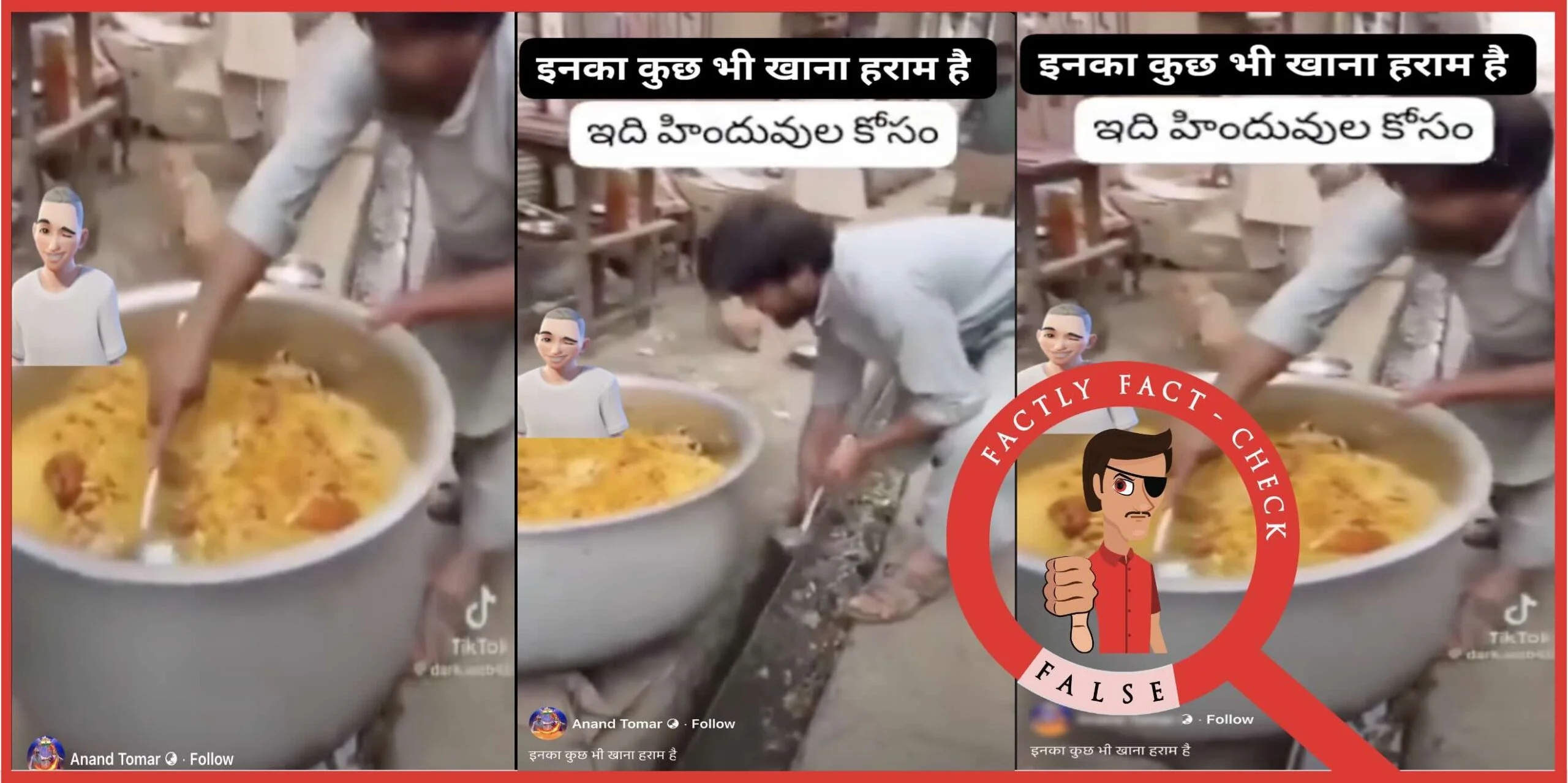


A video circulating widely on social media, allegedly showing a Muslim man cooking biryani using water taken from a drainage, has been found to be fake and AI-generated, according to fact-checkers.
The clip shows a man pouring water from a drain into a vessel containing yellow rice and what appear to be meat pieces. Social media users shared the video with communal captions, falsely claiming it exposed unhygienic practices at “Muslim hotels”.
Communal claim shared widely
An X (formerly Twitter) user shared the video with a caption suggesting that people who eat biryani from Muslim-run eateries were being deceived about cleanliness. Similar posts spread rapidly, fuelling communal prejudice and misinformation.
Video found to be AI-generated
A fact-check by NewsMeter confirmed that the claim is false. Several users had flagged the video as suspicious, prompting a closer analysis of the footage.
Upon examination, multiple visual inconsistencies were observed:
- People in the background remain unnaturally motionless
- A man wearing a green shirt has anatomically distorted legs
- Faces appear blurred and poorly defined, lacking realistic detail
These anomalies are commonly associated with AI-generated or deepfake videos.
AI detection tools confirm manipulation
To verify the findings, the video was analysed using multiple AI-detection platforms:
- Hive Moderation flagged the clip as likely AI-generated with 89.2 per cent confidence
- Deepfake-O-Meter, using five different detectors, returned confidence scores of 100%, 98.3%, 100%, 99.8% and 91.2%, strongly indicating synthetic content
Based on these results, fact-checkers concluded that the video does not depict a real incident.
Warning against sharing unverified content
Media analysts and fact-checkers have warned that AI-generated videos are increasingly being used to spread misinformation, particularly content designed to inflame communal sentiments.
Users are urged to verify videos before sharing, especially when claims target specific communities or professions. Sharing such content without verification can contribute to social harm and misinformation.