


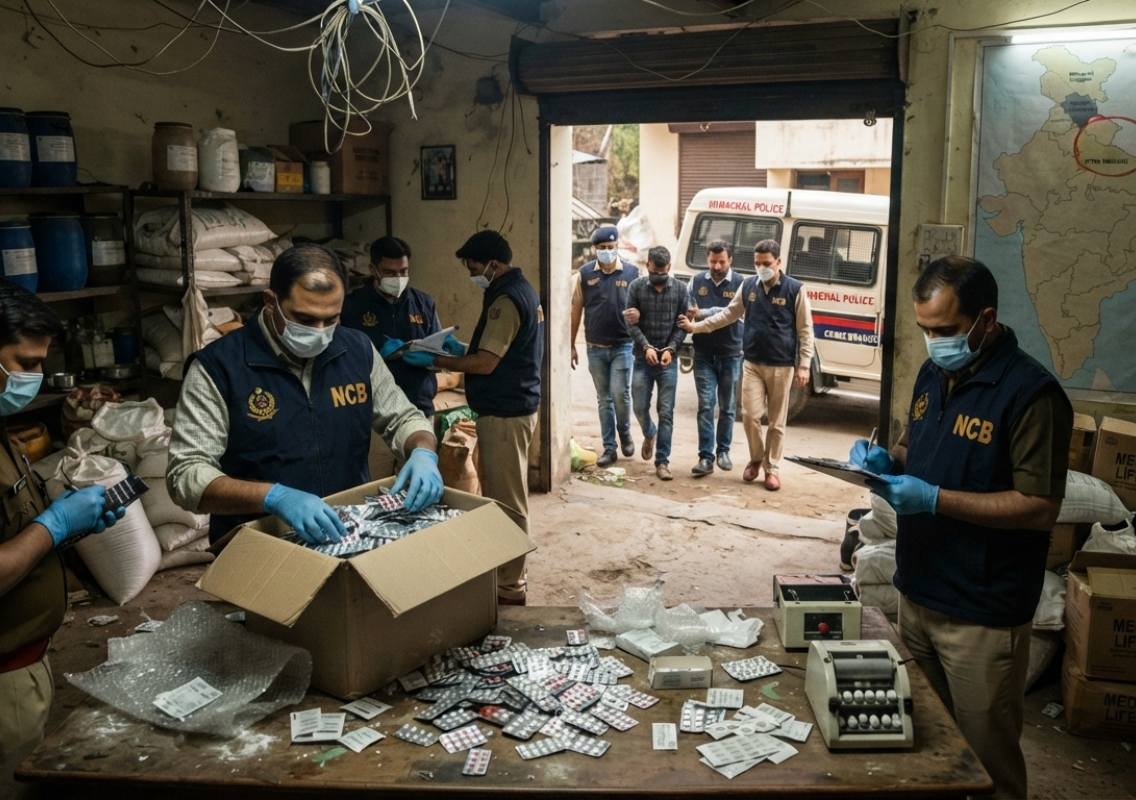


Varanasi: An investigation into counterfeit medicines in Uttar Pradesh has exposed an alleged interstate drug manufacturing and supply racket, with officials uncovering two unlicensed pharmaceutical units in Himachal Pradesh. Raids in Solan and Baddi led to the seizure of manufacturing machinery, raw materials, semi-finished products and finished medicines carrying the names of established pharmaceutical brands.
The investigation, which began with the seizure of suspected fake medicines from a medical store in Varanasi, gradually led the Uttar Pradesh Food Safety and Drug Administration (UPFSDA) to suppliers, storage facilities and suspected manufacturing locations. The department conducted the operation in coordination with the Uttar Pradesh Special Task Force (STF).
The latest breakthrough came with the discovery of an unlicensed manufacturing unit at V.D. Pharma in the Jhundikalan area of Baddi. This followed an earlier raid in Solan district. Himachal Pradesh drug control authorities and the police are taking further action.
The operation was conducted under the supervision of the UPFSDA Commissioner as part of the Uttar Pradesh government’s stated zero-tolerance policy towards the illegal drug trade. Investigators are now examining the alleged supply chain to establish how counterfeit medicines bearing the names of recognised pharmaceutical companies reached the market.
Varanasi medical store raid sets investigation in motion
The investigation began on October 30, 2026, when a UPFSDA team raided SP Medical Store in Varanasi. The establishment was allegedly operating without a drug licence and was found selling Nurokind-LC tablets bearing the name of pharmaceutical company Mankind.
During questioning, the store owner, Sunil Kumar Patel, told investigators that he had purchased the medicines without bills from Ashok Kumar Verma, a salesman associated with Super Drug Agency in Lahartara.
The UPFSDA team contacted Mankind to verify the products. Following a complaint from the company and a comparative examination, the medicines were confirmed to be counterfeit. Officials also seized other illegal medicines worth approximately Rs 5 lakh during the operation.
The findings prompted investigators to trace the supply agency and identify those allegedly involved in distributing the suspected fake medicines. What initially appeared to be an isolated case of illegal medicine sales soon developed into a wider investigation involving distributors and bulk storage facilities.
Storage facility exposed, 17 types of medicines seized
Acting on information gathered during the first raid, a joint UPFSDA team questioned Ashok Verma and delivery agent Priyanshu Tiwari on November 2.
Their questioning led investigators to the residence of Surendra Nath Mishra in Varanasi. A room on the premises contained a substantial stock of 17 types of allopathic medicines stored without bills or a valid licence.
Officials noticed serious labelling and spelling errors on strips of Gudcef-Plus and Nurokind-LC. These irregularities raised suspicions that the medicines could be counterfeit.
The team collected 11 samples for testing and seized the remaining stock, estimated to be worth around Rs 2 lakh.
The discovery widened the scope of the investigation. Officials began looking beyond retail outlets and distributors to identify those allegedly storing and supplying medicines in bulk.
Zangi App communication helps identify supplier
During questioning, Surendra Nath Mishra told investigators that he received the suspected counterfeit medicines from Abhishek Singh, alias Ravi, a resident of Anpara in Sonbhadra district.
He also disclosed that he communicated with Singh through the encrypted messaging application Zangi App.
Following this lead, an FIR was registered at Rohania police station against four accused under relevant provisions of the Bharatiya Nyaya Sanhita (BNS), based on a complaint filed by a drug inspector.
Investigators also found that Abhishek Singh had previously been named as the main accused in a major counterfeit medicine case registered at Varanasi’s Sigra police station in 2023.
His arrest became a significant development in the investigation, as officials were able to question him about the alleged sources of the medicines and the locations where they were being manufactured.
Accused’s questioning leads investigators to Himachal Pradesh
During questioning, Abhishek Singh provided information about locations where the suspected counterfeit medicines were allegedly manufactured. The names of Haseen and Waseem, residents of Saharanpur and sons of Salim, also emerged during the investigation. The two were originally from Chilkhana.
Investigators found that Haseen and Waseem were allegedly getting medicines manufactured in the Solan region of Himachal Pradesh before supplying them to different markets.
After corroborating the information with inputs from informers, a UPFSDA special investigation team, accompanied by the Lucknow STF, conducted a raid on November 18 at a manufacturing unit near the Rajpura-Khera bypass in Nalagarh tehsil of Solan district.
The premises were found operating without a licence. Officials recovered machinery used for manufacturing medicines, along with materials allegedly intended to replicate the packaging of established pharmaceutical brands.
The discovery suggested that the investigation had reached beyond the distribution of suspected counterfeit products to facilities involved in their alleged manufacture and packaging.
Machinery and packaging material linked to branded medicines seized
The Solan raid led to the recovery of materials associated with several pharmaceutical products. These included Pan-D (Alkem), Pressiz-300, C-AZ, A-Cipex-625, Neruro-300, Clavam-625, Clav-625, Cef-200LB, Obefix LB-200, Alcemox-CV, Zedi-200-LB, V-Clav-625, Zerodol-SP and Shelcal-500 mg.
The premises contained equipment used in medicine manufacturing and packaging. Officials recovered blister-packing machines, Alu-Alu packing machines, capsule-filling machines and weighing equipment.
Printed foil, stereo-printing materials and other packaging equipment were also found at the location.
Investigators are examining the seized materials to establish how medicines bearing the names and packaging of recognised pharmaceutical brands were allegedly manufactured and supplied. The examination is also expected to help officials understand the scale and nature of the operation.
The presence of both manufacturing machinery and packaging material has become an important part of the investigation, which is focused on tracing the suspected counterfeit products from production facilities to the markets where they were distributed.
Second illegal pharmaceutical unit found in Baddi
Further leads obtained during the Solan operation took investigators to V.D. Pharma in Jhundikalan, Baddi.
The team found another pharmaceutical manufacturing unit allegedly operating without a licence. Machinery and equipment used to manufacture tablets, capsules and syrups were recovered from the premises.
Officials also seized substantial quantities of raw materials, semi-finished medicines and finished products. These included materials associated with the manufacture of antibiotics, antacids and cough syrups.
The quantity and range of machinery and materials recovered indicated that the premises had an extensive arrangement for pharmaceutical manufacturing.
The Himachal Pradesh drug control department is undertaking further legal action in connection with the unit. Authorities are expected to examine the seized material and establish the extent of manufacturing activity at the premises.
The discovery of two unlicensed units in the same broader region has strengthened the focus on the alleged manufacturing network and its links with suppliers operating in Uttar Pradesh.
Investigation expands to Saharanpur
The investigation has also expanded to locations in Saharanpur linked to Haseen and Waseem. Officials have identified leads relating to the alleged illegal manufacture, storage and sale of medicines at premises connected with the two men.
Legal action is being initiated at these locations, including the process of registering FIRs.
The UPFSDA investigation has therefore moved well beyond the initial seizure at SP Medical Store in Varanasi. It now covers suspected manufacturing facilities in Himachal Pradesh, bulk storage locations and supply channels across multiple states.
Investigators are continuing to examine the network, verify the roles of those named during questioning and establish the extent of its operations. The seized medicines, raw materials, machinery and packaging equipment are expected to form a key part of the ongoing inquiry.
The case has highlighted the importance of tracing suspicious medicines through the entire supply chain, from retail outlets and distributors to storage facilities and manufacturing units. Further action by the authorities will depend on the findings of the ongoing investigation and examination of the seized material.