


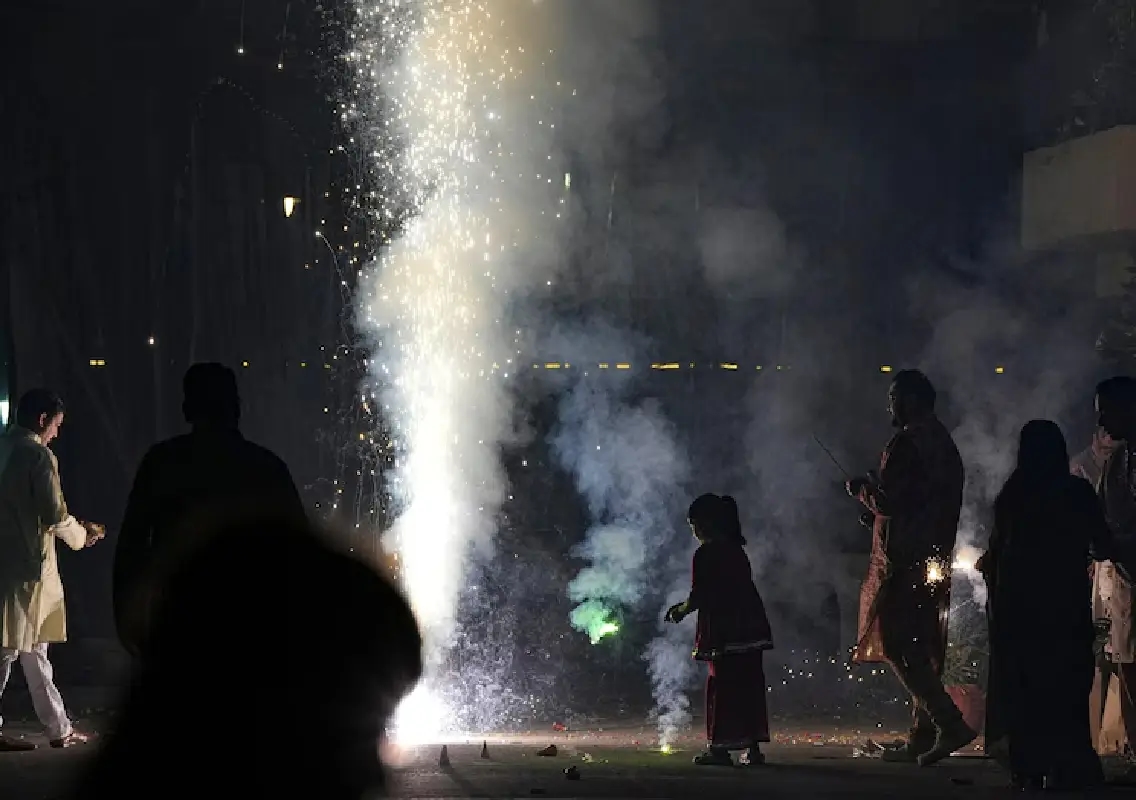


Delhi: Firecrackers accounted for more than 80% of the estimated pollution load in the national capital during the early hours of November 9, the day after Diwali, according to an assessment by the Indian Institute of Tropical Meteorology (IITM).
The findings highlight the significant impact of fireworks on Delhi’s already deteriorating air quality, which remained dangerously poor after the festival. The city woke up to a thick blanket of smog on November 9, with pollution levels remaining in the very poor to severe categories.
Delhi recorded an average Air Quality Index (AQI) of 376 on Diwali, November 8, making it the most polluted Diwali in five years. The situation remained grim the following morning, with the AQI standing at 371 at 10 am. As many as 14 of the city’s 51 air-quality monitoring stations recorded severe pollution levels.
Firecrackers emerge as biggest contributor
According to IITM’s source assessment, firecrackers were responsible for more than 80% of Delhi’s estimated pollution load during the early hours of November 9. Other contributors included secondary organic compounds, which accounted for 5.8%, and vehicle emissions, which contributed 4.4%.
A separate assessment of IITM data estimated that firecrackers contributed 71.1% of PM2.5 pollution between 1 am and 9 am on November 9.
An estimate published on the government’s AIRWISE-Delhi portal put the contribution of firecrackers at 80.2%. However, the portal’s estimate carried a wide uncertainty range.
The figures refer to specific time windows and should not be interpreted as the contribution of firecrackers to the city’s pollution throughout the entire day. Nevertheless, the assessments point to fireworks as the dominant source of the post-Diwali pollution spike during the early hours.
The impact continued into November 10. According to IITM data, firecrackers accounted for 29.9% of the estimated pollution contribution between 1 am and 9 am that day, indicating that pollutants released during the celebrations continued to affect the city’s air quality.
Multiple sources contribute to Delhi’s pollution
While firecrackers emerged as the biggest contributor to the post-Diwali pollution spike, they were not the sole reason for Delhi’s air-quality crisis.
The national capital faces a combination of pollution sources, including vehicle exhaust, industrial emissions, construction dust, waste burning and smoke from agricultural fires in neighbouring states. These sources add to the pollution burden, particularly during winter, when weather conditions can make it difficult for pollutants to disperse.
The IITM assessment also indicated that stubble burning was not a major contributor to Delhi’s pollution load on November 9. This is significant because smoke from farm fires in neighbouring states is frequently cited as one of the factors affecting air quality in the national capital during the winter months.
The findings therefore underline the need to examine the contribution of different pollution sources rather than attributing the city’s deteriorating air quality to a single factor.
Winds bring temporary improvement
Delhi’s air quality showed some improvement on November 10, with favourable winds helping disperse part of the accumulated pollution.
The AQI dropped to 299 at 4 pm before rising slightly to 302 by 6 pm. Although this marked an improvement from the severe levels recorded around Diwali, the air quality remained a concern.
The improvement also demonstrated the role played by weather conditions in determining pollution levels. When winds are favourable, accumulated pollutants can disperse, but stagnant conditions can allow emissions from different sources to remain concentrated over the city.
The IITM findings highlight the immediate impact that intensive fireworks can have on air quality, particularly when a city is already burdened by emissions from transport, industries, construction and other activities.
The post-Diwali pollution spike has once again drawn attention to the challenges facing Delhi in controlling air pollution. While reducing firecracker emissions could help limit sudden increases during festivals, sustained improvements will require measures addressing the multiple sources contributing to the capital’s pollution throughout the year.