







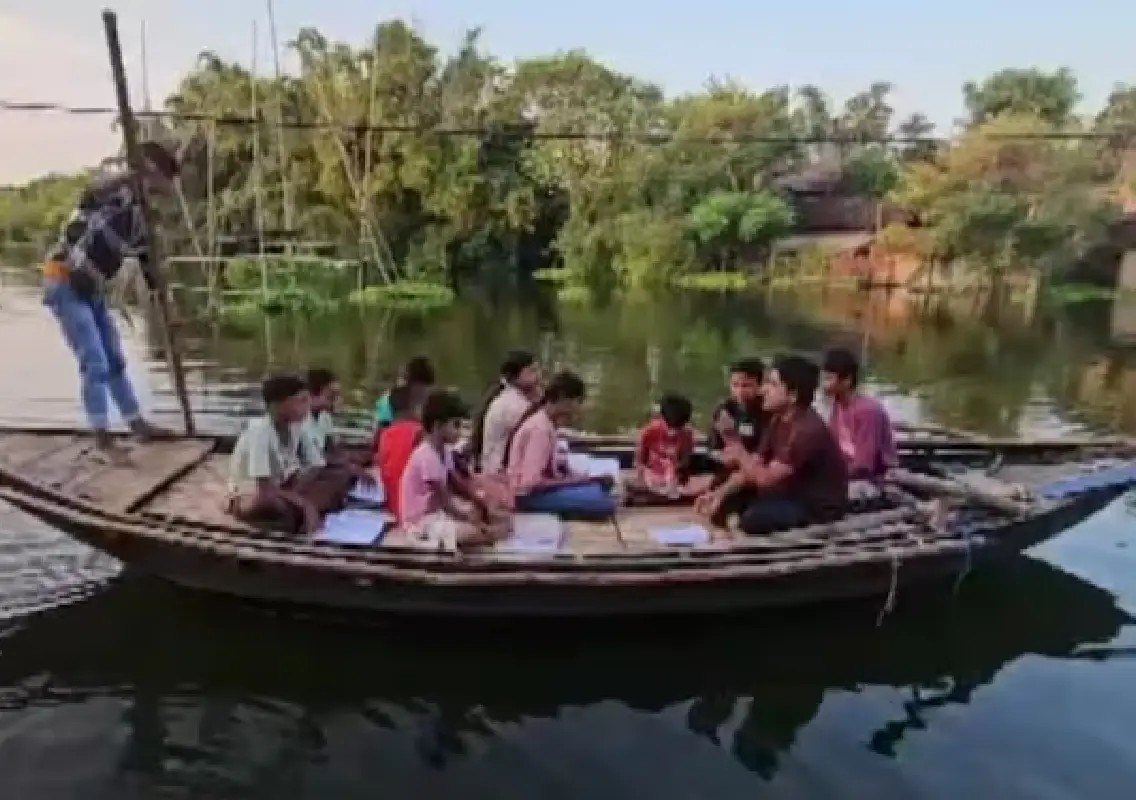


Katihar : As floodwaters have submerged parts of Bihar’s Katihar district, a government school teacher has found an unusual way to ensure that children do not lose touch with their education. Mohammad Saheb is conducting classes from a boat near the submerged school in flood-hit Raghunathpur, turning the vessel into a makeshift classroom for local children.
The initiative has emerged as a small but meaningful effort to keep children engaged with their studies while normal schooling has been disrupted by the floods.
With classrooms inaccessible because of the rising water, the teacher has taken lessons closer to the children, using a boat as the setting for teaching.
School submerged by floodwaters
Raghunathpur is among the areas affected by flooding in Katihar. With water entering and surrounding local settlements, regular educational activities have been disrupted.
For children in flood-affected communities, the closure or inaccessibility of schools can mean a prolonged interruption to learning. Families are also often preoccupied with securing food, shelter and other essentials during such emergencies.
In these circumstances, maintaining even basic educational activities can be difficult.
Mohammad Saheb’s decision to continue teaching from a boat provides an alternative for children who would otherwise be unable to attend their regular classroom.
A boat becomes a classroom
The makeshift classroom is being conducted from a boat positioned near the submerged school.
Instead of allowing the disruption to bring lessons to a complete halt, the teacher has adapted to the circumstances and brought the classroom to the children.
The images and account of the boat school have drawn attention because of the simplicity of the initiative. The setting is very different from a conventional classroom, but the purpose remains the same — helping children continue their education despite the difficult conditions.
The effort also highlights the determination of teachers working in communities affected by natural disasters.
Keeping children connected to education
Floods can have consequences for education that extend beyond the immediate period of school closure. When children remain away from classrooms for an extended period, they can fall behind academically and may find it difficult to return to regular studies once conditions improve.
This is particularly important for children from vulnerable communities, where disruptions to schooling can compound existing educational challenges.
By continuing lessons during the flood, the teacher is helping maintain a sense of routine for students.
The boat classroom also provides children with an opportunity to remain connected with their teacher and classmates during a period when many aspects of daily life have been interrupted.
Teachers adapt during emergencies
Natural disasters frequently force teachers to work beyond the conventional boundaries of a classroom.
In flood-affected areas, schools can become inaccessible or may be temporarily used for relief and shelter operations. Roads can also become difficult to navigate, preventing students and teachers from reaching educational institutions.
In such circumstances, teachers and local communities often have to find practical alternatives.
The initiative in Raghunathpur demonstrates how teaching can continue even when the physical infrastructure normally required for education is unavailable.
It also reflects the importance of local initiative during emergencies, particularly in communities where access to technology or online education may be limited.
Education amid Bihar’s flood crisis
Bihar regularly experiences flooding during the monsoon, with rivers overflowing and affecting large areas of the state.
Flooding can damage homes, roads, agricultural land and public infrastructure. Schools in affected areas can also face prolonged disruption, particularly when water levels rise around buildings and transport routes.
For families living in such conditions, education may understandably become a secondary concern as they focus on immediate safety and survival.
However, efforts such as the boat classroom show why maintaining educational continuity remains important even during a crisis.
The initiative does not replace a functioning school, but it provides a temporary way of keeping children engaged until normal conditions return.
A simple lesson in resilience
The sight of children learning from a boat amid floodwaters has become a powerful illustration of resilience.
For Mohammad Saheb, the extraordinary classroom appears to have emerged from an ordinary responsibility: ensuring that his students continue to learn.
The makeshift arrangement demonstrates that education does not always depend on a conventional classroom. A blackboard, desks and a school building may provide an ideal learning environment, but commitment from teachers and communities can help sustain learning when circumstances make those facilities unavailable.
At the same time, such initiatives also underline the need for adequate institutional support for children and teachers during natural disasters.
Temporary learning spaces, educational materials, safe transportation and other forms of assistance can help reduce the impact of emergencies on children’s education.
Hope beyond the floodwaters
The boat school in Raghunathpur is a modest response to an extraordinary situation, but its significance extends beyond the lessons being taught on the water.
It sends a message that education can continue even when communities face severe disruption.
For the children sitting in the boat, the classroom may look very different from the one they are accustomed to. Yet the act of gathering for lessons provides a degree of normality at a time when floodwaters have transformed their surroundings.
As Bihar’s flood-affected communities work towards recovery, initiatives such as this highlight the role teachers can play in keeping children connected to learning.
Mohammad Saheb’s boat classroom is therefore more than a temporary teaching arrangement. It is a reminder of the resilience of educators and students and of the importance of ensuring that a natural disaster does not permanently interrupt a child’s education.