




New Delhi: The Food Safety and Standards Authority of India (FSSAI) has initiated action against quick-commerce platform Zepto and several food companies over alleged food safety and labelling violations. The cases involve complaints about expired gram flour deliveries, the use of the term “cream” on a bakery product, health-related claims on cranberry supplements and the marketing of pomegranate juice.
According to notices and an adjudication order referred to in a recent post on FSSAI’s official social media account, the regulatory action involves Zepto Marketplace Private Limited, Bakelite Food Processing Private Limited, BMS Lifescience, Healthyhey Foods LLP and Storia Foods & Beverages Private Limited.
The cases cover different aspects of food regulation, including the handling of products beyond their use-by dates, accurate ingredient declarations, the presentation of health claims and the information displayed on beverage packaging.
The proceedings highlight the responsibility of food businesses to ensure that products are handled appropriately and that their labels and marketing claims provide consumers with accurate information. However, the allegations and concerns raised in notices should not be treated as final findings of liability.
Zepto faces notice over allegedly expired besan packets
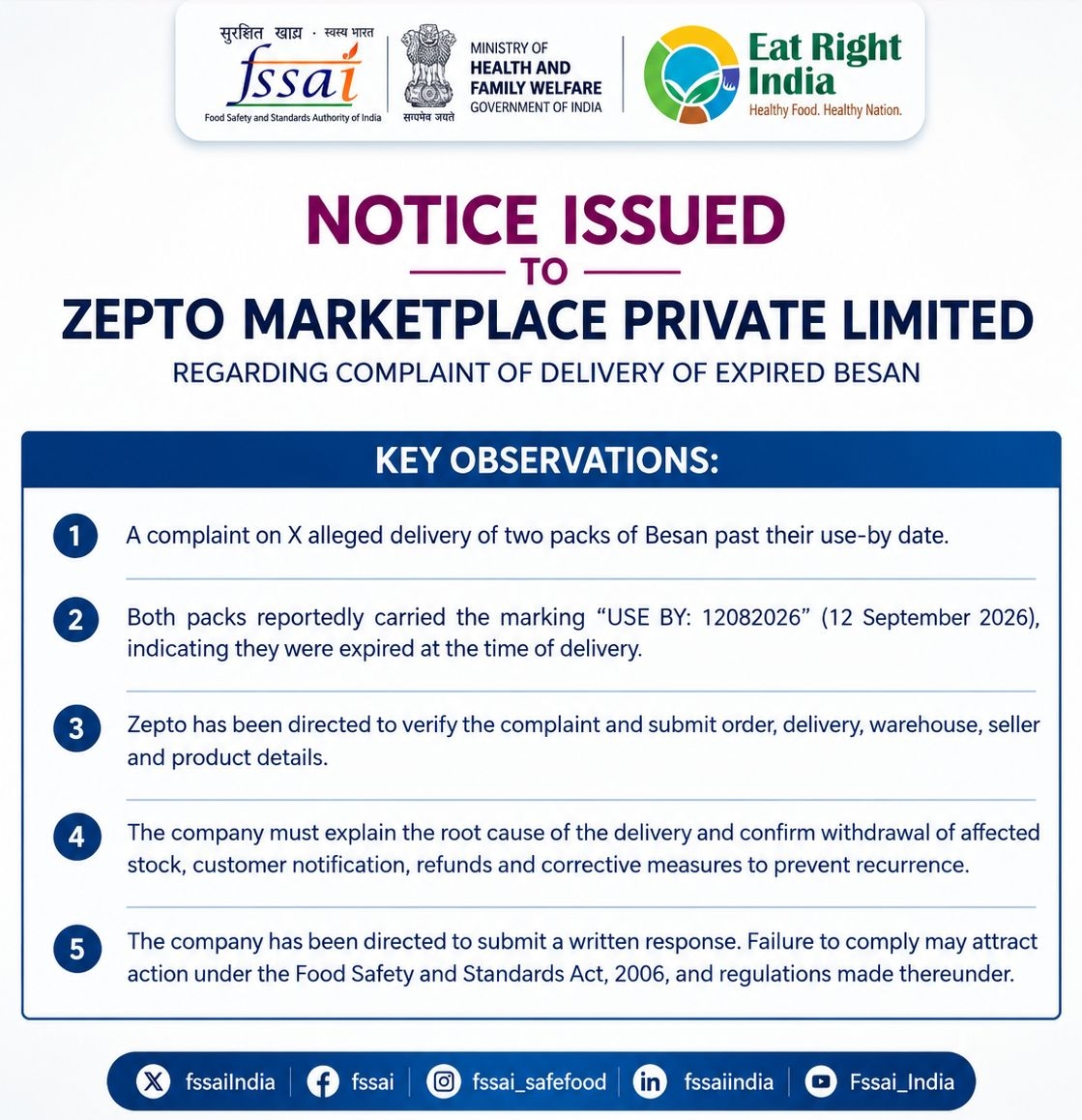
FSSAI issued a notice to Zepto Marketplace Private Limited following a complaint posted on X alleging that two packets of besan, or gram flour, had been delivered after their use-by date.
According to the complaint details cited by the regulator, the packets carried the marking “USE BY: 12092026”, indicating September 12, 2026, as the use-by date.
The notice seeks information to establish the circumstances surrounding the alleged delivery. FSSAI has directed the company to verify the complaint and provide details about the order, delivery, warehouse, seller and product concerned.
The regulator has also sought an explanation for the alleged lapse and information about the corrective steps taken or proposed by the company.
These measures include withdrawing the affected stock, informing customers and issuing refunds wherever applicable.
The proceedings focus on whether the product passed through the company’s order fulfilment and delivery system despite being beyond its stated use-by date. The information sought by FSSAI is expected to help establish how the alleged lapse occurred and whether changes are required in the handling and monitoring of inventory.
For consumers using quick-commerce platforms, the case highlights the importance of checking the dates printed on packaged food products upon delivery, particularly for items that may remain in storage before being dispatched.
FSSAI questions use of ‘cream’ in bakery product name
In a separate case, FSSAI issued a notice to Bakelite Food Processing Private Limited concerning its product, “Malpani’s Bake-Lite Puneri Cream Roll”, sold through quick-commerce platforms Blinkit and Zepto.
The regulator raised concerns that the product’s name and presentation could create a misleading impression about the ingredients used in its filling.
According to the notice, the declared ingredients included refined wheat flour, hydrogenated vegetable fat, margarine and sugar. The ingredient list cited by the regulator did not include milk, cream or other dairy ingredients.
FSSAI questioned whether the use of the word “cream” could mislead consumers about the product’s composition and the nature of its filling.
The issue centres on whether the product’s name and presentation accurately reflect what buyers receive. Consumers may associate the word “cream” with a dairy-based filling, making clear ingredient declarations particularly important when purchasing packaged bakery products.
The case places the emphasis on transparent food labelling and the need for product descriptions to avoid creating an impression that is inconsistent with the ingredients declared on the package.
The notice represents a regulatory concern that the company may respond to through the applicable process. It does not, by itself, establish a final determination against the manufacturer.
Cranberry supplements face scrutiny over health claims
FSSAI has also raised concerns about the labelling and health-related claims used for cranberry supplement products marketed by BMS Lifescience and Healthyhey Foods LLP.
In the case involving BMS Lifescience’s “Haog’s Cranberry Urinary Tract Health Capsules”, the regulator cited concerns relating to an expired FSSAI registration certificate, potentially misleading disease-related claims and the use of the FSSAI logo in a way that could imply certification or endorsement.
The notice questioned whether the product’s claims and presentation complied with the applicable food safety and labelling requirements.
The concerns are significant because consumers may rely on descriptions of supplements when deciding whether to purchase products for particular health-related purposes. Claims relating to urinary tract health or other conditions can influence how buyers understand a product’s intended use and potential benefits.
FSSAI also raised similar concerns about cranberry extract capsules marketed by Healthyhey Foods LLP. The issues included labelling discrepancies and claims that the regulator said required prior approval.
The proceedings bring attention to the rules governing the marketing of food supplements, particularly when descriptions go beyond identifying the product’s ingredients and suggest specific health benefits.
Food businesses must ensure that their product information complies with applicable regulations and does not mislead consumers about a supplement’s properties or intended effects.
The notices do not, however, establish that the products caused harm or that every claim made about them has been conclusively found to violate the law. The specific concerns remain subject to the relevant regulatory process.
Storia Foods faces proceedings over pomegranate juice label
Separately, FSSAI initiated adjudication proceedings against Storia Foods & Beverages Private Limited over labelling claims on its pomegranate juice product.
The regulator raised questions about the product’s stated composition, which included 4% pomegranate juice concentrate and 12% apple juice concentrate.
FSSAI also questioned the claim “Equivalent to 100% Fruit Juice (Reconstituted)” and the presentation of “No Added Sugar” alongside information about naturally occurring fruit sugar.
The concerns relate to how the beverage’s composition and sugar content are communicated to consumers. Product labels play an important role in helping buyers understand the ingredients in a drink, particularly when its name or promotional claims emphasise a specific fruit.
The use of apple juice concentrate alongside pomegranate juice concentrate also raises questions about whether the product’s description clearly communicates the relative contributions of the ingredients.
Similarly, claims about fruit juice equivalence and added sugar can shape consumers’ perceptions of a beverage’s nutritional characteristics. The regulator’s proceedings seek to examine whether the claims and presentation comply with the applicable requirements.
Unlike the notices in the other cases, the proceedings against Storia were described as adjudication proceedings. This is a distinct stage of regulatory action and should not automatically be interpreted as a final determination of liability.
What happens next in the FSSAI cases?
The companies concerned have been directed to respond to the notices or comply with the requirements specified in their respective proceedings. The next steps will depend on the explanations submitted, the evidence examined and the applicable regulatory procedures.
The cases cover several separate issues rather than one common violation. Zepto’s case concerns the alleged delivery of expired besan packets, while the action involving Bakelite Food Processing relates to the accuracy of a bakery product’s name and ingredient presentation.
The cranberry supplement cases focus on registration, labelling and health-related claims. The proceedings involving Storia Foods concern how a juice product’s composition and sugar-related claims are presented to consumers.
For food businesses, the cases underscore the importance of maintaining inventory controls, keeping registrations and licences up to date where required, declaring ingredients accurately and ensuring that product claims meet regulatory standards.
For consumers, the developments are a reminder to check use-by dates, read ingredient lists and assess health or nutritional claims carefully when buying packaged food and supplements, including through quick-commerce services.
FSSAI’s action also highlights the role of regulatory oversight in addressing concerns about how food products are stored, described and marketed. The outcome of each case will depend on its individual facts and the applicable legal process. Until the proceedings are concluded, the allegations and concerns raised by the regulator should not be treated as final findings against the companies.