







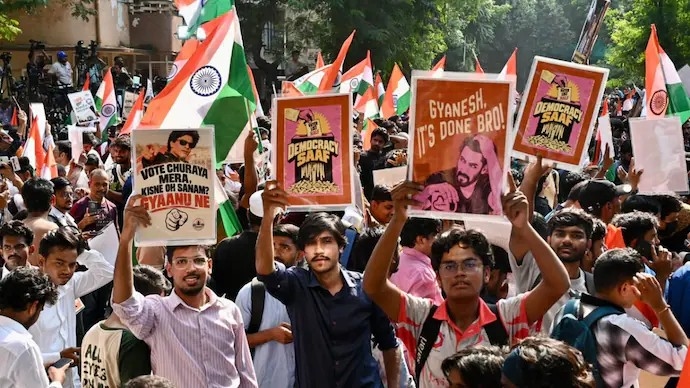


Mumbai: From “Gyanu must go” to Bollywood-style wordplay, protesters at Mumbai’s Shivaji Park turned placards, memes and film references into slogans as the Cockroach Janta Party (CJP) held a demonstration on Friday demanding the resignation of Chief Election Commissioner Gyanesh Kumar.
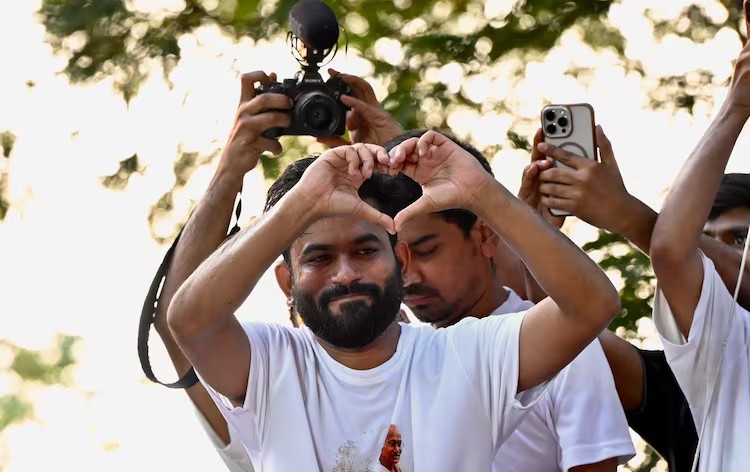
The protest, held on October 2, drew thousands of people despite police refusing permission for the gathering. The Mumbai Police Special Branch estimated that around 9,000 to 10,000 people had gathered at the venue by 4 pm, according to Times of India.
The demonstration brought together student groups, activists, cultural figures and supporters of political parties. Veteran actors Shabana Azmi and Naseeruddin Shah, singer-composer Vishal Dadlani and activist Tushar Gandhi were among those who attended.
At the centre of the gathering was the CJP’s demand that Kumar step down, along with its call for a freeze on the 2025 electoral roll and a more transparent process for appointing the next Chief Election Commissioner.
Placards turn protest into satire
One of the most noticeable features of the Shivaji Park gathering was the creativity displayed on the placards.
Protesters carried messages including “Gyanu, Tujha Democracy Var Bharosa Nay Kay?” — or “Gyanesh, don’t you trust democracy?” — as well as “Gyanesh BRO, JUST RESIGN” and “Gaddaar Gyaanu Must Go”.
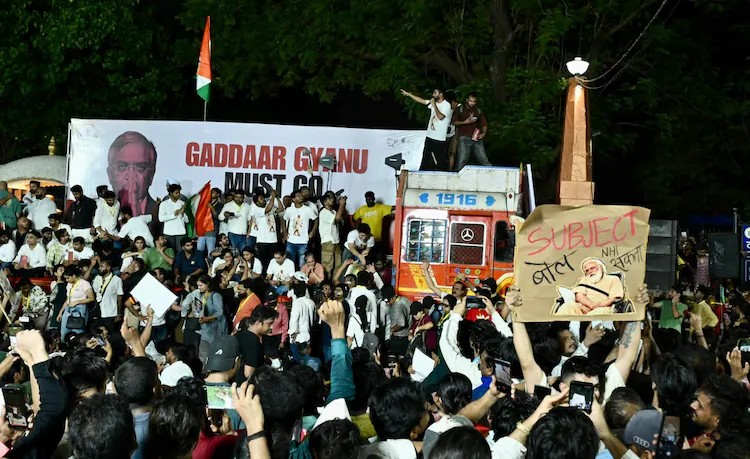
Other posters used memes, Bollywood references and wordplay to make political statements. The visual campaign gave the demonstration a distinctly youthful character, with participants using popular culture alongside conventional protest slogans.
The use of satire was also reflected in slogans directed at the Chief Election Commissioner and the Election Commission over the controversy surrounding the Special Intensive Revision (SIR) of electoral rolls.
The Times of India reported that protesters used film dialogues, memes and even creative props during the gathering, while the New Indian Express also documented the slogans and placards displayed at Shivaji Park.
CJP challenges Election Commission over SIR
The immediate trigger for the CJP’s campaign was a report by The Indian Express that Election Commissioners Sukhbir Singh Sandhu and Vivek Joshi had formally recorded objections at least 14 times over a 10-month period concerning decisions and orders linked to the electoral-roll revision process.
The report said the objections related to issues including voter registration, deletion of names, changes to Form 6, access to electoral-roll databases and certain decisions that the two commissioners said had been taken without their knowledge.
The CJP subsequently made Kumar’s resignation one of its principal demands.
The organisation has also called for the 2025 electoral roll to be frozen and for elections to be conducted using that list, while seeking a more transparent and independent process for appointing the next Election Commissioner, including participation from civil society.
CJP founder Abhijeet Dipke had said before the Mumbai protest that the agitation would continue and expand to other cities before culminating in a demonstration at Delhi’s Jantar Mantar.
Election Commission says decisions were unanimous
The Election Commission has rejected the suggestion that the reported objections amounted to formal dissent on decisions taken by the poll panel.
Following the report about the 14 objections, the Commission said individual views expressed by its members should not be treated as separate decisions of the institution. It maintained that decisions of the three-member Commission, including those related to the SIR exercise, were taken unanimously with the approval of all three commissioners.
EC sources reiterated the position again on October 1, saying that no Election Commissioner had formally dissented on any decision since February 19, 2025, even though the earlier media report had documented objections raised by Sandhu and Joshi over various aspects of the SIR process.
The differing accounts over the internal communications have become a central part of the wider debate surrounding the Election Commission and the electoral-roll revision exercise.
Heavy police deployment at Shivaji Park
The protest took place amid a substantial security presence in central Mumbai.
Police barricaded routes around Dadar railway station and monitored access to Shivaji Park. The authorities had refused permission for the demonstration, citing restrictions governing gatherings at the ground, but the CJP proceeded with its planned agitation.
The party had announced that the protest would begin near Gate No. 6 of Shivaji Park at 4 pm. Dipke had said before the event that the demonstration would go ahead even without official permission.
The police presence was also aimed at preventing disruption to traffic and maintaining law and order around the venue.
Some local residents objected to the protest, raising concerns about noise, disruption and the impact on the neighbourhood. Reports said groups of residents had earlier confronted CJP members over the planned demonstration.
Despite those objections and the security restrictions, protesters continued to arrive at the ground.
Students, actors and activists join gathering
The demonstration attracted participation from several student and civil society groups.
Members of the Students’ Federation of India (SFI) and the All India Students’ Federation (AISF) were among those present.
The presence of prominent cultural figures also drew attention to the protest. Shabana Azmi, Naseeruddin Shah and Vishal Dadlani attended, while Tushar Gandhi, the great-grandson of Mahatma Gandhi, was also present. Filmmakers and other public figures were reported to have joined or expressed support for the gathering.
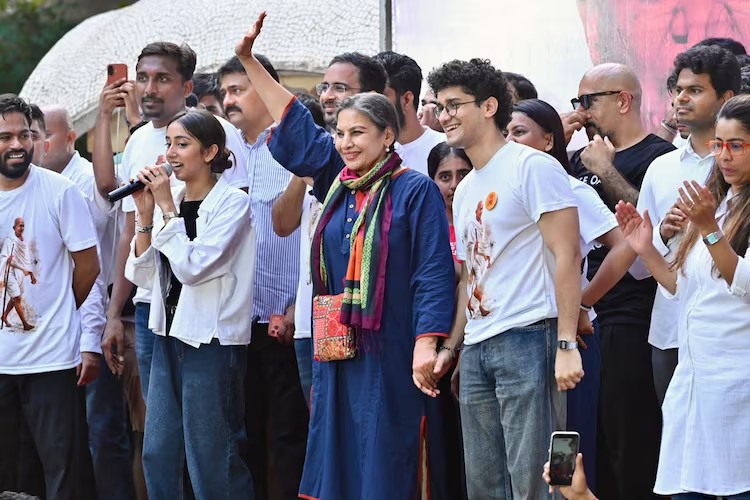
Azmi addressed the gathering and spoke about voting as a constitutional right while backing the organisation’s demand for Kumar’s resignation.
Dadlani had also publicly announced his support for the CJP’s protest before Friday’s gathering.
Political parties extend support
The Shiv Sena (UBT) and Maharashtra Navnirman Sena (MNS) extended support to the agitation, according to reports. Both parties have a political presence in and around the Dadar area.
The protest also became part of a broader political debate over the Election Commission’s handling of the SIR exercise.
CJP leader Abhijeet Dipke used his address to criticise the Narendra Modi-led central government and challenged Maharashtra Chief Minister Devendra Fadnavis over the possibility of police action against protesters.
Dipke had earlier said he was prepared to face arrest if the demonstration was held without permission, while arguing that the right to protest should not depend entirely on official approval.
His remarks added a confrontational political dimension to the gathering, although the central focus remained the CJP’s demand concerning the Election Commission.
Protest comes amid wider SIR debate
The Mumbai demonstration is taking place against the backdrop of an increasingly contentious debate over the Special Intensive Revision of electoral rolls.
An Indian Express investigation reported that the SIR process had removed more than 13 crore names from draft rolls across 30 states and Union Territories, placing the Election Commission under scrutiny over how voter lists were being revised. The figures refer to names removed from draft rolls and do not by themselves establish that all those individuals were permanently disenfranchised.
The Election Commission has maintained that its decisions were taken collectively and has continued to emphasise the availability of mechanisms for eligible citizens to seek inclusion in electoral rolls.
The controversy has nevertheless prompted political parties, activists and civil society groups to raise questions about the transparency of the process and the functioning of the poll panel.
The Supreme Court has also agreed to hear a petition challenging aspects of the Election Commission’s functioning and the nationwide SIR, although the allegations in the petition remain matters for judicial consideration.
Shivaji Park becomes stage for a national campaign
Friday’s gathering at Shivaji Park was therefore more than a single-city protest. The CJP has described it as the beginning of a nationwide campaign that will move through other cities before reaching Delhi.
For the protesters, the placards and slogans provided a way to express their objections through humour, popular culture and political satire. For the Election Commission, the controversy centres on its position that decisions of the three-member panel, including those concerning SIR, were taken unanimously.
The competing claims have placed the functioning of the poll panel and the revision of electoral rolls at the centre of renewed public debate.
At Shivaji Park, however, the political message was delivered through a distinctly Mumbai style: large crowds, colourful placards, film-inspired slogans and a heavy police presence surrounding a protest that had gone ahead despite the absence of official permission.