







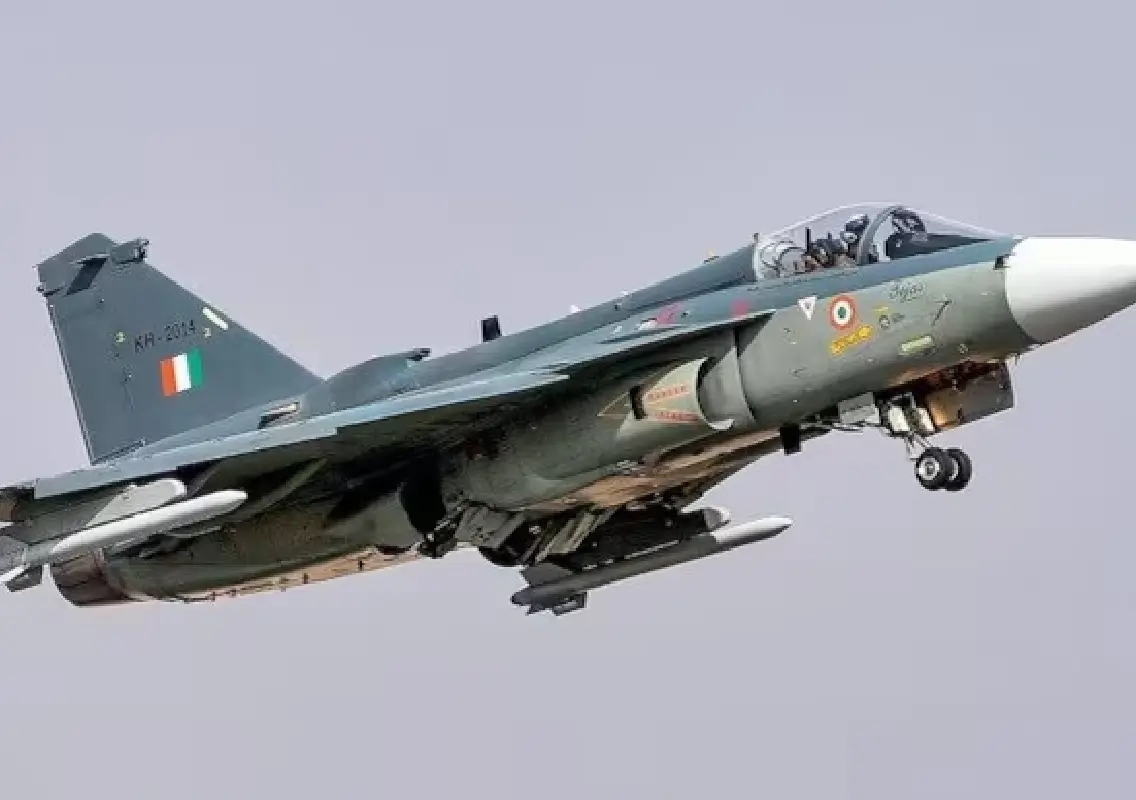


Nashik: The first Tejas Mk1A fighter aircraft produced at Hindustan Aeronautics Limited’s (HAL) new Nashik manufacturing complex completed its maiden flight on Friday, marking a major milestone in India’s indigenous defence production programme.
The event came shortly after Defence Minister Rajnath Singh inaugurated HAL’s Light Combat Aircraft (LCA) Tejas and HTT-40 trainer aircraft assembly lines at the facility. The rollout was celebrated with a traditional water cannon salute, underscoring HAL’s push to expand domestic fighter jet production.
Maiden flight marks new phase in indigenous defence manufacturing
The Tejas Mk1A’s successful first flight is seen as a crucial step toward meeting the Indian Air Force’s (IAF) operational requirements. However, the aircraft’s formal induction into the IAF will only take place after the successful completion of ongoing weapon and radar integration trials.
The pre-induction test phase involves clearance for Astra beyond-visual-range missiles, short-range air-to-air missiles, and laser-guided bombs. It will also validate integration with the Israeli-origin ELTA ELM-2052 radar and its fire-control system.
Earlier trials had encountered software-related issues, prompting HAL engineers to make modifications before final validation.
Nashik adds new production capacity
The Nashik complex now houses HAL’s third Tejas production line and second HTT-40 line, significantly expanding the PSU’s output potential. Designed to produce up to eight aircraft annually, the facility supports HAL’s goal of scaling up Tejas Mk1A production to meet IAF’s urgent requirements.
The Nashik rollout is part of HAL’s broader plan to ramp up production beyond its two existing Tejas lines in Bengaluru.
To accelerate output, HAL has also established a private-sector supply chain, involving:
- VEM Technologies – Centre fuselage production
- Alpha Design Technologies – Rear fuselage assembly
- Larsen & Toubro (L&T) – Wing fabrication
This ecosystem is expected to support the production of an additional six aircraft annually, eventually enabling an output of 30 Tejas Mk1A fighters per year by 2026–27.
Engine delays pose short-term challenges
Despite progress on the airframe front, HAL is contending with delays in the supply of 99 GE F404 engines, contracted in August 2021 for ₹5,375 crore. So far, only four engines have been delivered.
General Electric (GE) has assured that eight more engines will be supplied by March 2026, followed by around 20 engines annually thereafter.
HAL officials said the company has managed to keep production and testing on schedule by rotating available engines among prototype and pre-production aircraft.
Expanding IAF fleet amid urgent requirements
The initial order for 83 Tejas Mk1A aircraft, cleared in 2021, is scheduled for delivery between 2024 and 2028. In August 2025, the Cabinet Committee on Security (CCS) approved an additional 97 Mk1A fighters for ₹66,500 crore, taking the total order size to 180 aircraft.
Air Chief Marshal A.P. Singh has repeatedly emphasised the IAF’s urgent need for new fighters, noting that the force requires at least 40 new aircraft each year to sustain operational readiness.
HAL has expressed confidence that the production ecosystem will stabilise soon, allowing it to meet delivery timelines and address integration challenges efficiently.
Demonstration flight and symbolic rollout
Friday’s ceremony concluded with a formation flight featuring the Tejas Mk1A, HTT-40 trainer, and Su-30MKI, showcasing India’s growing self-reliance in defence aviation.
Defence officials hailed the maiden flight as a symbol of Atmanirbhar Bharat, reinforcing India’s commitment to indigenous defence manufacturing and technology development.