







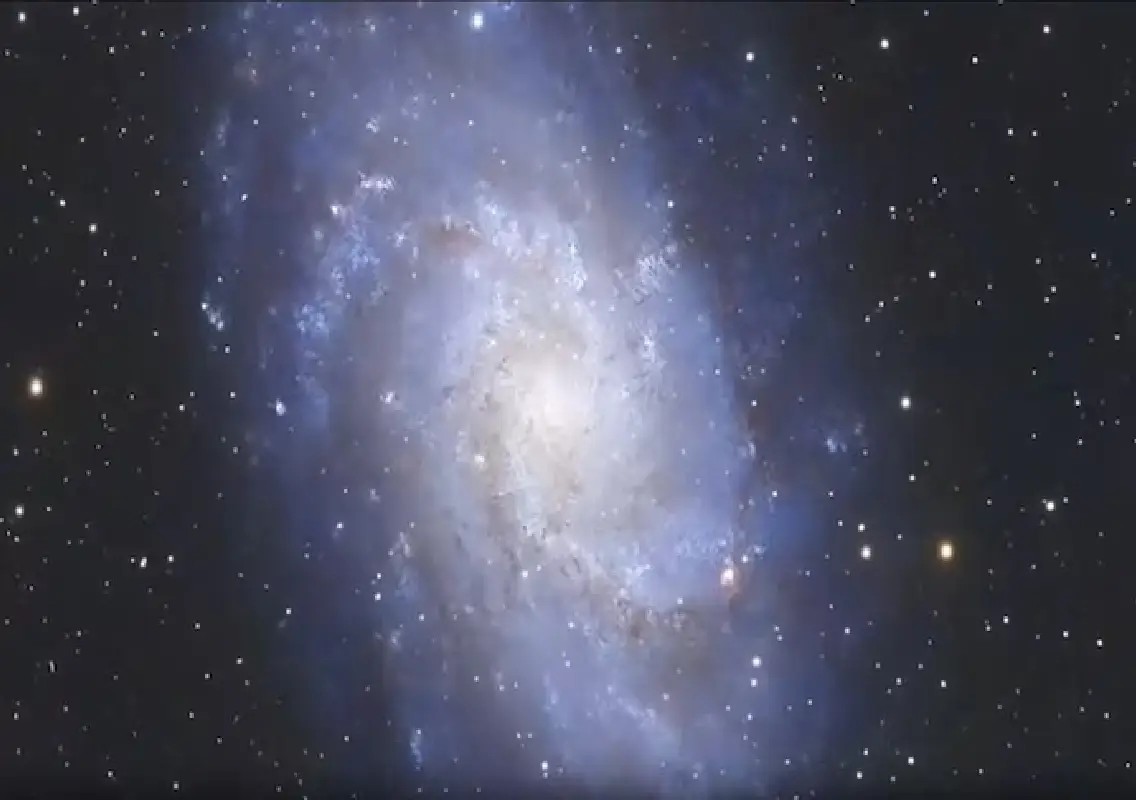


Tehri Garhwal: A remarkable image captured by an Indian astrophotographer from a remote Himalayan village in Uttarakhand has drawn attention after it revealed a galaxy located nearly 27 lakh light-years away from Earth. Amateur astrophotographer Ramesh Bhadri photographed the distant celestial object using compact equipment from a region known for its exceptionally dark skies and low light pollution.
The image features the Triangulum Galaxy, also known as Messier 33 or NGC 598, one of the major galaxies located in Earth’s cosmic neighbourhood.
Ancient light reaches Earth after millions of years
What makes the image particularly fascinating is the journey of the light itself.
Astronomers estimate that light from the Triangulum Galaxy takes around 27 lakh years to reach Earth. This means the photons captured by the camera had already begun travelling through space long before modern human civilisation existed.
Scientists explain that observing distant objects in space is essentially equivalent to looking back in time because light requires enormous periods to travel across cosmic distances.
The image captured from the Himalayan region therefore represents a view of the galaxy as it existed millions of years ago rather than its current state.
Triangulum remains a major member of our cosmic neighbourhood
The Triangulum Galaxy is considered the third-largest member of the Local Group of galaxies, a collection of nearly 50 galaxies that includes the Milky Way and the Andromeda Galaxy.
The galaxy is estimated to contain nearly 40 billion stars and has a spiral structure with curved arms extending from its central region.
Astronomers often refer to it as the Pinwheel Galaxy because of its appearance.
Although enormous by human standards, the Triangulum Galaxy is smaller than the Milky Way, which is estimated to contain between 100 billion and 400 billion stars.
Massive star-forming region attracts scientific interest
One of the most prominent structures within the galaxy is NGC 604, an enormous stellar nursery where stars continue forming.
Scientists estimate that the region spans approximately 1,500 light-years.
The glowing pink appearance seen in many astrophotography images originates from hydrogen-alpha emission, a phenomenon created when energetic young stars interact with surrounding hydrogen gas.
Such regions continue to provide astronomers with valuable insights into how stars form and evolve.
Compact equipment and dark skies made the image possible
Reports indicate that Bhadri used a compact telescope and specialised imaging equipment to capture the galaxy.
Long-exposure photography techniques allow cameras to collect light particles over extended periods, helping reveal faint structures that remain invisible to the naked eye.
Dark Himalayan skies, largely free from urban light pollution, also played an important role in obtaining clear images of distant celestial objects.
The achievement highlights how modern astrophotography equipment combined with ideal observation conditions can allow enthusiasts to capture extraordinary images of deep-space objects.
Future cosmic event may reshape nearby galaxies
Astronomers believe that in approximately 400 crore to 500 crore years, the Milky Way and Andromeda galaxies are expected to collide and merge.
Scientists suggest that the Triangulum Galaxy may also become part of this massive cosmic interaction because of its gravitational relationship with Andromeda.
For now, however, the image captured from a Himalayan village offers a rare reminder of the immense scale of the universe and the extraordinary distances light travels before reaching Earth.