







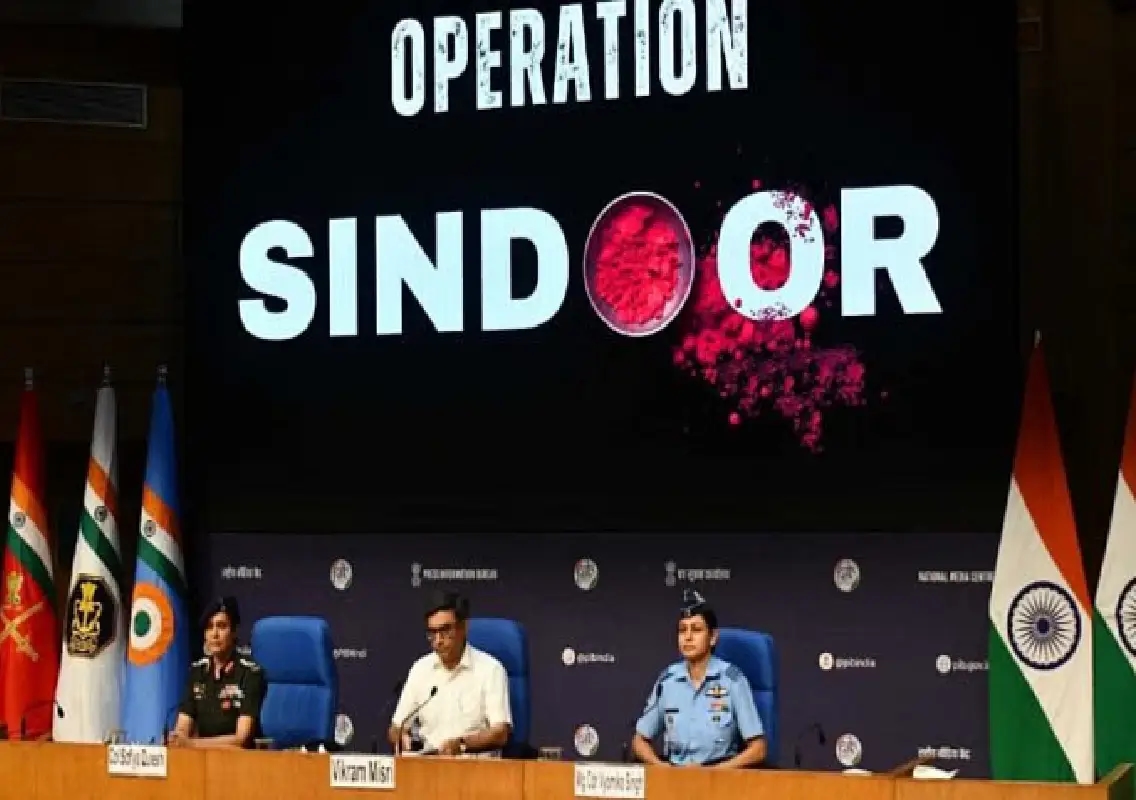


New Delhi: Operation Sindoor has emerged as a landmark in India’s military history, being the first cross-border operation to integrate Artificial Intelligence (AI) across the full spectrum of planning, targeting, and execution. The use of AI drastically shortened the “kill chain” — the time between identifying a target and neutralising it — and enabled pinpoint precision with human oversight, senior Army officials said on Monday.
India’s first AI-driven conflict engagement
Lieutenant General Rajiv Kumar Sahni, Director General of Electronics and Mechanical Engineers (DG EME) and the former Director General of Information Systems during Operation Sindoor, revealed that AI-based tools were instrumental in giving the Indian Army an unprecedented battlefield edge.
“AI was fed with 26 years of historical data related to Pakistan’s military activity. This modelling, combined with live feeds, allowed us to predict enemy movement with 94 percent accuracy,” Lt Gen Sahni said. The predictive models could indicate where enemy guns, missile units, or armoured formations were likely to be stationed along the border.
According to him, this capability marked a transformation in operational efficiency, helping the Army strike specific targets with reduced collateral damage. “The operation showed how AI can act as a force multiplier when combined with traditional combat intelligence,” he added.
China’s covert support and the dual-front challenge
Lt Gen Sahni acknowledged that India faced simultaneous challenges from both its western and northern borders. “There was both overt and covert support from China to Pakistan. The way things are progressing, this pattern is likely to persist,” he warned.
The Army’s strategic assessments during Operation Sindoor indicated that Chinese assistance had enhanced Pakistan’s surveillance and weapon guidance systems, reinforcing the need for India to develop indigenous technological superiority.
23 systems integrated for full battlefield awareness
The Army fused data from 23 applications to create a single, real-time battlefield picture. These included tools for surveillance, intelligence analysis, weather prediction, and post-strike assessments.
Key systems used were the Electronic Intelligence Collation and Analysis System (ECAS), TRINETRA (integrated with Project SANJAY), and predictive modelling and weather forecasting platforms. Together, these tools provided commanders with situational awareness at tactical and strategic levels.
One of the significant innovations was an in-house application that predicted weather conditions, including wind speed, up to 48 hours in advance. “This enabled accurate firing of extended-range artillery by factoring in weather dynamics,” Lt Gen Sahni explained.
Towards a military-specific large language model
Highlighting future developments, he said the Army is working on a military-specific large language model (LLM), tailored for combat analysis and decision support. The LLM, expected to become operational within six months, will assist in synthesising intelligence from multiple data sources to provide commanders with real-time recommendations.
“AI adoption is being pursued responsibly and in a phased manner,” he said, stressing that all systems retain “human in the loop” control to ensure ethical governance and accountability.
Building a connected digital force
The Army’s ongoing digital transformation has seen a 1,200 percent increase in system users and a 620 percent rise in data storage capacity, Lt Gen Sahni noted. These upgrades have made the digital backbone more resilient, interconnected, and capable of supporting joint decision-making across commands.
He underlined that the adoption of AI and advanced analytics was aimed at reducing risks to soldiers and enhancing operational readiness. “This is not about replacing human judgement but strengthening it with data-driven insights,” he said.
A decisive step into future warfare
Operation Sindoor has demonstrated how technology can redefine modern warfare by combining data analytics, automation, and ethical oversight. Military observers see this as a significant step towards a smarter, faster, and more precise Indian Army—capable of countering hybrid threats on multiple fronts.
With lessons from Sindoor, the Army is now refining its AI tools for wider deployment, signalling a new era in India’s defence preparedness where algorithms and soldiers work hand in hand.