







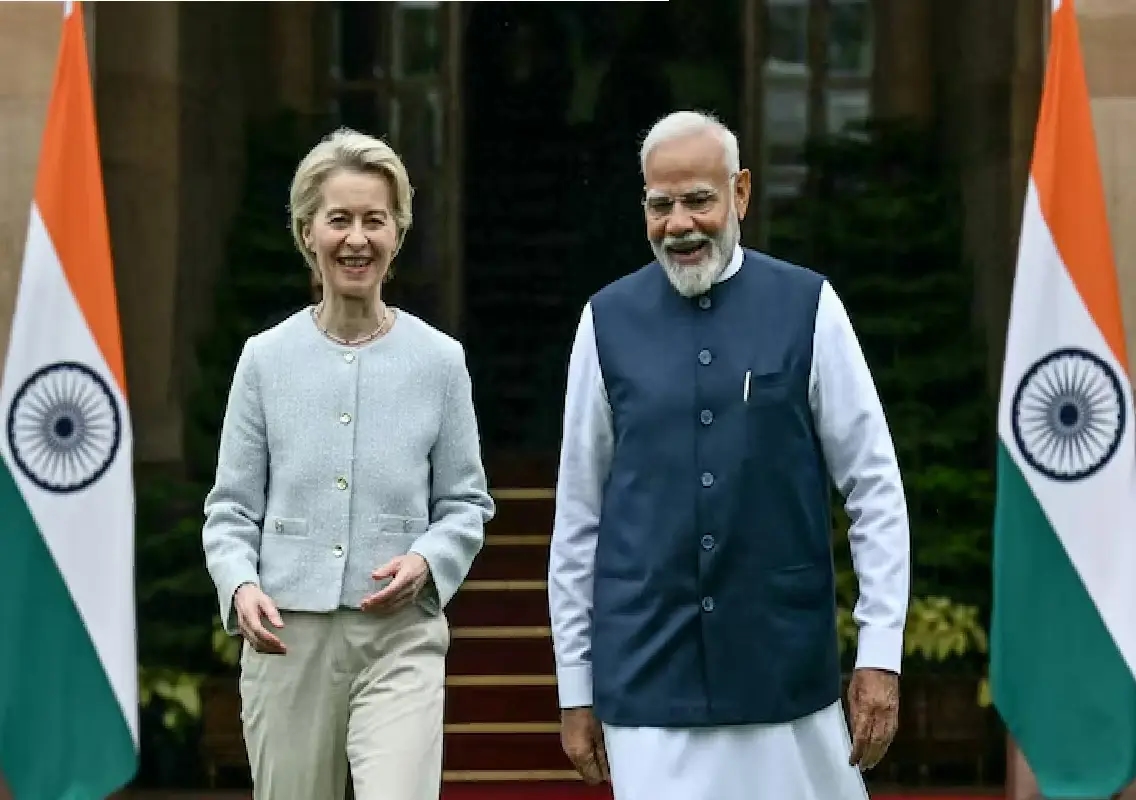


New Delhi: European Commission President Ursula von der Leyen has indicated that negotiations between India and the European Union are nearing a crucial breakthrough, signalling that both sides are “on the cusp of a historic trade agreement” that could significantly reshape global commerce and supply chains. Her remarks, delivered at the World Economic Forum (WEF) in Davos on Tuesday, mark the clearest public signal yet of renewed momentum in the long-pending India-EU free trade talks.
Addressing global leaders and business executives, von der Leyen framed the proposed agreement as a central pillar of Europe’s evolving economic strategy. She emphasised the European Union’s commitment to what she described as “fair trade over tariffs, partnership over isolation, and sustainability over exploitation”, underscoring the bloc’s intent to diversify supply chains and reduce strategic vulnerabilities.
“And right after Davos, the next weekend, I will travel to India. There is still work to do, but we are on the cusp of a historic trade agreement,” von der Leyen said. She added that the agreement, which some have dubbed the “mother of all deals”, would create a combined market of nearly two billion people and account for close to a quarter of global GDP.
Strategic importance of India in EU’s global vision
Von der Leyen placed India at the heart of Europe’s strategy to engage with major growth centres of the world. She described the Indo-Pacific region as one of the “economic powerhouses of this century” and said Europe was keen to deepen economic ties with countries driving global growth.
“Europe wants to do business with the growth centres of today and the economic powerhouses of this century, from Latin America to the Indo-Pacific and far beyond,” she said, adding that Europe “will always choose the world, and the world is ready to choose Europe”.
For the European Union, the proposed trade agreement with India is seen as a key step in de-risking its economy by reducing excessive dependence on a limited set of suppliers. Brussels has been increasingly focused on building resilient and diversified supply chains, particularly in strategic sectors such as clean energy technologies, digital infrastructure, pharmaceuticals and critical raw materials.
Renewed momentum after years of negotiations
India and the EU have held multiple rounds of trade negotiations over the years, but talks often stalled due to differences on issues such as market access, tariffs, data protection, intellectual property rights and sustainability standards. However, shifting geopolitical and economic realities have injected fresh urgency into the discussions.
Rising global trade tensions, supply chain disruptions and the need for trusted economic partners have prompted both New Delhi and Brussels to re-evaluate the strategic value of closer economic integration. Analysts note that von der Leyen’s strong statement at Davos suggests a clear political push to bridge remaining gaps and move towards a conclusion.
If finalised, the agreement would give European companies a significant first-mover advantage in one of the world’s fastest-growing major economies, while offering Indian exporters improved access to one of their largest trading partners.
High-profile visit to India adds political weight
Von der Leyen’s comments come just days ahead of her scheduled visit to India later this month, a trip expected to give a major political boost to the trade negotiations. According to a statement issued earlier this month by India’s Ministry of External Affairs (MEA), European Council President Antonio Luis Santos da Costa and European Commission President Ursula von der Leyen will be on a State Visit to India from January 25 to 27, 2026, at the invitation of Prime Minister Narendra Modi.
In a significant diplomatic gesture, the two European leaders will serve as the Chief Guests at India’s 77th Republic Day celebrations. Observers see this as a strong signal of the growing strategic importance both sides attach to the India-EU partnership.
During the visit, von der Leyen and da Costa will co-chair the 16th India-EU Summit with Prime Minister Modi on January 27. The leaders are also scheduled to meet the President of India and hold both restricted and delegation-level talks with the Prime Minister. An India-EU Business Forum is expected to be organised on the sidelines of the summit, bringing together industry leaders to explore new trade and investment opportunities.
Broadening scope of India-EU ties
India and the European Union have been strategic partners since 2004, but the relationship has gained new depth and urgency in recent years. The visit of the EU College of Commissioners to India in February 2025 was described by both sides as historic, reflecting a shared intent to elevate cooperation across multiple domains.
According to the MEA, bilateral ties now span a wide range of areas, including trade, technology, climate action, connectivity, security and people-to-people exchanges. The proposed trade agreement is expected to build on this broader partnership framework.
Potential impact of a landmark agreement
If concluded, the India-EU trade agreement would rank among the largest and most ambitious trade deals globally. Beyond tariff reductions, it is expected to cover services, investment, digital trade, sustainability norms and regulatory cooperation.
For India, the deal could mean deeper access to European markets, increased foreign investment and greater integration into global value chains. For the EU, it would secure a stronger foothold in a vast and rapidly expanding market at a time when global trade patterns are being reshaped by geopolitical tensions and economic fragmentation.
Conclusion
While negotiators on both sides acknowledge that complex issues remain, Ursula von der Leyen’s remarks at Davos underline strong political will to finalise the agreement. With a high-profile summit in New Delhi just days away, expectations are rising that India and the European Union may finally move closer to sealing what Brussels has already described as a “historic” and potentially game-changing trade deal.