







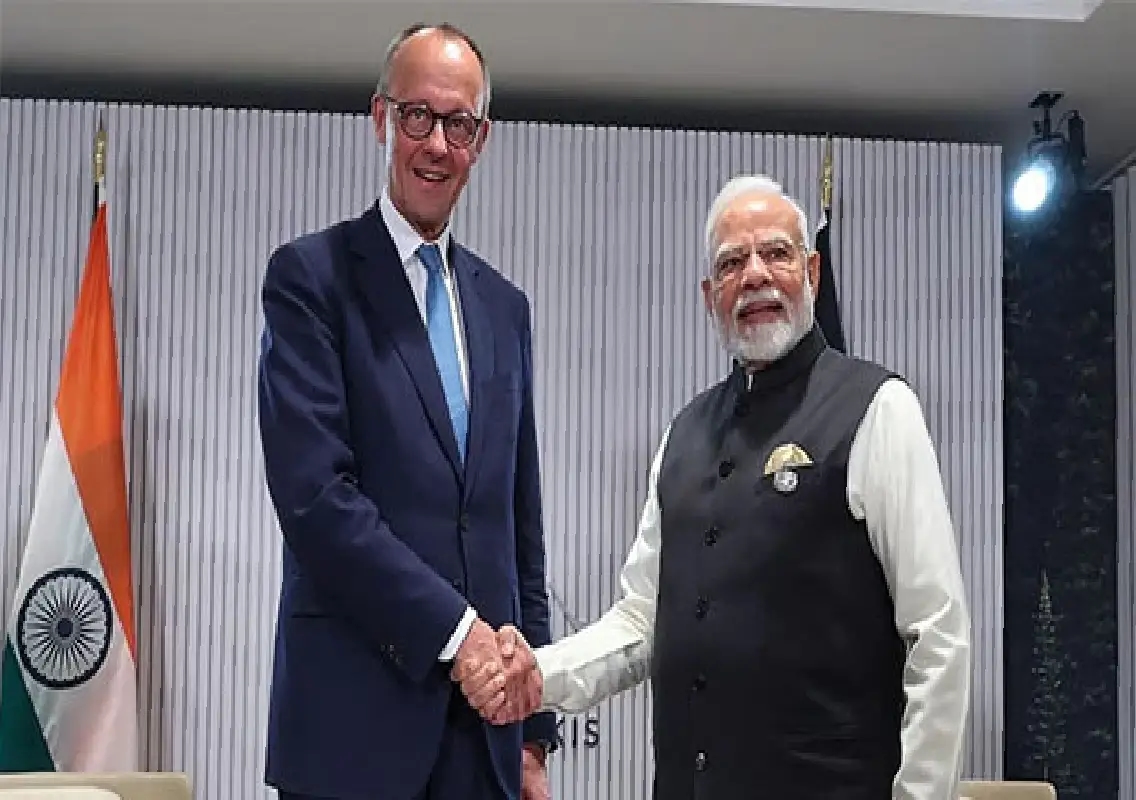


New Delhi: India and Germany on Monday signed a series of Memorandums of Understanding (MoUs) in the presence of Prime Minister Narendra Modi and German Chancellor Friedrich Merz, marking a significant step forward in bilateral relations as trade between the two countries crossed the $50 billion mark.
Bilateral trade at historic high
Addressing the media after the signing of the MoUs, Prime Minister Modi said that India–Germany trade has reached its highest-ever level, reflecting the growing strength and depth of economic ties between the two nations. He noted that the milestone underscores Germany’s sustained confidence in India’s economic potential.
“More than 2,000 German companies have a long-standing presence in India. This reflects their unwavering confidence in India and the immense opportunities available here,” Modi said. He added that cooperation between the two countries in the field of technology has consistently strengthened over the years.
Germany is one of India’s most important economic partners in Europe, with collaboration spanning manufacturing, engineering, automobiles, electronics, chemicals and emerging technologies. Officials said the latest agreements are expected to further boost investment flows and joint ventures.
Focus on renewable energy and climate action
Prime Minister Modi highlighted that India and Germany share common priorities in renewable energy and climate action. He announced the decision to establish an India–Germany Centre of Excellence to deepen cooperation in clean energy and innovation.
“To further enhance this cooperation, we have decided to establish the India–Germany Centre of Excellence. This will serve as a shared platform for knowledge, technology and innovation,” Modi said.
He also revealed that companies from both countries are jointly working on new projects in climate, energy, urban development and urban mobility. Among these initiatives, a major green hydrogen project involving firms from India and Germany was described as a potential “game changer” for the future of energy.
Green hydrogen is seen as a critical element in global efforts to transition away from fossil fuels, and both India and Germany have outlined ambitious national strategies in this sector.
Cooperation in development, migration and skills
Another key area of cooperation highlighted during the talks was development, migration, mobility and skill enhancement. Modi acknowledged the growing contribution of Indian professionals, particularly young workers, to the German economy.
“India’s talented youth are making a significant contribution to the German economy. The Joint Declaration of Intent on the Global Skills Partnership issued today is a symbol of this trust,” Modi said.
He added that the agreement would particularly facilitate the movement of healthcare professionals, addressing skill shortages in Germany while creating global opportunities for trained Indian workers.
Officials said the Global Skills Partnership framework aims to align skill development in India with international labour market requirements, ensuring mutual benefit for both countries.
Steps forward in education and sports
The two leaders also announced concrete steps to expand cooperation in sports and education. Modi said collaboration in sports would help build stronger people-to-people ties, especially among the youth of both nations.
“Today, we have also taken concrete steps to further cooperation in the field of sports. This will be an effective means of connecting young people,” he said.
In the education sector, Modi referred to a comprehensive roadmap on higher education developed as part of the discussions. He invited German universities to open campuses in India, in line with India’s push to internationalise its higher education ecosystem under the National Education Policy.
“The comprehensive roadmap on higher education developed today will give a new direction to our partnership in the education sector. I invite German universities to open their campuses in India,” Modi said.
Education experts said such collaborations could help Indian students access high-quality global education domestically while strengthening academic exchange and research cooperation.
German push for India–EU trade deal
German Chancellor Friedrich Merz, speaking on the occasion, stressed the importance of concluding a free trade agreement between India and the European Union to unlock the full potential of India–Germany economic relations.
“To tap into the full potential of India–Germany economic relations, we need to conclude the negotiations on a free trade agreement between India and the European Union,” Merz said.
Negotiations for an India–EU free trade agreement have been ongoing, with both sides seeking greater market access and regulatory alignment. German officials see the agreement as crucial for expanding trade, investment and supply chain resilience.
Strategic partnership deepens
The MoUs signed on Monday are expected to strengthen the already robust strategic partnership between India and Germany. Beyond trade and investment, the two countries cooperate closely in multilateral forums on issues such as climate change, sustainable development and global governance.
Analysts said the emphasis on renewable energy, green hydrogen, skills and education reflects a future-oriented partnership aimed at addressing global challenges while delivering tangible benefits to both societies.
Conclusion
With bilateral trade surpassing $50 billion and new agreements covering energy, skills, education and development, India and Germany have reaffirmed their commitment to deepening cooperation. As both countries look to navigate economic transitions and global uncertainties, the strengthened partnership is expected to play a key role in shaping sustainable growth and innovation in the years ahead.