




New Delhi:India’s road transport ministry has proposed colour-coded driving licences for Indian and foreign nationals, stricter document verification, a higher online driving assessment pass mark and faster processing of licence-related applications.
Draft rules propose separate licence colours by nationality
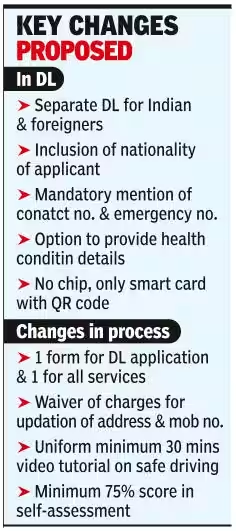
The Union government has proposed sweeping changes to India’s driving licence system, including separate colour schemes for Indian citizens and foreign nationals and a requirement to mention the nationality of licence holders on their driving licences.
The Ministry of Road Transport and Highways issued a draft notification on Wednesday outlining amendments to the Motor Vehicles Rules. The proposed changes aim to strengthen document verification, improve road safety assessments and make licence-related services more accessible through online platforms.
Under the proposal, driving licences would also have to include the holder’s blood group, mobile number and emergency contact details. These requirements are intended to ensure that important information is available when needed, particularly in emergencies.
The proposals are part of a wider effort to standardise the licensing process and reduce the possibility of fraudulent applications. However, the changes are still at the draft stage and should not be treated as rules already in force.
Affidavits and life insurance policies may no longer qualify as proof
One of the key proposals concerns the documents applicants can submit to establish their age and address.
Under the existing provisions described in the notification, applicants who cannot provide any of the 12 listed documents may be allowed to submit an affidavit sworn before an executive magistrate, judicial magistrate or notary public as proof of age and address.
The ministry has proposed removing this option, along with the acceptance of life insurance policies as proof of age and address. Applicants would instead have to provide documents that can be independently verified.
Anil Chhikara, an expert in motor vehicle licensing, said the use of simple affidavits was being phased out because some people had allegedly used them to register false addresses and dates of birth.
“Applicants must now provide verifiable documents,” he said.
The proposed change is intended to make it more difficult to submit misleading personal information during the licensing process. Requiring verifiable records could also help licensing authorities establish a more consistent standard for checking applications.
For applicants, however, the change would mean ensuring that they have the prescribed documentation before applying. Those who previously relied on affidavits because they lacked conventional proof would need to check which alternative documents are accepted under the final rules.
List of acceptable documents for driving licences
The draft notification sets out separate categories of documents for proof of address, age and identity.
For address verification, the proposed list includes Aadhaar, the Electoral Photo Identity Card, e-ration cards and electricity or gas bills covering the preceding three months. Foreign nationals would also need to provide proof of their legal presence in India.
For proof of age, the listed documents include passports, school board mark sheets, birth certificates and identity cards issued by government departments.
The proposed list of identity documents includes Aadhaar, passports, e-ration cards and PAN.
Separating these categories is intended to clarify the evidence required for different parts of the application process. It would also give applicants and licensing authorities a defined list against which documents can be checked.
The inclusion of proof of legal presence for foreign nationals is particularly relevant to the proposal to record nationality and introduce separate licence colour schemes. The ministry is seeking to make the information associated with licence holders more clearly identifiable within the licensing framework.
Applicants should refer to the final notification, if issued, to confirm the exact requirements and whether any additional conditions apply to particular categories of licence.
Online safe-driving assessment to become more stringent
The government has also proposed raising the qualifying score for the online safe-driving tutorial assessment from 60% to 75%.
Under the draft rules, the tutorial would have to last at least 30 minutes. The higher qualifying threshold is intended to make the assessment more demanding and encourage applicants to demonstrate a stronger understanding of safe-driving principles.
The proposed change would mean that applicants who currently qualify with a score of 60% would need to answer a greater proportion of the assessment correctly if the new threshold is adopted.
The tutorial forms part of the wider licensing process, which is intended to ensure that applicants understand the responsibilities associated with driving. A more demanding assessment could place greater emphasis on learning traffic rules and safe-driving practices before obtaining a licence.
The draft does not mean that the new pass mark has already taken effect. Applicants should continue to follow the requirements applicable to them until the amended rules are formally notified and implemented.
Aadhaar-based online services may become free
The ministry has proposed waiving fees for specified driving licence services when applicants use online Aadhaar authentication.
The services covered by the proposal include changes to a licence holder’s address, name and contact number. The measure is intended to encourage applicants to use digital services and reduce the administrative burden associated with routine updates.
Online authentication could help authorities verify an applicant’s identity while allowing certain transactions to be completed without a visit to a licensing office. The proposed fee waiver could also lower the cost of updating personal information for eligible applicants.
The scope of the waiver would depend on the services specified in the final rules. Applicants would need to use the prescribed online process and satisfy the applicable authentication requirements to benefit from the proposed exemption.
The proposal forms part of the government’s wider effort to streamline licence administration through digital systems.
Authorities may face deadlines for processing applications
The draft also proposes time limits for licensing authorities handling online applications to change details on a driving licence.
Under the proposed rules, applications involving changes to particulars such as a name or address would have to be approved or rejected within 15 days. If an application is rejected, the authority would have to provide reasons for the decision.
The proposal is intended to make the process more transparent by giving applicants a clearer expectation of when they should receive a decision. Requiring reasons for rejection could also help applicants understand what needs to be corrected or clarified.
The draft further proposes that an application for a change of address that remains undecided for 30 days would be deemed approved.
This provision could reduce delays in routine updates, although its operation would depend on the final wording of the rules and the conditions attached to deemed approval.
The proposed timelines would place greater responsibility on licensing authorities to process applications within the prescribed period. They could also help applicants track their requests and understand the next steps if an application is rejected or remains pending.
Consolidated application form proposed for multiple services
The ministry has proposed introducing a consolidated application form for several driving licence services.
These would include licence renewal, the issuance of duplicate licences, the addition of a vehicle class and changes to personal particulars.
Under the proposal, specified applicant details would be retrieved electronically from the Sarathi portal wherever the information is available. This could reduce the need for applicants to enter the same details repeatedly when requesting different services.
The use of existing digital records may also help simplify the application process and improve consistency across licence-related transactions.
For applicants, a consolidated form could make it easier to identify the information and documents required for common services. For licensing authorities, electronic retrieval of available details could reduce repetitive data entry and support more efficient processing.
The practical impact would depend on how the revised system is implemented and how effectively the relevant records are integrated with the application process.
What the proposed driving licence changes mean
The draft amendments cover several aspects of driving licence administration, from the information printed on licences to document verification, online assessments and application processing.
The proposed nationality details and colour-coded licences would distinguish between Indian and foreign licence holders. The removal of affidavits and life insurance policies as acceptable proof of age and address would place greater emphasis on verifiable documents.
Meanwhile, the higher safe-driving assessment threshold, proposed fee waivers for selected Aadhaar-authenticated services and processing deadlines are intended to address road safety, accessibility and administrative delays.
For applicants, the most immediate consideration is that these are proposals rather than confirmed changes already in force. The final requirements will depend on the outcome of the draft notification process and the formal implementation of any amendments.
If adopted, the measures would change how applicants establish their identity and personal details, complete online assessments and seek updates to their driving licences. The government’s stated objectives are to reduce the risk of false documentation, strengthen the licensing process and make routine services more efficient.