







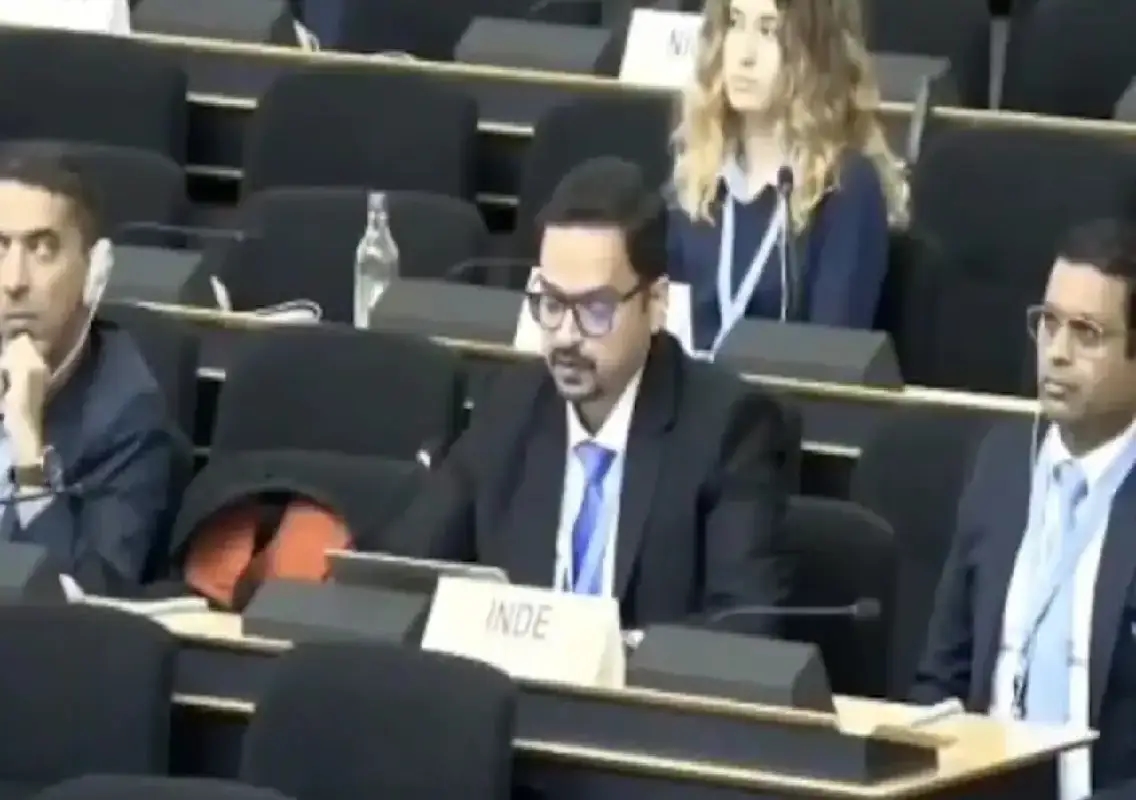


New Delhi: India strongly countered Switzerland’s remarks on the treatment of minorities during a session of the United Nations Human Rights Council (UNHRC), terming them “surprising, shallow, and ill-informed.” The exchange took place on Wednesday during the General Debate on the oral update by the UN High Commissioner for Human Rights at the 60th Session of the Human Rights Council in Geneva.
Switzerland’s statement at UNHRC
Switzerland, which currently holds the presidency of the UN Human Rights Council, had urged India to take stronger measures to safeguard the rights of minorities. The Swiss delegation also pressed New Delhi to protect freedom of expression and ensure the independence of the media. With its role as president, Switzerland’s comments carried additional diplomatic significance and were closely watched in international circles.
India’s rebuttal
Responding on behalf of India, Kshitij Tyagi, Counsellor at the Permanent Mission of India in Geneva, dismissed Switzerland’s observations as inaccurate and unhelpful.
“We would also like to respond to the surprising, shallow, and ill-informed remarks made by Switzerland, a close friend and partner,” Tyagi said. He argued that, as president of the Council, Switzerland had a greater responsibility to avoid “wasting the Council’s time with blatantly false narratives” that misrepresent the situation in India.
Pointing to domestic issues within Switzerland, Tyagi added: “Instead, it should focus on its own challenges such as racism, systematic discrimination, and xenophobia. As the world’s largest, most diverse and vibrant democracy, with a civilizational embrace of pluralism, India remains ready to help Switzerland address these concerns.”
Parallel exchange with Pakistan
India also delivered a strongly worded Right of Reply to Pakistan during the same debate. Tyagi accused Pakistan of using the Council to push political propaganda and reiterated New Delhi’s longstanding claim that Pakistan sponsors cross-border terrorism.
“We are compelled, once again, to address provocations from a country whose own leadership recently likened it to a ‘dump truck’, perhaps an inadvertently apt metaphor for a state that continues to deposit recycled falsehoods and stale propaganda before this distinguished Council,” Tyagi said.
He cited multiple terrorist attacks linked to groups based in Pakistan, including incidents in Pulwama, Uri, Pathankot, Mumbai, and the recent Pahalgam attack in April, which he described as turning “a meadow of joy into a killing field.”
Reference to global terrorism
Tyagi reminded the chamber that Pakistan had sheltered al-Qaeda leader Osama bin Laden until he was killed in Abbottabad by US Navy SEALs in 2011. The timing of the reminder was significant, coming just a day ahead of the anniversary of the 9/11 attacks.
“We need no lessons from a terror sponsor; no sermons from a persecutor of minorities; no advice from a state that has squandered its own credibility,” Tyagi concluded.
Conclusion
The exchanges underscored India’s determination to push back against criticism at international forums, particularly on sensitive issues of minority rights and terrorism. While Switzerland’s comments highlighted ongoing scrutiny of India’s domestic policies, New Delhi’s sharp response showcased its readiness to challenge both friendly nations and adversaries when national image is at stake.