







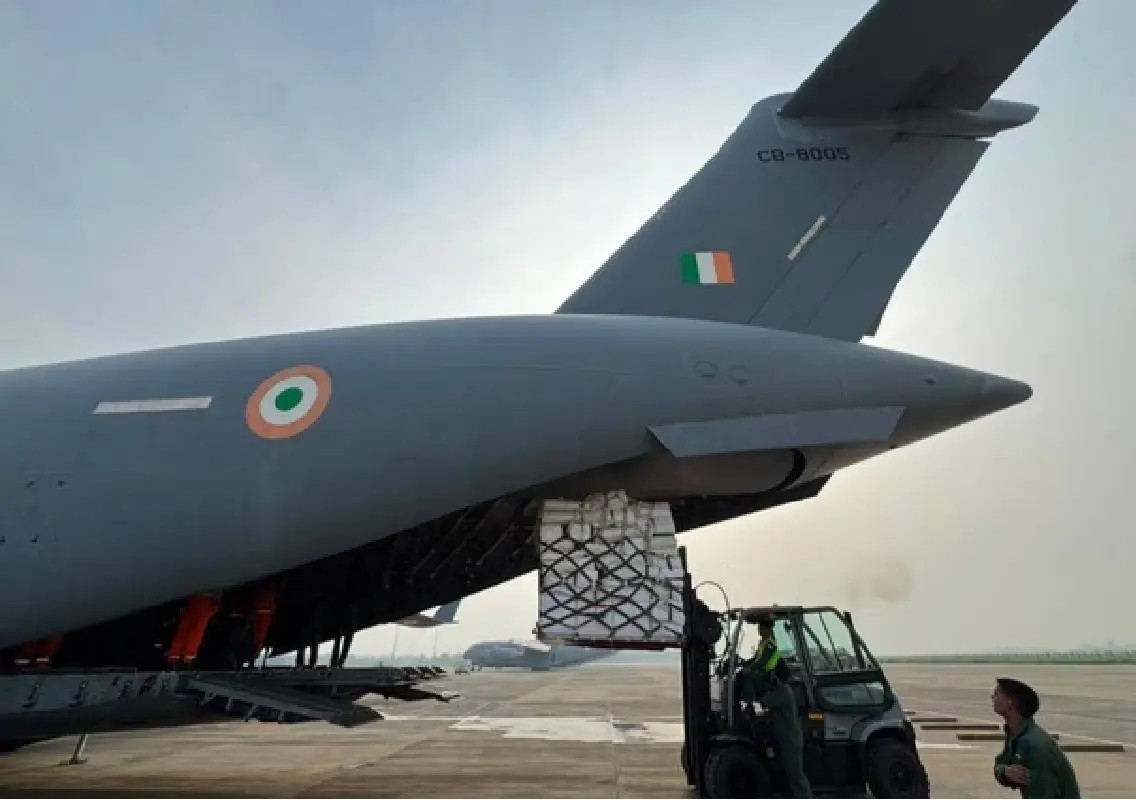


New Delhi: India has sent 68.5 tonnes of relief material to flood-hit Nepal and deployed specialised technical teams, forensic experts and search-and-rescue equipment to support ongoing relief operations following devastating flash floods in the neighbouring country.
The assistance comes as rescue teams continue efforts to reach people believed to be trapped inside hydropower tunnels in areas affected by the floods.
The Indian Embassy in Kathmandu said the support includes technical expertise for tunnel rescue operations, forensic assistance for DNA analysis and essential relief supplies for affected communities.
Fourth Indian flight carries 11 tonnes of aid
The Ministry of External Affairs said a fourth Indian flight carrying 11 tonnes of relief material had arrived in Nepal.
According to the MEA, the consignment included a tunnel technical contingent and equipment for search-and-rescue operations. It also carried a team of forensic experts equipped to assist with DNA analysis.
The relief supplies included blankets, sleeping bags, tarpaulins, plastic sheets and hygiene kits.
The latest consignment forms part of India’s broader assistance to Nepal following the devastating flash floods that swept through the Bhotekoshi and Trishuli river corridors.
Tunnel experts join rescue operations
India has deployed a specialised technical contingent comprising tunnel experts to assist in rescue operations at hydropower projects where workers are believed to be trapped.
An 11-member Indian technical team, comprising doctors, paramedics and tunnel engineers, reached Kathmandu on Friday.
The team subsequently conducted an on-site reconnaissance of hydropower tunnels in the flood-affected Trishuli area of Nuwakot district on Saturday.
Before beginning rescue-related work around the tunnel area, the team also conducted an aerial survey of the Chilime and Langtang regions.
The specialised expertise is expected to assist Nepali authorities in dealing with the difficult conditions inside the affected tunnels, where entrances have been blocked by mud and debris.
Security forces clear debris
Nepal has mobilised a large joint security contingent to assist in the search-and-rescue operation.
An 82-member joint security team, comprising personnel from the Nepal Army, Armed Police Force and Nepal Police, has been working since Friday night to clear debris and reach people believed to be trapped inside a hydropower tunnel.
Nepali security forces have already rescued 191 workers from tunnels at various hydropower projects across the country, according to the Nepal Army.
However, reports of additional workers being trapped inside tunnels have prompted Nepal to seek specialised assistance from India.
Many people are believed to be trapped inside tunnels associated with the Upper Trishuli-1 and Trishuli-3A hydropower projects in Rasuwa district near the Nepal-Tibet border.
Rescue operations have been complicated by the accumulation of mud and debris at tunnel entrances as well as adverse weather conditions.
Forensic teams sent for DNA analysis
India has also deployed forensic experts and equipment to support DNA analysis following the disaster.
The assistance comes as Nepal seeks foreign expertise for forensic work and other specialised requirements arising from the large-scale destruction and loss of life caused by the floods.
The forensic teams are expected to support authorities in identifying victims where conventional identification methods may be difficult.
The deployment forms part of India’s wider response, which combines immediate relief supplies with specialised technical assistance.
Bailey bridge equipment reaches Nepal
India has also extended support for restoring transport connectivity in the flood-affected areas.
The Indian Embassy said 16 trucks carrying equipment for a 230-foot single-lane modular steel bridge had arrived in Nepal.
Equipment required for installing seven additional Bailey bridges will be supplied soon, while technical teams to assist with their installation are expected to reach Nepal shortly.
Nepal has sought assistance from both India and China for the construction of 42 Bailey bridges to restore transport links damaged by the floods.
The bridges are expected to play an important role in reconnecting areas where roads and permanent bridges have been washed away or severely damaged.
Floods cause widespread destruction
The flash floods swept through the Bhotekoshi and Trishuli river corridors on Wednesday, causing widespread destruction across affected areas.
The disaster has resulted in hundreds of deaths and extensive damage to roads, bridges, settlements and hydropower infrastructure.
The destruction of transport links has further complicated rescue and relief operations, leaving several affected areas difficult to access.
Hydropower projects have been particularly affected, with debris blocking tunnel entrances and reports of workers being trapped underground.
The continuing adverse weather has added to the challenges facing rescue teams.
India expands humanitarian support
India’s latest assistance combines relief supplies with specialised manpower and equipment, reflecting the range of challenges created by the disaster.
The deployment of tunnel engineers, medical personnel and forensic experts is aimed at addressing specific requirements identified by Nepal during the rescue and recovery operation.
The arrival of bridge equipment is also expected to support efforts to restore connectivity in areas where critical infrastructure has been destroyed.
As rescue teams continue clearing debris and searching for missing workers, Indian technical personnel are expected to work alongside Nepali authorities in the affected areas.
The relief effort is likely to remain focused on rescuing trapped workers, identifying victims, restoring transport links and providing essential supplies to communities affected by the devastating floods.